
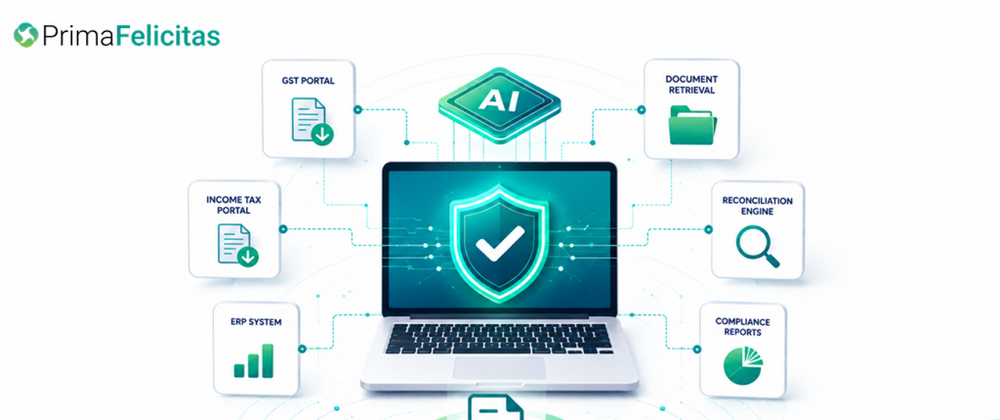

Many businesses want to adopt artificial intelligence without replacing the software, databases, and workflows they already depend on. Their existing systems may support finance, customer service, sales, inventory, document management, and other essential operations. Introducing AI into this environment requires careful planning to avoid data silos, workflow interruptions, security gaps, and unnecessary technology costs.
AI Consulting Services help organizations determine how AI can work alongside existing business applications. By evaluating current infrastructure, identifying integration opportunities, and defining a practical implementation approach, businesses can introduce intelligent capabilities while protecting the value of their existing technology investments.
The goal is not simply to add AI to a company's software environment. It is to make AI useful, secure, and compatible with the way the organization operates.
Why Is Integrating AI Into Existing Business Systems Challenging?
Businesses often use multiple applications that were developed at different times and may not share information efficiently. Integrating AI into these environments can require changes to data access, application interfaces, authentication, and workflow management.
Several common challenges can affect implementation.
Disconnected data sources: AI applications may need information from several systems, but the data might be stored in inconsistent formats or separate databases.
Legacy technology: Older applications may lack modern interfaces or documentation, making integration more complex.
Workflow disruption: Introducing a new AI tool can create extra work if employees must switch between applications or manually transfer information.
Security concerns: AI systems may process confidential business information, making access controls, permissions, and data protection essential.
Unclear responsibilities: Teams may not know who should monitor AI outputs, resolve errors, or maintain the integrated system.
An experienced AI Consulting Company can evaluate these challenges before development begins and recommend an integration approach suited to the organization's technical environment.
How Do AI Consulting Services Assess Existing Systems?
Before selecting an AI tool, businesses need to understand how their current technology supports daily operations. A structured assessment can identify dependencies, limitations, and opportunities for improvement.
1. Map Applications and Business Workflows
The first step is to document the systems involved in the target process. This may include customer relationship management software, enterprise resource planning platforms, accounting applications, document repositories, and internal databases.
Consultants examine how information moves between these systems and identify where employees perform repetitive tasks manually.
For example, a finance team may receive invoices through email, store them in a document repository, enter information into accounting software, and manually verify extracted details. An AI-assisted workflow could help extract invoice data and transfer it for review through an approved integration.
Mapping the existing process helps ensure that the proposed solution addresses the actual bottleneck instead of creating another disconnected tool.
2. Evaluate Integration Options
AI applications can connect with existing systems through application programming interfaces (APIs), approved connectors, data pipelines, middleware, or other integration methods.
The most suitable option depends on the capabilities of the current applications, data sensitivity, processing requirements, and available infrastructure.
Through AI Software Consulting Services, businesses can compare these options and determine whether an existing AI platform can meet their needs or whether custom development is necessary.
A well-planned integration should also account for error handling, access permissions, data validation, and system availability.
3. Identify Data and Security Requirements
An AI system should access only the information required to perform its assigned task. Businesses need to define which data sources can be used, who can access them, and how information will be stored and processed.
Consultants can help identify data-quality issues, establish integration boundaries, and consider requirements for encryption, authentication, logging, and retention.
These controls are especially important when AI applications interact with financial records, customer information, internal documents, or other sensitive business data.
Which AI Integration Approach Is Best for a Business?
There is no single integration method that works for every organization. The right choice depends on business requirements, existing systems, technical resources, and long-term maintenance needs.
API-Based Integration
APIs allow applications to exchange information through defined interfaces. When existing software supports suitable APIs, this approach can enable AI functionality without replacing the underlying system.
For example, a customer support application could use an AI service to categorize incoming requests and return suggested responses to an existing ticketing platform.
Businesses should evaluate authentication, rate limits, data permissions, service availability, and error handling before relying on this method.
Middleware and Integration Platforms
Middleware can help connect applications that use different data formats or communication methods. It may be useful when AI needs information from several business systems.
An integration layer can coordinate data movement, manage transformations, and help teams monitor failures. However, adding middleware also introduces another component that must be configured, secured, and maintained.
Custom Integration Development
Some organizations have specialized workflows or legacy applications that cannot connect easily through standard tools. Custom integration may be necessary to meet these requirements.
An AI Software Consulting Company can help assess the development effort, evaluate long-term support needs, and determine whether a custom approach offers sufficient benefits compared with available alternatives.
The decision should be based on functionality, reliability, security, and total cost rather than technical complexity alone.
How Can Businesses Integrate AI Without Disrupting Daily Operations?
AI integration should be introduced gradually, particularly when the affected workflows support essential business activities.
Begin With One Clearly Defined Workflow
Choose a process with measurable problems and manageable integration requirements. Examples include document classification, internal knowledge search, or customer inquiry categorization.
A limited scope makes it easier to test the system, identify technical issues, and collect employee feedback.
Keep Existing Systems Operational
Where practical, introduce AI alongside the current workflow rather than immediately replacing established processes. Employees can compare AI-generated outputs with existing results before the organization increases its reliance on the new system.
For high-impact processes, human review and clear escalation procedures should remain available.
Test Integration Under Realistic Conditions
Testing should cover more than whether the AI model produces an acceptable answer. Businesses also need to verify that data reaches the right system, permissions work correctly, errors are handled safely, and records remain consistent.
Testing should include unusual inputs, incomplete records, system outages, and other conditions that could affect reliability.
Train Employees Before Expanding
Employees need to understand how the integrated solution works, when to trust its outputs, and how to report problems.
Training should explain the new workflow, review responsibilities, and procedures for handling incorrect or uncertain results. Early feedback can reveal usability issues that technical testing alone may miss.
How Do AI Solution Advisory Services Help With Technology Selection?
Businesses often face a choice between adopting an existing AI service, extending a current software platform, or building a custom solution.
AI Solution Advisory Services help organizations compare these options against their functional needs and technical constraints.
A useful evaluation should consider:
- Compatibility with existing applications and databases.
- Data privacy and security requirements.
- Accuracy and reliability for the intended task.
- Integration complexity and implementation timelines.
- Licensing, infrastructure, and maintenance expenses.
- Flexibility to support future business requirements.
For example, a company that needs AI-powered document search may be able to extend its existing document management platform. Another organization with complex proprietary workflows may require a tailored integration.
The best option is the one that solves the business problem effectively while remaining practical to operate and maintain.
How Can Businesses Measure the Success of AI Integration?
Successful integration should produce observable improvements rather than simply introduce a new technology.
Businesses should establish baseline measurements before deployment and compare them with results after implementation.
Useful indicators include:
Processing time: Does the integrated workflow reduce the time required to complete a task?
Manual effort: Are employees spending less time copying information between applications?
Error rates: Has the solution reduced incorrect entries, missed information, or repeated work?
System reliability: Does information move consistently between applications, and are failures detected promptly?
Employee adoption: Can users complete their work more effectively with the integrated solution?
Operating costs: Do the benefits justify development, infrastructure, licensing, support, and maintenance expenses?
These measurements help organizations identify whether the integration is delivering value and where additional improvements may be needed.
How Can an AI Consulting Partner Support Long-Term Integration?
AI integration requires ongoing attention after the initial deployment. Business applications change, APIs are updated, data structures evolve, and AI services may require configuration or model changes.
An experienced AI Consulting Partner can help organizations plan monitoring, maintenance, access reviews, performance evaluation, and future enhancements.
Businesses should establish clear ownership for system reliability, data quality, AI output review, and incident management. They should also document dependencies so that future software changes do not unexpectedly break important workflows.
Working with suitable AI Consulting service Providers can help organizations connect technical planning with business priorities and build an integration environment that can evolve as requirements change.
How Can PrimaFelicitas Help Businesses Integrate AI?
PrimaFelicitas provides AI consulting and development services to help businesses evaluate AI opportunities and plan technology solutions around their operational needs.
A structured approach can help organizations assess existing applications, understand integration requirements, compare implementation options, and identify practical ways to introduce AI into established workflows.
By considering system compatibility, data security, scalability, and measurable business outcomes, businesses can make informed decisions about how AI should fit into their technology environment.
Explore PrimaFelicitas AI Consulting Services to learn more about planning AI initiatives that align with business and technical requirements.
Frequently Asked Questions
1. What are AI Consulting Services for system integration?
AI Consulting Services for system integration help businesses evaluate existing applications, identify suitable AI tools, plan data connections, address security requirements, and introduce AI into established workflows.
2. Can AI be added to existing business software?
Yes. Depending on the software's capabilities, AI can be integrated through APIs, approved connectors, middleware, or custom development. The appropriate method depends on technical compatibility and business requirements.
3. Does AI integration require replacing legacy systems?
Not necessarily. Many businesses can introduce AI alongside existing applications. Replacement may be worth considering when legacy systems cannot meet critical security, performance, or integration requirements.
4. How long does AI integration take?
The timeline depends on the complexity of the workflow, data readiness, existing application interfaces, security requirements, and testing needs. A limited pilot is often easier to plan than a company-wide integration.
5. Why should a business work with an AI Consulting Company?
An AI Consulting Company can help evaluate technical options, identify integration risks, select appropriate tools, plan implementation, and establish measurements for assessing the solution's business value.
Conclusion
Integrating AI into existing business systems requires more than choosing an AI model. Organizations must understand their current workflows, evaluate integration methods, protect sensitive information, and ensure employees can use the resulting solution effectively.
With the support of AI Consulting Services, businesses can introduce AI gradually, preserve valuable technology investments, and focus on improvements that deliver measurable results. A practical integration strategy helps organizations adopt AI without creating unnecessary complexity or disrupting essential operations.






Top comments (0)