
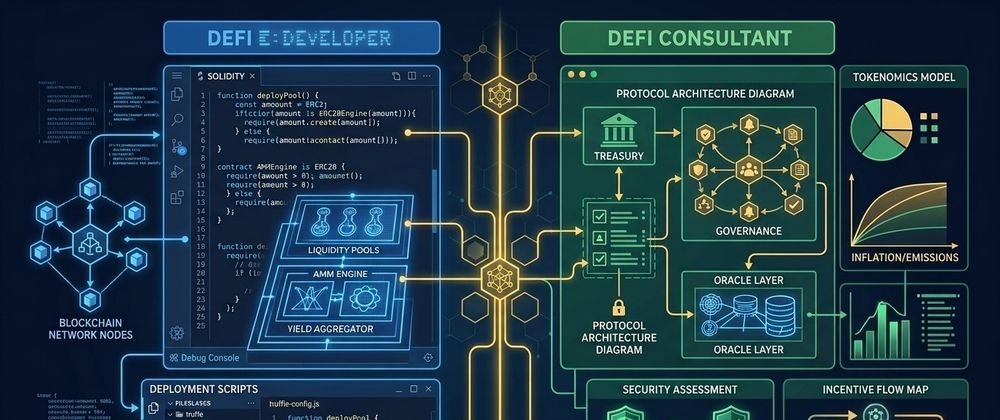

When people outside the blockchain industry hear that a DeFi project failed, they usually assume the developers wrote bad code. Sometimes that's true. More often, the code worked exactly as written — and the problem was that nobody asked the right questions before writing it.
This confusion points to a gap in how most teams think about building decentralized finance protocols. They treat DeFi development as a purely technical problem and go looking for developers to solve it. What they actually need — before the developers ever open a code editor — is a DeFi consultant.
These two roles are genuinely different. Understanding the difference is not ``an academic exercise. It is one of the most practical decisions any Web3 team will make.
Two Different Questions
The clearest way to separate these roles is by the question each one answers.
A DeFi developer answers: "How do we build this?"
A DeFi consultant answers: "Should we build it this way?"
Development is execution. Consulting is judgment. Both matter, but they operate at different stages and on different problems. Hiring only developers means you get excellent execution of a plan that may be fundamentally flawed. Hiring only a consultant means you get excellent strategy with no one to implement it.
The best DeFi projects use both — in the right order.
What a DeFi Developer Does
A DeFi developer is responsible for the technical implementation of a protocol. They write smart contracts, build the on-chain logic that governs how funds move, integrate with oracles and external protocols, develop the frontend that users interact with, and handle deployment and infrastructure.
Professional DeFi development services cover this entire technical lifecycle — from writing the first line of Solidity to deploying contracts on mainnet and monitoring their performance afterward.
A skilled DeFi developer understands blockchain architecture deeply. They know how to write gas-efficient code, how to structure contracts for upgradeability, how to integrate with Chainlink or Uniswap, and how to avoid known vulnerabilities like reentrancy, integer overflow, or access control failures.
What a DeFi developer is not responsible for — and should not be expected to provide — is the strategic layer that sits above the code. That is the consultant's territory.
What a DeFi Consultant Does
A DeFi consultant operates before, around, and sometimes after the development phase. Their job is to ensure that what gets built is worth building — that the protocol is economically sound, architecturally defensible, and positioned for real-world success.
This work covers several distinct areas:
Tokenomics Design and Review A DeFi consultant models how tokens will behave under real market conditions — not ideal ones. They stress-test distribution models against adversarial actors: whales accumulating supply, bots farming incentives, arbitrageurs exploiting price differences. A token model that looks clean on a whiteboard can destroy a protocol in its first week of trading if it hasn't been pressure-tested first.
Protocol Architecture Advisory Before DeFi development services begin writing contracts, a consultant reviews the protocol's architecture. Should it be upgradeable or immutable? Which upgrade pattern carries the least risk? How should admin privileges be structured? What oracle solution is least susceptible to manipulation? These are strategic decisions, not implementation decisions — and they are far cheaper to get right before development than after.
Security Posture, Not Just Security Audits An audit reviews the code that was written. A consultant reviews the decisions that led to the code. These are different things. A clean audit of a badly designed protocol is not safety — it is a false sense of security. A DeFi consultant identifies design-level risks that no auditor can catch because they exist above the code layer.
Incentive Structure Analysis DeFi protocols live or die by their incentive design. A consultant asks: what behaviors does this protocol reward? What behaviors does it accidentally punish? Will liquidity stay after emissions slow down, or will it evaporate the moment rewards drop? What happens when a single participant controls a significant share of governance?
Market Positioning and Chain Strategy Which blockchain should the protocol launch on? What are the trade-offs between Ethereum mainnet, a Layer 2, and an alternative chain? Who is the target user and where do they already live on-chain? A DeFi consultant brings market intelligence to these decisions that most development teams don't have time to develop themselves.
Where the Roles Overlap
In practice, some experienced blockchain professionals do both. A senior DeFi developer with years of production experience may also provide consulting-level input on protocol architecture and security design. A DeFi consultant with a development background can speak credibly about implementation trade-offs.
But even when one person does both, the work is distinct. The consulting work — questioning assumptions, modeling adversarial scenarios, reviewing economic design — happens separately from the development work. Treating them as the same thing, or skipping the consulting phase because your developer seems knowledgeable, is one of the most common and costly mistakes in Web3.
Which One Does Your Project Need Right Now?
If you are in the idea or early planning stage, you need a DeFi consultant first. The decisions made at this stage — tokenomics, architecture, chain selection, governance — will shape everything that comes after. Getting them wrong is expensive to fix and sometimes impossible.
If you have a validated design and need to turn it into working code, you need DeFi development services. This is where a development team executes against a clear, well-reviewed specification
If you are preparing for launch, you likely need both — the consultant reviewing the final architecture and economic design, the development team delivering the implementation, and an independent auditor verifying the security of the code.
The Practical Takeaway
DeFi consultant and DeFi developer are not interchangeable titles for the same job. One builds the protocol. The other makes sure the protocol is worth building.
The projects that have defined DeFi — the ones that survived market downturns, resisted exploits, and retained genuine user loyalty — invested in both. The projects that burned out quietly, or loudly, usually skipped one or the other.
If your team is serious about launching something that lasts, start with the question. Then build the answer.







Top comments (0)