

Selecting healthcare software is a significant investment for organizations that manage skilled nursing, senior living, home health, hospice, or other post-acute services. While features are important, pricing often becomes one of the first questions for administrators and decision-makers. Understanding what influences the cost of a platform can make the software evaluation process more practical and transparent.
When researching matrixcare software, organizations should look beyond a single advertised number. MatrixCare serves multiple care settings and offers different solutions, so the final cost can depend on the product, organization size, implementation requirements, integrations, users, and services selected. Current MatrixCare materials describe solutions across skilled nursing, senior living, life plan communities, home health, hospice, palliative care, and private duty.
This guide explains what healthcare providers should know about MatrixCare pricing, which factors can affect the total investment, and how to evaluate value before signing a contract.
Does MatrixCare Have a Standard Price?
One of the most important things to understand about MatrixCare pricing is that there is not one universal price that applies to every organization.
Different healthcare providers may require different products, modules, user configurations, integrations, and implementation services. A skilled nursing facility with multiple locations may have very different requirements from a small home health agency or senior living community.
Third-party software directories reflect this variation. Capterra currently lists MatrixCare Skilled Nursing Facility as requiring a quote, while its separate Home Health & Hospice listing provides pricing information for that particular product. These listings should not be interpreted as a universal price for every MatrixCare customer. For this reason, the most reliable way to understand matrixcare emr pricing is to request a quote based on the organization's actual requirements.
What Influences MatrixCare Pricing?
Several factors can affect the total cost of a healthcare software implementation.
1. Care Setting
The first consideration is the type of organization purchasing the system.
MatrixCare has solutions designed for different care environments, including:
Skilled nursing
Senior living
Home health
Hospice
Palliative care
Private duty
Life plan communities
Each environment has different clinical, administrative, regulatory, and financial requirements. A specialized configuration may therefore include different functionality and services.
2. Organization Size
The number of facilities, agencies, residents, patients, employees, and users can influence software requirements.
A single-site organization may have a simpler implementation than a multi-location healthcare company that needs centralized reporting, multiple user roles, extensive integrations, and broader administrative controls.
When requesting pricing, organizations should provide accurate information about their current size and expected growth.
3. Features and Modules
Not every organization needs every available capability.
For example, one provider may prioritize clinical documentation and scheduling, while another may require advanced financial workflows, analytics, interoperability, or additional operational functionality.
A buyer should identify essential features before reviewing a quote. This helps prevent paying for capabilities that are unlikely to contribute meaningful value.
Understanding MatrixCare EMR Pricing
Organizations searching for matrixcare emr pricing are often trying to determine whether the platform fits within their technology budget.
However, the license or subscription price is only one part of the calculation.
A complete budget should consider:
Software licensing or subscription
Implementation
Data migration
Training
Technical support
Integrations
Customization
Additional modules
Hardware or mobile requirements, where applicable
Professional services
This broader calculation provides a more realistic view of the total cost of ownership.
What Features Are Included?
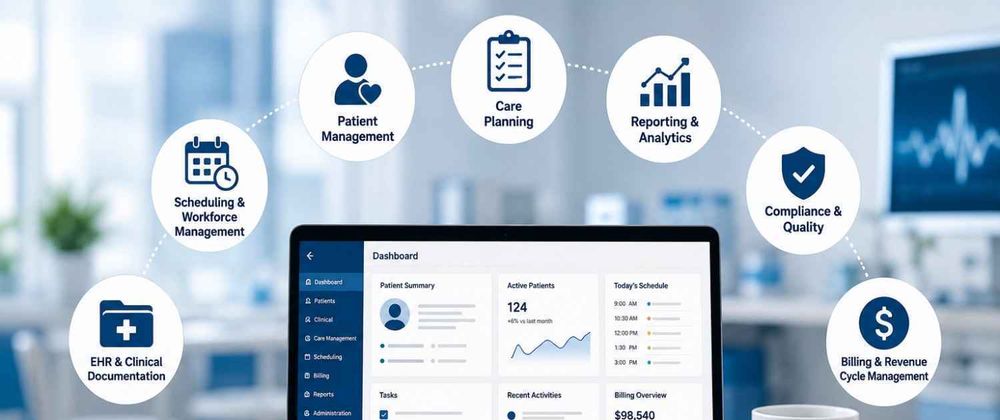
The features available depend on the specific MatrixCare solution and configuration. Across its portfolio, MatrixCare promotes capabilities supporting clinical documentation, care coordination, scheduling, billing, analytics, interoperability, compliance, and operational management.
Clinical Documentation
Electronic documentation is fundamental for post-acute care organizations. The MatrixCare EHR is designed to support clinical information management across relevant care environments.
During a pricing discussion, buyers should ask exactly which clinical functions are included in the proposed package and whether additional modules are required.
Care Management
Care management functionality can help teams organize information and coordinate services around individual patients or residents.
This becomes particularly important in long-term care and senior living, where care needs can change over time.
Scheduling
Scheduling requirements differ significantly between facility-based and home-based providers. Home health agencies, for example, need to coordinate clinicians, locations, availability, disciplines, and patient needs.
MatrixCare's home health materials describe scheduling capabilities intended to support these operational requirements.
Billing and Revenue Cycle
Financial functionality is another important consideration. Organizations researching MatrixCare billing software should determine which billing, claims, reimbursement, and revenue-cycle capabilities are included in their specific proposal.
The value of integrated financial workflows can be significant when clinical and billing information needs to move between departments efficiently.
Is MatrixCare Worth the Cost?
Price alone does not determine whether healthcare software represents good value.
A less expensive system can become costly if it requires extensive manual work, multiple disconnected applications, inefficient reporting, or significant administrative effort.
Conversely, a more comprehensive platform may justify a higher investment if it reduces duplication, improves workflows, supports compliance, and helps an organization operate more efficiently.
When evaluating MatrixCare, organizations should compare total value rather than subscription price alone.
Consider questions such as:
Can it reduce administrative workload?
Does it support the organization's care setting?
Can it integrate with existing systems?
Will employees be able to learn it efficiently?
Does it support regulatory requirements?
Can it scale as the organization grows?
Does it improve visibility into financial performance?
Can it replace multiple disconnected systems?
MatrixCare Pricing for Different Care Settings
Skilled Nursing
Skilled nursing facilities often require comprehensive clinical, financial, regulatory, and operational functionality.
MatrixCare's skilled nursing solution is designed around these requirements and includes capabilities supporting clinical workflows, financial operations, reporting, and interoperability.
For these organizations, pricing should be evaluated against resident volume, facility count, staffing structure, implementation complexity, and integration requirements.
Home Health
Home health organizations have different technology needs because care is delivered across multiple locations.
A pricing evaluation should include point-of-care documentation, scheduling, patient management, billing, interoperability, and mobile workflow requirements.
Hospice
Hospice organizations should evaluate pricing alongside documentation, care coordination, compliance, billing, and communication requirements.
A platform that connects these workflows may provide greater value than several disconnected systems, depending on the organization's needs.
Senior Living
Senior living communities should consider resident management, care documentation, reporting, communication, and integration requirements.
Organizations operating multiple communities should also examine centralized management and reporting capabilities.
What to Ask During a MatrixCare Pricing Discussion
A software quote should never be accepted without understanding what is included.
Ask the vendor to clarify:
Implementation Costs
Does the quoted price include implementation, configuration, and onboarding?
Data Migration
Will existing resident or patient information be migrated? If so, what is the migration cost?
Training
Is staff training included, or is it billed separately?
Integrations
Are required third-party integrations included in the quoted price?
Support
What level of technical support is provided, and are premium support services available at an additional cost?
Contract Terms
Ask about contract length, renewal terms, price increases, cancellation provisions, and additional-user costs.
These details can have a major impact on the actual long-term investment.
How a MatrixCare EMR Demo Can Help
A matrixcare emr demo should be more than a general product presentation.
Healthcare organizations should use the demonstration to test workflows that employees actually perform.
For example, ask the presenter to demonstrate:
Creating and updating a patient or resident record
Completing clinical documentation
Managing care plans
Handling scheduling
Processing billing information
Generating reports
Exchanging information with other systems
Managing user permissions
Accessing the system remotely
Reviewing operational data
This approach makes it easier to connect the proposed price with real-world functionality.
MatrixCare Reviews and Value Assessment
Online matrixcare reviews can provide useful context when researching usability, functionality, support, and overall satisfaction.
However, reviews should not be treated as a substitute for a customized evaluation. Different users may work in different care settings and use different MatrixCare products.
For example, Capterra currently reports different review ratings and volumes for MatrixCare's skilled nursing and home health/hospice listings, illustrating why buyers should examine product-specific feedback.
The best comparison combines independent reviews with demonstrations, reference calls, and an analysis of your organization's requirements.
How Codatis Can Support Your Evaluation
Healthcare software selection can become complicated when organizations compare features, pricing, integrations, implementation requirements, and alternatives at the same time.
Codatis can help healthcare organizations approach this evaluation more strategically by providing information about MatrixCare, its capabilities, and the factors that should be considered before selecting a healthcare technology platform.
The goal should be to determine whether the software delivers measurable operational value not simply whether its initial quote fits the budget.
Conclusion
MatrixCare pricing should be viewed as a customized technology investment rather than a single fixed number. The final cost can depend on care setting, organization size, selected features, users, implementation, integrations, training, support, and other services.
For organizations considering MatrixCare, the best approach is to identify essential requirements first, request a detailed proposal, evaluate the complete cost of ownership, and then compare the expected benefits with suitable alternatives.
A structured matrixcare software evaluation can help healthcare leaders determine whether the platform aligns with their clinical workflows, financial objectives, operational requirements, and long-term growth plans.
FAQ’s
How much does MatrixCare cost?
MatrixCare does not have one universal price for every organization. Pricing can vary according to product, care setting, organization size, configuration, implementation, integrations, and services.
Is MatrixCare EMR pricing publicly available?
Some third-party software directories publish pricing information for specific MatrixCare products, but organizations should request a customized quote for accurate current pricing.
What should be included in a MatrixCare quote?
Ask whether the quote includes licensing, implementation, training, data migration, support, integrations, additional modules, and professional services.
Does MatrixCare offer different solutions for different care settings?
Yes. MatrixCare currently offers solutions for areas including skilled nursing, senior living, life plan communities, home health, hospice, palliative care, and private duty.
Can I request a MatrixCare EMR demo?
Yes. A demonstration can help organizations evaluate workflows and determine whether the platform meets their operational requirements.
Is MatrixCare billing software included?
Billing capabilities depend on the specific MatrixCare product and configuration. Buyers should confirm which financial and revenue-cycle functions are included in their proposal.
What is the best way to evaluate MatrixCare pricing?
Compare the complete cost of ownership—including implementation, training, integrations, support, and ongoing licensing—with the expected operational and financial benefits.







Top comments (0)