
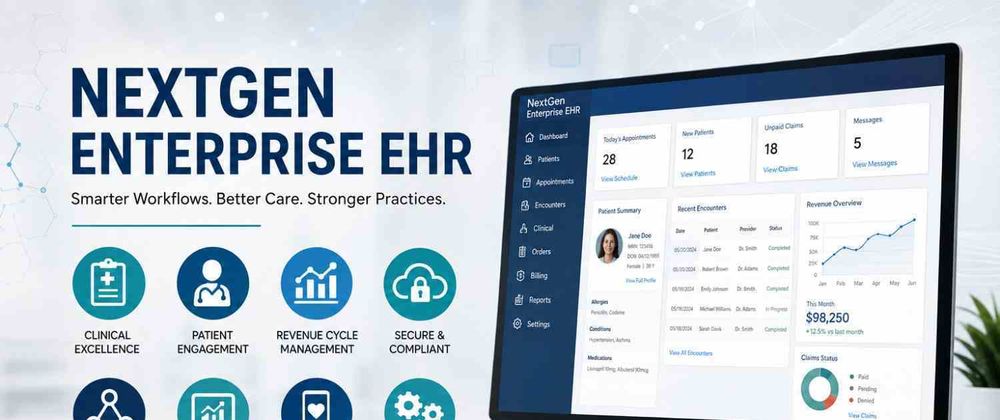

Medical practices need an EHR that does more than store digital patient charts. Providers need efficient documentation, administrators need operational visibility, billing teams need connected financial workflows, and patients increasingly expect convenient digital access to healthcare services. This is why understanding the actual capabilities behind nextgen enterprise ehr is important before choosing a healthcare technology platform.
NextGen Healthcare positions its Enterprise EHR as a solution for mid-size and enterprise practices, with capabilities spanning clinical workflows, patient engagement, mobile access, interoperability, analytics, and revenue-related processes.
Rather than simply listing features, this guide looks at what the major capabilities can mean for physicians, staff, administrators, and patients.
Clinical Documentation and Charting
Clinical documentation is at the center of any EHR.
A major feature of nextgen ehr is its ability to support electronic charting and specialty-specific clinical workflows. NextGen Healthcare says its platform includes more than 2,000 clinical workflows across 30 specialties through its Adaptive Content Engine, with options for customization.
This matters because different specialties document patient encounters differently.
For example, a cardiology practice may require different clinical workflows from an internal medicine or behavioral health organization. Specialty-oriented content can reduce the need for providers to build every workflow from scratch.
Why Customizable Workflows Matter
Customization can help practices align the EHR with existing clinical processes.
Instead of forcing every provider to follow an identical documentation structure, configurable workflows can accommodate different specialties, visit types, and organizational preferences.
AI-Assisted Documentation
One of the newer developments in nextgen enterprise ehr is the use of artificial intelligence to reduce documentation work.
NextGen Ambient Assist can use conversations between patients and providers to generate structured SOAP notes for provider review. NextGen Healthcare states that its current solution can save providers up to 2.5 hours of documentation time per day, although actual results can vary by organization and workflow.
AI can also assist with suggestions involving areas such as ICD-10 codes, medications, and orders.
The important point is that AI-generated information still requires appropriate provider review before becoming part of the medical record.
Mobile EHR Access
Healthcare providers are not always sitting at a desktop workstation.
Mobile access can allow clinicians to review information, manage tasks, document, prescribe, and interact with other clinical workflows away from a traditional workstation. NextGen Healthcare describes mobile capabilities that support access to the EHR from different locations and devices.
For physicians who move between examination rooms, facilities, or virtual appointments, mobile functionality can provide additional flexibility.
Patient Portal and Engagement Features
The patient experience is another important part of modern healthcare technology.
NextGen Enterprise includes patient engagement capabilities designed to connect patients with practices digitally. The platform's patient experience tools include portal access, self-scheduling, virtual visits, online payments, communication, and other patient-facing services.
These features can help patients interact with practices without relying entirely on telephone calls.
For example, patients may be able to:
Request or schedule appointments
Access selected health information
Communicate with the practice
Complete digital forms
Make payments
Participate in virtual visits
Scheduling and Practice Management
An EHR becomes more valuable when clinical workflows connect with administrative operations.
NextGen Healthcare describes integrated practice management capabilities that include scheduling, eligibility checks, billing, claims processing, reporting, and analytics.
For practices researching nextgen office and NextGen Enterprise, understanding the difference in intended practice size is important. NextGen Healthcare currently describes Enterprise as its solution for 10+ providers, while NextGen Office is positioned for smaller practices under 10 providers.
Revenue Cycle and Billing Support
Healthcare organizations also need technology that connects clinical activity with financial operations.
Revenue cycle capabilities can support processes associated with charge capture, claims, collections, and financial reporting.
NextGen Healthcare describes its broader platform as integrating EHR, practice management, and revenue cycle capabilities. Its practice management tools include billing, clearinghouse and EDI functionality, claim-related automation, and collections support.
For administrators, the advantage of an integrated environment is greater visibility across clinical and financial workflows.
Interoperability
Patients frequently receive care from multiple providers and organizations. Healthcare information therefore needs to move between systems securely and efficiently.
Interoperability is one of the key capabilities associated with nextgen healthcare emr technology.
NextGen Healthcare highlights secure data exchange with providers, payers, registries, patients, and other organizations. Its platform also includes interoperability solutions designed to connect different healthcare systems.
For a medical practice, interoperability can be especially important when working with external laboratories, hospitals, pharmacies, specialists, and health information networks.
Telehealth and Virtual Visits
Virtual healthcare has become another important EHR capability.
NextGen Enterprise supports virtual visit workflows, allowing organizations to incorporate remote care into broader clinical operations. NextGen Healthcare also describes virtual visits as part of its integrated patient and practice experience.
For practices offering telehealth, the key advantage is keeping virtual encounters connected to the patient's broader clinical workflow rather than treating them as an entirely separate process.
Population Health and Care Coordination
EHR technology can also support healthcare beyond individual appointments.
NextGen Healthcare describes population health capabilities that can help organizations identify patient populations, evaluate risk, identify care gaps, and support patient outreach.
Care coordination features can also support referrals, medication refills, patient recall, and other post-visit activities.
These capabilities can be particularly relevant for organizations participating in value-based care programs.
Reporting and Analytics
Healthcare administrators need reliable data to understand practice performance.
Analytics can help organizations examine clinical, operational, and financial information.
Potential uses include:
Monitoring practice performance
Evaluating patient populations
Tracking financial trends
Supporting regulatory reporting
Identifying workflow bottlenecks
Measuring operational efficiency
The usefulness of analytics depends not only on the reports available but also on the quality and consistency of the underlying data.
Cloud-Based Infrastructure
NextGen Healthcare states that its Enterprise EHR can be hosted through AWS cloud infrastructure. Cloud hosting can provide access to healthcare applications without requiring organizations to maintain the same type of traditional on-site infrastructure.
Cloud-based environments can also make software updates and system access easier to manage, although practices should still evaluate security, availability, backup, and compliance requirements carefully.
Specialty-Specific Support
One of the more important features for medical practices is specialty customization.
An EHR designed around generic workflows may not provide the same experience as one that accommodates specialty-specific requirements.
NextGen Healthcare lists support for specialties including cardiology, internal medicine, behavioral health, gastroenterology, neurology, orthopedics, pulmonology, ophthalmology, and others.
Practices should verify that the workflows and templates they need are available before implementation.
Which Features Matter Most?
Not every practice needs every capability.
A practice focused on clinical efficiency may prioritize documentation and mobile access. A growing multi-location organization may care more about interoperability, analytics, scalability, and centralized workflows. A patient-focused practice may prioritize portal functionality, self-scheduling, digital intake, and communication.
A useful evaluation approach is to divide features into three categories:
Essential Features
These are capabilities the practice cannot operate effectively without.
Valuable Features
These improve efficiency but are not necessarily required.
Future Features
These may become important as the practice grows or changes its care model.
This approach helps prevent organizations from choosing software simply because it has a long feature list.
How Codatis Can Help With EHR Evaluation
When evaluating nextgen ehr, practices should look beyond individual features and consider how those features work together.
Codatis can help healthcare organizations approach EHR research by examining clinical workflows, administrative requirements, patient engagement, interoperability, scalability, and technology needs as connected parts of the decision.
The goal should be to identify capabilities that solve real operational problems rather than purchasing technology based purely on marketing terminology.
Final Thoughts
Nextgen Enterprise offers a broad set of capabilities covering clinical documentation, specialty workflows, AI-assisted charting, mobile access, patient engagement, practice management, billing-related processes, interoperability, telehealth, analytics, and population health.
For organizations researching nextgen emr solutions, the right question is not simply, "How many features does the system have?" Instead, practices should ask whether those features improve clinical workflows, reduce administrative burden, support patients, and provide the scalability needed for future growth.
FAQ’s
1. What are the main features of NextGen Enterprise EHR?
Key capabilities include clinical documentation, specialty-specific workflows, patient engagement, mobile access, interoperability, telehealth, reporting, practice management, and revenue cycle-related functionality.
2. Does NextGen Enterprise EHR use artificial intelligence?
Yes. NextGen Healthcare offers AI capabilities such as Ambient Assist for generating structured clinical documentation from provider-patient conversations, subject to provider review.
3. Does NextGen EHR support mobile access?
Yes. NextGen Mobile provides mobile access to various EHR workflows, including documentation, tasks, prescribing, and patient information.
4. Does NextGen Enterprise include patient engagement tools?
Yes. Its patient experience capabilities include features such as a patient portal, self-scheduling, virtual visits, online payments, and digital communication.
5. Is NextGen Enterprise suitable for specialty practices?
It is designed to support specialty-specific workflows, and NextGen Healthcare states that its platform includes thousands of clinical workflows across multiple specialties. Practices should verify the specific templates and workflows required for their specialty.
6. Does NextGen Enterprise support interoperability?
Yes. Interoperability and health information exchange are major components of the platform, with capabilities designed to connect patients, providers, payers, registries, and other healthcare organizations.







Top comments (0)