
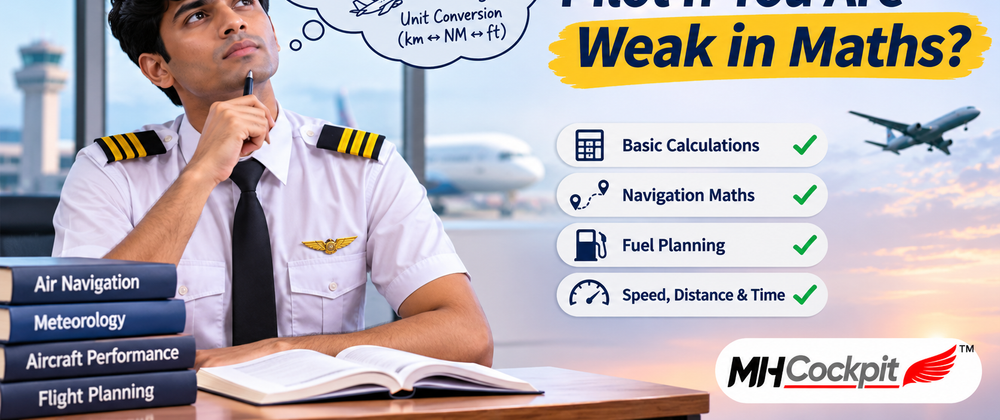

Many students dream of becoming commercial pilots but hesitate when they think about Mathematics. Some enjoy learning about aircraft, aviation technology and flying, but their academic performance in Maths makes them question whether they are suitable for a career in aviation.
So, can you become a pilot if you are weak in Mathematics?
Yes, you can. Being weak in Maths does not automatically prevent you from becoming a pilot. However, you must meet the academic eligibility requirements and develop the mathematical skills needed for flight training and aircraft operations.
Let's understand what Mathematics means in aviation, which subjects aspiring pilots should focus on and how students can prepare for commercial pilot training in India.
- Is Mathematics Compulsory to Become a Pilot in India?
If you want to obtain a Commercial Pilot Licence (CPL) in India, Physics and Mathematics are required at the Class 12 level under the applicable DGCA eligibility requirements.
This means students from Commerce or Arts backgrounds who did not study these subjects need to check the recognised qualification routes for completing the required subjects.
It is important to understand the difference between being weak in Mathematics and not having studied Mathematics at all. A student who has passed Mathematics but struggles with calculations can work on improving those skills. Someone who has not studied the subject must first meet the academic eligibility requirements.
Before enrolling in flight training, check the latest requirements published by the Directorate General of Civil Aviation (DGCA).
For a step-by-step overview of the licensing process, eligibility and training stages, read this guide on how to become a commercial pilot in India.
- What Type of Mathematics Do Pilots Use?
Pilots do not need to solve advanced engineering equations during every flight. However, they must understand mathematical concepts that support navigation, flight planning and aircraft performance.
Some important areas include:
- Basic Arithmetic: Addition, subtraction, multiplication and division for routine calculations.
- Speed, Distance and Time: Estimating flight duration and calculating travel time.
- Fuel Calculations: Understanding fuel consumption, endurance and reserve requirements.
- Unit Conversions: Working with nautical miles, kilometres, feet, metres and other aviation measurements.
- Navigation Calculations: Understanding headings, bearings, wind correction and flight routes.
- Percentages and Ratios: Applying numerical values to aircraft performance and operational calculations.
These concepts are introduced during aviation ground training and become part of the knowledge required for flight operations.
- A Simple Example of Mathematics Used in Aviation
Imagine an aircraft travelling at 120 knots with 360 nautical miles remaining before reaching its destination.
How much time will it take to cover the remaining distance?
The formula is:
Time = Distance ÷ Speed
360 ÷ 120 = 3 hours.
Therefore, the estimated time is three hours, assuming a constant speed and no changes to the route or operating conditions.
Actual flight planning involves additional considerations, including wind speed, weather, routing, aircraft performance and fuel requirements.
This example shows why basic calculations are useful in aviation. You do not need to be a Maths expert, but you should be comfortable working with numbers.
- Which Subjects Should Aspiring Pilots Focus On?
Mathematics is only one part of the academic foundation required for pilot training. Physics and English also play important roles.
Physics: Helps students understand motion, force, pressure, energy and aerodynamics. These concepts explain how aircraft generate lift, maintain stability and respond to changes in flight conditions.
English: Pilots must communicate clearly with Air Traffic Control (ATC), follow standard aviation phraseology and understand operational instructions.
Mathematics: Supports navigation, flight planning, speed calculations, fuel planning and aircraft performance.
Students interested in aviation education can also learn about academic pathways such as B.Sc. Aviation and B.Sc. Aeronautical Science through MH Cockpit's aviation training programmes.
- How Can You Improve Your Maths Before Pilot Training?
If Mathematics has always been a difficult subject, start preparing before joining a flight training programme.
Here are five practical steps:
Step 1: Strengthen Basic Arithmetic
Revise multiplication, division, fractions, decimals and percentages. These concepts form the foundation for aviation-related calculations.
Step 2: Practise Speed, Distance and Time
Work through simple problems involving aircraft speed, distance and estimated travel time.
Step 3: Learn Unit Conversions
Practise converting kilometres into nautical miles, metres into feet and other commonly used aviation measurements.
Step 4: Understand Basic Physics
Study motion, force, pressure, temperature and the principles of flight.
Step 5: Practise Every Day
Set aside 30 minutes daily for numerical exercises. Start with simple questions and gradually move towards aviation-related calculations.
Regular practice can help you become more comfortable with numbers before starting formal pilot training.
- What Happens During Commercial Pilot Training?
Meeting the academic eligibility requirements is only the beginning of the journey.
Aspiring commercial pilots in India must complete the applicable DGCA examinations, satisfy medical fitness requirements, undergo the required flying training and meet the licensing requirements.
Ground training includes subjects such as Air Navigation, Aviation Meteorology, Air Regulations and Technical General.
Among these, Air Navigation involves mathematical applications such as navigation calculations, headings, distances, flight times and related concepts.
Students should therefore prepare for both theoretical examinations and practical flying requirements.
- Should You Give Up Your Pilot Dream Because of Maths?
Absolutely not.
Being weak in Mathematics at school does not determine whether you can become a capable pilot. What matters is whether you are prepared to improve your skills and meet the academic, medical and training requirements.
Aviation also requires discipline, decision-making, situational awareness, communication and the ability to follow procedures accurately.
However, pilot training is not the right choice for someone unwilling to study technical subjects or practise numerical calculations.
Final takeaway: You do not have to be a Mathematics topper to become a commercial pilot. You do need a sound foundation in Mathematics, a willingness to learn and the discipline to apply your knowledge.
If flying is your goal, start by improving your fundamentals rather than allowing your current Maths ability to decide your future.





Top comments (0)