
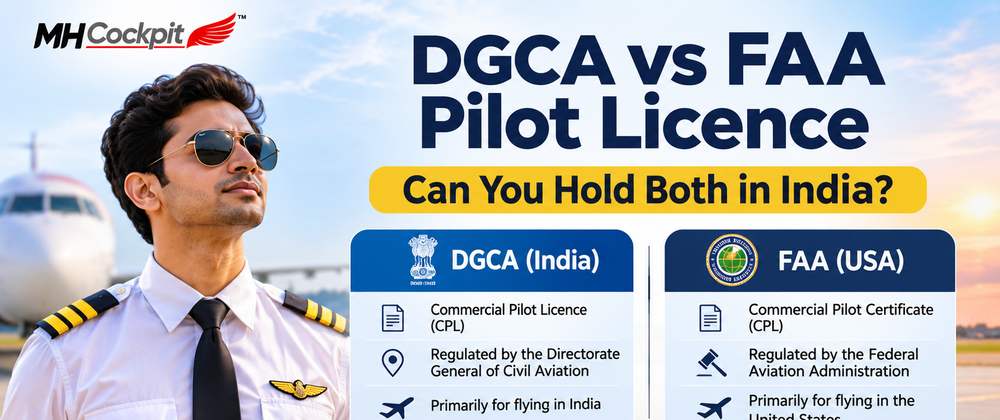

Becoming a commercial pilot is a dream for many aviation enthusiasts in India. While most aspiring pilots follow the Directorate General of Civil Aviation (DGCA) licensing route, some also consider obtaining a licence from the Federal Aviation Administration (FAA) in the United States.
This raises an interesting question: Can an Indian pilot hold both DGCA and FAA commercial pilot qualifications?
The answer is yes. However, both authorities follow different licensing systems, and obtaining one qualification does not automatically grant the privileges of the other.
- Understanding DGCA and FAA Pilot Licences
Before deciding on a training route, it is important to understand the two aviation authorities.
DGCA (Directorate General of Civil Aviation)
The DGCA is India's civil aviation regulatory authority. It oversees pilot licensing, flight training standards, medical requirements and aviation safety regulations in India.
A DGCA Commercial Pilot Licence (CPL) is required to pursue commercial flying opportunities under the applicable Indian aviation regulations.
FAA (Federal Aviation Administration)
The FAA regulates civil aviation in the United States. It issues pilot certificates, including Private Pilot Certificates, Commercial Pilot Certificates and Airline Transport Pilot Certificates.
The FAA follows the regulations prescribed under Title 14 of the Code of Federal Regulations (14 CFR), particularly Part 61 for pilot certification.
Although both authorities follow international aviation standards, their licensing procedures, examinations and operating requirements are different.
- Can Indian Students Obtain Both DGCA and FAA Licences?
Yes. An Indian student can pursue qualifications under both licensing systems, provided they meet the respective eligibility, training and examination requirements.
There are two possible approaches.
Route 1: DGCA First, FAA Second
A student can complete pilot training and obtain a DGCA CPL before pursuing FAA certification.
Under FAA regulation FAR 61.75, a pilot holding an eligible foreign pilot licence can apply for an FAA Private Pilot Certificate based on that licence.
However, this certificate provides private pilot privileges. It does not automatically grant commercial flying privileges.
A foreign-licensed pilot may subsequently pursue an FAA Commercial Pilot Certificate by meeting the applicable requirements under FAR 61.123, including the required training, aeronautical experience, knowledge test and practical test.
Route 2: FAA First, DGCA Second
Another option is to complete flight training in the United States and obtain an FAA Commercial Pilot Certificate.
If the pilot intends to work in India, the foreign licence must go through the applicable DGCA conversion process.
This involves meeting DGCA requirements under Rule 41 of the Aircraft Rules, 1937, along with the applicable examinations, flying experience and skill tests.
Therefore, obtaining an FAA certificate does not automatically qualify someone to fly commercially in India.
- Key Differences Between DGCA and FAA Licensing
The two systems have different regulatory requirements.
DGCA Licensing
- Regulatory authority: Directorate General of Civil Aviation, India.
- Licence: Commercial Pilot Licence.
- Regulatory framework: Aircraft Rules, 1937 and applicable DGCA requirements.
- Primary jurisdiction: India.
- Training and examinations: Must satisfy DGCA requirements.
FAA Licensing
- Regulatory authority: Federal Aviation Administration, USA.
- Certificate: Commercial Pilot Certificate.
- Regulatory framework: 14 CFR Part 61.
- Primary jurisdiction: United States.
- Training and examinations: Must satisfy FAA requirements.
Pilots should also consider medical certification, aircraft ratings, instrument qualifications and flight currency when planning to maintain both qualifications.
- Does Having Both Licences Improve Airline Career Opportunities?
Holding both qualifications may be useful for pilots who have a clear intention to pursue flying opportunities in different countries.
However, having two licences does not guarantee airline employment.
Airlines have their own recruitment criteria, which may include:
- Required pilot licence and aircraft ratings.
- Minimum flying hours.
- Instrument and multi-engine qualifications.
- Medical fitness.
- Type rating requirements.
- Immigration and employment eligibility.
For example, an FAA Commercial Pilot Certificate does not independently authorise a pilot to conduct commercial operations on Indian-registered aircraft.
Likewise, an Indian DGCA CPL does not automatically provide commercial operating privileges on US-registered aircraft.
The applicable licensing and operational requirements must always be met.
- Which Licensing Route Should Indian Students Choose?
The right route depends on where you intend to build your flying career.
For students planning to fly in India:
Starting with the DGCA licensing route is generally the practical choice. It aligns your training and licensing process with the requirements for commercial flying in India.
For students planning to fly in the United States:
The FAA route may be more appropriate. Before enrolling, understand the training requirements, eligibility conditions and employment opportunities available to international pilots.
For students considering both countries:
Plan the two qualifications carefully. Consider the additional training, examination, conversion and certification expenses before committing to both routes.
- Start With the Right Pilot Training Path
Choosing a pilot training programme is an important decision. Students should understand the licensing process, medical requirements, ground examinations and flying experience needed before beginning their training.
For those planning to become commercial pilots in India, understanding the commercial pilot training process and DGCA CPL requirements in India is a useful starting point.
MH Cockpit Aviation Academy, based in Chennai, Tamil Nadu, supports aspiring pilots through CPL ground training and DGCA examination preparation.
Conclusion
Obtaining both DGCA and FAA commercial pilot qualifications is possible, but each requires meeting the respective aviation authority's rules.
If your primary goal is to become an airline pilot in India, focus on meeting DGCA requirements first. If you plan to pursue opportunities in the United States, understand the FAA certification route.
Ultimately, the right qualification is the one that matches your intended flying career, not simply the number of licences you hold.






Top comments (0)