
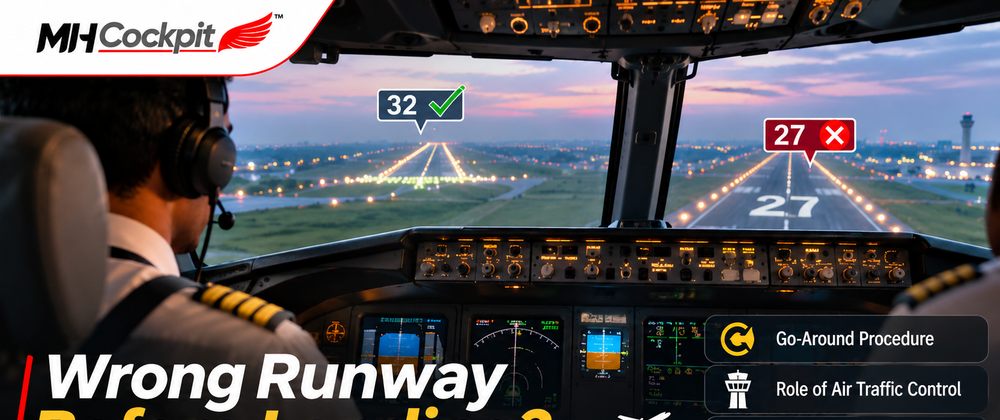

Landing an aircraft requires careful coordination between pilots, air traffic controllers and airport ground operations. Every approach involves several checks, including runway identification, aircraft alignment, altitude, speed and landing clearance.
But what happens when a pilot suddenly realises that the aircraft is approaching the wrong runway just seconds before landing?
Although this is an unusual situation, it is one that aviation professionals take seriously. Pilots receive training to identify approach errors and respond appropriately. In many situations, the safest decision is to discontinue the landing and perform a go-around.
How Can a Pilot Approach the Wrong Runway?
Airports can have multiple runways, sometimes running parallel or intersecting with one another. From the cockpit, identifying the correct runway requires more than simply looking at the runway ahead.
Pilots use several sources of information:
- Airport charts: These provide runway numbers, layouts, taxiways and geographical references.
- Instrument Landing System (ILS): Where available, this helps pilots maintain the correct approach path.
- Navigation systems: GPS and other onboard systems assist with position awareness.
- Visual identification: Pilots confirm runway markings, lighting and surrounding airport features.
- Air Traffic Control: Controllers provide runway assignments, approach instructions and landing clearances.
Despite these safeguards, incorrect runway approaches can occur due to confusion, navigation errors, distractions or misidentification, particularly at airports with complex layouts.
What Happens When the Pilot Notices the Mistake?
The immediate response depends on the aircraft's position, speed, configuration and proximity to the runway.
If the aircraft is still airborne and the situation permits, the pilot will generally initiate a go-around rather than continue an unsuitable approach.
A go-around is a standard aviation procedure in which an aircraft abandons its landing attempt and climbs away from the runway.
The process generally involves:
- Applying go-around thrust: The pilots set the required engine thrust according to the aircraft's procedure.
- Establishing a climb: The aircraft's pitch and flight path are adjusted to achieve a safe climb.
- Configuring the aircraft: Flaps and landing gear are managed according to the aircraft's approved procedure.
- Communicating with ATC: The flight crew informs air traffic control about the go-around.
- Preparing for another approach: Once safely established, the pilots follow ATC instructions and prepare for another landing attempt.
The exact procedure varies depending on the aircraft type and operating conditions.
Why Is a Go-Around Safer Than Forcing a Landing?
A landing should only continue when the aircraft is in a suitable position and the landing conditions are acceptable.
Consider a situation where an aircraft is approaching a runway that is shorter than the one assigned, closed for maintenance or occupied by another aircraft.
Continuing the approach could create serious safety risks.
A go-around gives the flight crew another opportunity to assess the situation, communicate with ATC and establish a safe approach to the correct runway.
It is important to understand that a go-around is not considered a failed landing. It is a normal operational safety procedure used by commercial and general aviation pilots.
What If the Pilot Notices the Wrong Runway Just Seconds Before Touchdown?
This is a more demanding situation because the aircraft may already be very close to the ground.
The pilot must assess several factors, including:
- Aircraft height above the runway.
- Airspeed and descent rate.
- Remaining runway distance.
- Aircraft configuration.
- Whether the aircraft has already touched down.
- The availability of a safe flight path away from the runway.
If the aircraft remains airborne, a go-around may still be possible, provided the aircraft's performance and operating conditions permit it.
However, once the aircraft has touched down, the situation changes. The crew must follow the appropriate landing or rejected-landing procedures for that aircraft and situation. An immediate take-off is not automatically the correct response.
The priority is to maintain control of the aircraft and avoid creating another hazard.
What Role Does Air Traffic Control Play?
Air Traffic Control plays an important role in managing runway operations and preventing conflicts between aircraft.
Controllers monitor aircraft movements and issue clearances for take-off, landing and ground operations.
If a pilot reports an incorrect runway approach, ATC may provide instructions such as:
- Assigning a safe heading.
- Providing an altitude to maintain.
- Coordinating with other aircraft in the airport traffic pattern.
- Arranging another approach to the assigned runway.
However, the pilot remains responsible for the safe operation of the aircraft. A landing clearance does not remove the flight crew's responsibility to discontinue an unsafe approach.
How Are Pilots Trained to Handle Such Situations?
Pilot training includes procedures for abnormal and unexpected situations, including unstable approaches, runway identification errors and go-arounds.
Flight simulators allow pilots to practise these situations in a controlled environment without exposing passengers or aircraft to real-world risks.
Students learning to become commercial pilots also study aircraft performance, navigation, meteorology, flight planning and operational safety.
Those interested in entering professional aviation can read this guide on how to become a commercial pilot in India, which explains the training pathway and relevant DGCA requirements.
Final Thoughts
Realising that an aircraft is approaching the wrong runway just seconds before landing can create a demanding situation for the flight crew. However, aviation procedures are designed to give pilots options when an approach becomes unsafe.
A go-around, when appropriate and safely achievable, allows the aircraft to climb away and gives the crew another opportunity to land correctly.
In aviation, completing a landing is never more important than maintaining the safety of the aircraft, its passengers and everyone operating at the airport.






Top comments (0)