
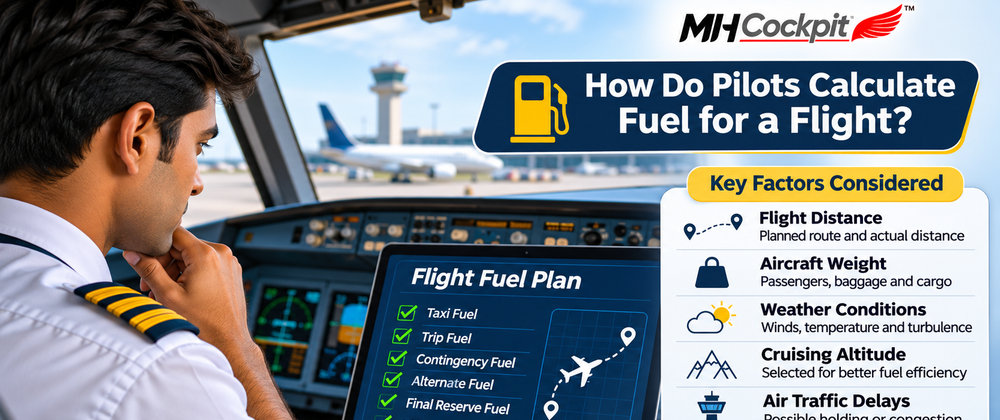

Have you ever wondered how an aircraft travelling thousands of kilometres knows exactly how much fuel it needs before taking off? Unlike cars, aircraft cannot simply stop at a nearby fuel station when they run low. Every flight requires careful fuel planning before departure to ensure the aircraft can complete its journey safely.
Pilots do not calculate fuel requirements using distance alone. They consider several factors, including aircraft weight, weather conditions, flight altitude, wind direction, air traffic conditions and mandatory fuel reserves. This process is known as flight fuel planning.
- Understanding Aircraft Fuel Consumption
Every aircraft has specific fuel-consumption characteristics. These depend on its engine type, aircraft model, weight and operating conditions.
For example, an Airbus A320 and a Boeing 737 have different fuel-consumption rates. Even when operating the same route, two aircraft may require different amounts of fuel depending on their configuration and operating conditions.
Aircraft manufacturers provide performance data that flight planning teams use to calculate expected fuel consumption throughout different phases of flight.
These calculations help determine how much fuel is required for taxiing, take-off, climbing, cruising, descending and landing.
- Six Important Factors That Affect Flight Fuel Requirements
Before departure, flight planning teams consider several operational factors.
Flight Distance: The distance between the departure and destination airports is one of the primary factors. However, aircraft do not always follow a straight-line route. Air traffic restrictions, restricted airspace and weather conditions can influence the actual flight path.
Aircraft Weight: Passenger weight, baggage, cargo and aircraft operating weight all affect fuel consumption. A heavier aircraft generally requires more fuel, particularly during take-off and climb.
Weather Conditions: Wind direction and speed can make a considerable difference. A headwind increases the time and fuel required to reach the destination, while a tailwind can reduce fuel consumption. Temperature and other atmospheric conditions also affect aircraft performance.
Cruising Altitude: Aircraft generally operate at selected cruising altitudes to achieve efficient performance. The appropriate altitude depends on aircraft weight, weather, air traffic and operational restrictions.
Air Traffic Delays: Congestion around busy airports may result in additional taxi time, holding patterns or route changes. Flight planners consider anticipated delays when determining fuel requirements.
Alternate Airports: Pilots must also account for situations where the destination airport becomes unsuitable for landing. The flight plan therefore includes provisions for reaching an appropriate alternate airport when required.
- Different Categories of Fuel Carried by Aircraft
Aircraft fuel planning involves more than calculating the fuel required to reach the destination. Several fuel categories are considered.
Taxi Fuel: This covers fuel expected to be consumed while the aircraft moves on the ground before take-off.
Trip Fuel: This is the estimated fuel required to fly from the departure airport to the destination airport.
Contingency Fuel: An additional allowance is included to account for unforeseen circumstances, such as unexpected routing changes or variations in fuel consumption.
Alternate Fuel: This covers the fuel required to fly from the destination airport to the planned alternate airport when diversion is necessary.
Final Reserve Fuel: This is a protected reserve that must remain available under the applicable operating regulations.
Additional Fuel: Extra fuel may be required for particular operational conditions, such as anticipated delays or other circumstances identified during flight planning.
Discretionary Fuel: The captain may decide to carry additional fuel beyond the calculated requirement based on operational judgement.
These categories help ensure that the aircraft has sufficient fuel not only for the planned journey but also for situations that may arise during the flight.
- How Flight Dispatchers and Pilots Work Together
Fuel planning is not necessarily a task performed by pilots alone. Airline operations departments and flight dispatchers play an important role.
Flight dispatchers prepare flight plans using aircraft performance information, weather forecasts, route details and operational requirements. Pilots review these plans before departure and consider whether the proposed fuel quantity is suitable for the flight.
The pilot-in-command has responsibility for ensuring that sufficient fuel is available before departure.
After take-off, pilots continue monitoring fuel consumption. They compare actual fuel remaining with the expected fuel at different stages of the journey. If conditions change, they may need to reassess their flight plan.
This coordination between pilots and dispatch teams helps maintain safe and efficient flight operations.
- Why Don't Airlines Simply Carry Extra Fuel?
It might seem safer to carry as much fuel as possible for every flight. However, additional fuel also increases aircraft weight.
A heavier aircraft requires more energy to take off, climb and maintain flight. This can result in additional fuel consumption.
Airlines therefore aim to carry sufficient fuel to meet operational and regulatory requirements without adding unnecessary weight.
Fuel planning is not about carrying the smallest possible quantity. It is about carrying the appropriate amount for the planned flight and its operational conditions.
- Why Fuel Planning Is an Important Part of Pilot Training
Understanding aircraft fuel consumption is an important part of aviation knowledge. Pilots must understand aircraft performance, flight planning, meteorology, navigation and operational procedures.
Students interested in becoming commercial pilots in India should also understand the training and licensing requirements established by the Directorate General of Civil Aviation (DGCA).
Learning how fuel calculations work helps future pilots understand why every flight requires careful preparation before departure.
Those interested in the commercial pilot training pathway can refer to MH Cockpit's guide to becoming a commercial pilot in India.
Conclusion
Calculating the fuel required for a flight involves much more than measuring the distance between two airports. Aircraft weight, weather, cruising altitude, route restrictions, alternate airports and mandatory fuel reserves all play a role.
Pilots and flight dispatchers work together to ensure that every flight begins with an appropriate fuel plan. Continuous monitoring during the journey also helps pilots respond to changing conditions.
Ultimately, accurate fuel planning supports three important objectives in aviation: safety, operational efficiency and responsible fuel management.







Top comments (0)