
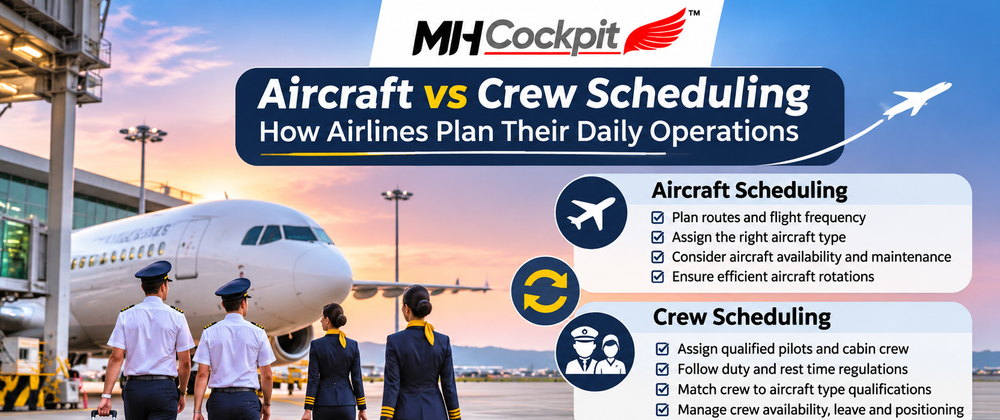

Airline operations involve much more than assigning an aircraft to a particular route. Behind every scheduled departure is a detailed planning process that involves aircraft availability, pilot assignments, cabin crew rosters, maintenance requirements and airport coordination. Airlines must bring all these elements together to ensure flights operate safely and on time.
One common question in aviation is whether aircraft scheduling takes priority over crew scheduling when an airline creates a new flight timetable. The answer is not entirely straightforward because both processes are closely connected.
How Does Aircraft Scheduling Work?
Aircraft scheduling generally begins with an airline's network and commercial planning. The airline evaluates passenger demand, route profitability, airport availability and the type of aircraft required for different destinations.
For example, an airline operating from Chennai might schedule an aircraft to fly from Chennai to Delhi in the morning, continue from Delhi to Mumbai and return to Chennai later in the day.
This process is known as aircraft rotation planning.
Airlines must consider several factors when creating these rotations:
- Aircraft availability and fleet size.
- Passenger capacity and expected demand.
- Flight distance and aircraft range.
- Airport departure and arrival slots.
- Turnaround time between flights.
- Planned maintenance and technical inspections.
The objective is to use the available fleet efficiently without creating operational difficulties.
Why Crew Scheduling Is Equally Important
Once the aircraft rotations have been planned, airlines must ensure that sufficient qualified crew members are available to operate every flight.
Pilots and cabin crew work according to carefully prepared rosters. However, pilot assignments involve additional requirements because pilots must hold the appropriate aircraft type qualifications and meet regulatory conditions.
For example, a pilot qualified on an Airbus A320 cannot automatically operate a Boeing 737 without the required training and qualifications.
Crew planners must consider:
- Pilot qualifications and aircraft type ratings.
- Flight Duty Period (FDP).
- Mandatory rest periods.
- Flight time limitations.
- Crew availability and leave schedules.
- Crew positioning between different airports.
- Cabin crew staffing requirements.
In India, the Directorate General of Civil Aviation (DGCA) establishes regulatory requirements governing flight crew operations and duty limitations.
These rules help airlines ensure that crew members are fit and legally permitted to operate their assigned flights.
What Happens When an Aircraft Is Available but the Crew Is Not?
Consider a situation where an aircraft is ready for departure, but the assigned captain has reached the permitted duty limit.
The airline cannot simply ask the pilot to continue operating the flight. It must comply with applicable duty and rest requirements.
The operations team may arrange a reserve pilot, assign another qualified crew member or reorganise the roster.
If no suitable crew is available, the airline may have to delay or cancel the flight.
The opposite situation can also occur. A complete crew may be available, but the assigned aircraft could develop a technical issue or require additional maintenance.
In that situation, the airline may arrange a replacement aircraft or adjust its flight schedule.
This demonstrates why aircraft availability alone cannot determine whether a flight operates.
How Airlines Coordinate Aircraft and Crew Scheduling
Airlines generally use specialised planning and rostering systems to coordinate aircraft rotations with crew assignments.
These systems help operations teams identify potential scheduling conflicts before they affect actual departures.
For example, if an aircraft is scheduled to operate four flights in one day, planners must ensure that the assigned crew can legally operate those flights within the applicable duty limits.
They must also consider the location of the crew at the beginning and end of their duty period.
This becomes particularly challenging for airlines operating large networks with multiple aircraft types, international routes and connecting services.
Disruptions such as weather conditions, technical problems, airport congestion and unexpected crew unavailability can also affect the original plan.
Airline operations control teams therefore monitor flight movements and make adjustments whenever necessary.
The Role of Flight Dispatchers in Airline Operations
Flight dispatchers also play an important role in airline operations. They support flight planning by considering weather conditions, aircraft performance, fuel requirements, route restrictions and operational information.
Their work helps pilots and airline operations teams prepare for safe and efficient flights.
Anyone interested in understanding this career can read about the responsibilities and qualifications of a flight dispatcher in India.
Understanding flight dispatch and airline operations can also help students interested in aviation management, airport operations and other airline-related careers.
So, Does the Aircraft Get Priority Over the Crew?
Aircraft scheduling often provides the starting point for building an airline's flight network. However, this does not mean aircraft availability takes priority over crew requirements during actual operations.
Both must be planned together.
An aircraft cannot operate a commercial flight without the required qualified crew. Similarly, pilots and cabin crew cannot operate a flight without an available and airworthy aircraft.
Airlines must also account for airport facilities, maintenance, weather conditions and regulatory requirements.
Ultimately, successful airline scheduling depends on coordination between aircraft planning, crew management, maintenance and flight operations. The goal is not simply to maximise aircraft utilisation but to create a schedule that can be operated safely, legally and reliably.






Top comments (0)