
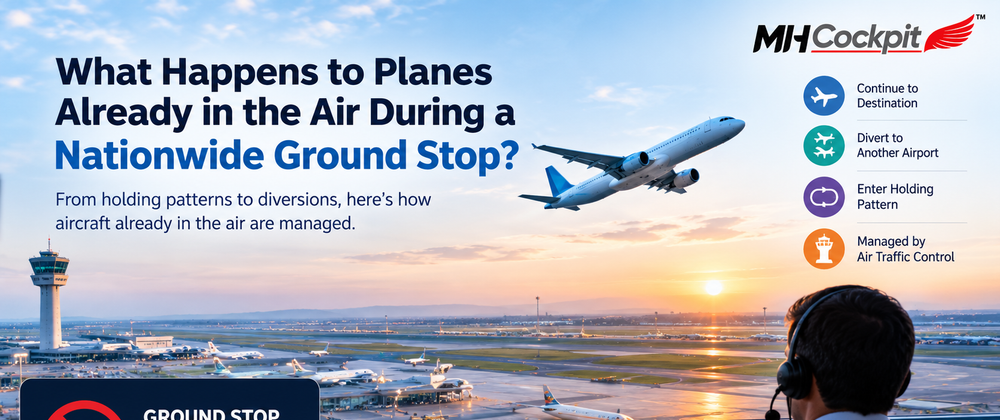

Imagine boarding a flight, taking off normally and reaching cruising altitude. Suddenly, aviation authorities announce a nationwide ground stop. Airports stop departures, airlines suspend operations, and passengers waiting at terminals begin receiving cancellation and delay notifications.
But what happens to the aircraft that are already flying?
Do pilots have to land immediately? Can aircraft continue towards their destinations? What happens if an airport can no longer accept arriving flights?
A nationwide ground stop is a major air traffic management measure, but it does not automatically mean every aircraft in the sky must land immediately. The response depends on the reason for the restriction, its geographical scope and instructions issued by Air Traffic Control (ATC).
- What Is a Nationwide Ground Stop?
A ground stop is an aviation traffic management measure that requires aircraft meeting specified criteria to remain on the ground.
It can be introduced because of severe weather, airport capacity problems, air traffic control equipment failures, communication disruptions or other operational emergencies.
In the United States, the Federal Aviation Administration (FAA) coordinates traffic management measures to maintain safe and manageable air traffic operations.
A ground stop may apply to:
- Flights heading towards a particular airport.
- Aircraft entering a specified airspace.
- Flights operating within a defined geographical area.
- Aircraft meeting certain operational or equipment criteria.
Even when authorities announce a nationwide ground stop, the actual restrictions depend on the instructions issued. It does not necessarily mean every airport has stopped all operations.
- What Happens to Aircraft Already in the Air?
Aircraft that have already departed are handled separately from flights waiting on the ground.
Pilots remain in contact with ATC and follow instructions based on the operational situation.
There are several possible outcomes.
Continuing towards the destination
If the destination airport remains operational and can safely accept arrivals, an aircraft may continue its planned journey. A ground stop does not automatically cancel an airborne flight.
Diverting to another airport
If the destination becomes unavailable or cannot accommodate arriving traffic, ATC and the flight crew may arrange a diversion to another suitable airport.
For example, an aircraft travelling from New York to Chicago might need to divert if its intended destination cannot safely receive it.
The alternative airport must have suitable runway facilities, operational support and the capacity to accommodate the aircraft.
Entering a holding pattern
Aircraft may also be instructed to enter a holding pattern when landing clearance is temporarily unavailable.
A holding pattern is a predetermined flight path, usually shaped like a racetrack, that allows aircraft to remain within a designated area while waiting for further instructions.
However, holding cannot continue indefinitely. Pilots must monitor fuel availability, weather conditions and operational requirements before deciding whether to continue holding or divert.
- Why Can't Every Aircraft Simply Land Immediately?
Landing every airborne aircraft at the same time would create another serious operational problem.
Airports have limited runway capacity, and air traffic controllers must maintain safe separation between aircraft.
If a large number of aircraft suddenly attempted to land at the same airport, the arrival demand could exceed its available capacity.
Instead, ATC manages aircraft movements based on available airspace, runway capacity, weather conditions and the operational status of individual airports.
Safety remains the priority. Aircraft may be sequenced for landing, instructed to hold or redirected to alternative airports depending on the circumstances.
- What Role Does Air Traffic Control Play?
Air Traffic Control plays a central role during a nationwide ground stop.
Controllers coordinate aircraft movements, communicate restrictions and issue instructions to pilots.
Their responsibilities include:
- Maintaining safe separation between aircraft.
- Managing arrival and departure traffic.
- Coordinating diversions when destinations become unavailable.
- Monitoring traffic congestion and available airport capacity.
- Communicating operational updates to flight crews.
During major disruptions, coordination between different ATC facilities becomes particularly important because aircraft may be travelling across several control sectors.
Communication systems are also essential. If controllers cannot reliably communicate with pilots, authorities may impose restrictions to prevent aircraft from entering situations that cannot be safely managed.
- What About Passengers on Board?
For passengers, the experience depends on the aircraft's location and the nature of the disruption.
Some passengers may reach their destination with a delay. Others may experience additional holding time, a diversion or an unexpected landing at another airport.
After landing, passengers may still face delays because the airline needs to arrange aircraft parking, ground handling, crew availability and onward travel.
Even after authorities lift a ground stop, normal operations may take several hours or longer to recover.
This happens because aircraft and flight crews are no longer necessarily positioned where the original schedules expected them to be.
- Ground Stop vs. Ground Delay: Are They Different?
Yes. Both measures help manage air traffic, but they work differently.
| Ground Stop | Ground Delay Program |
|---|---|
| Affected aircraft must remain at their departure airports. | Flights receive assigned departure delays or times. |
| Often introduced during sudden operational restrictions. | Used to manage sustained demand and capacity problems. |
| Can temporarily prevent affected flights from departing. | Allows flights to depart according to assigned schedules. |
The FAA uses both measures to balance traffic demand with available airport and airspace capacity.
- Why Flight Operations Professionals Matter During Such Disruptions
Aviation disruptions involve more than pilots and air traffic controllers. Airline operations teams also play an important role in managing the situation.
Flight dispatchers, for example, assist with flight planning, operational monitoring, weather information and coordination with flight crews, depending on their authority and the applicable regulations.
Their work becomes particularly relevant when airlines need to assess changing routes, destination conditions, fuel requirements and alternative airports.
For those interested in this career, understanding the responsibilities of a flight dispatcher in India provides a useful starting point for learning about airline operational support.
Final Thoughts
A nationwide ground stop is primarily a measure to control aircraft movements and protect aviation safety. It does not mean that every aircraft already in the sky must immediately land.
Aircraft may continue towards their destinations, enter holding patterns or divert to alternative airports, depending on the situation and ATC instructions.
The important distinction is that stopping departures and managing aircraft already airborne are two different operational challenges.
For passengers, a ground stop may mean delays and cancellations. For aviation professionals, it is a situation that requires careful coordination between pilots, air traffic controllers, airlines and airport operations teams.
Ultimately, the objective is straightforward: maintain safe aircraft movements while the aviation system works through the disruption.







Top comments (0)