

An engine failure shortly after take-off is one of the most challenging situations a pilot can face. At low altitude, there may be very little time to assess the aircraft's condition, identify a suitable landing area and decide whether returning to the departure runway is possible.
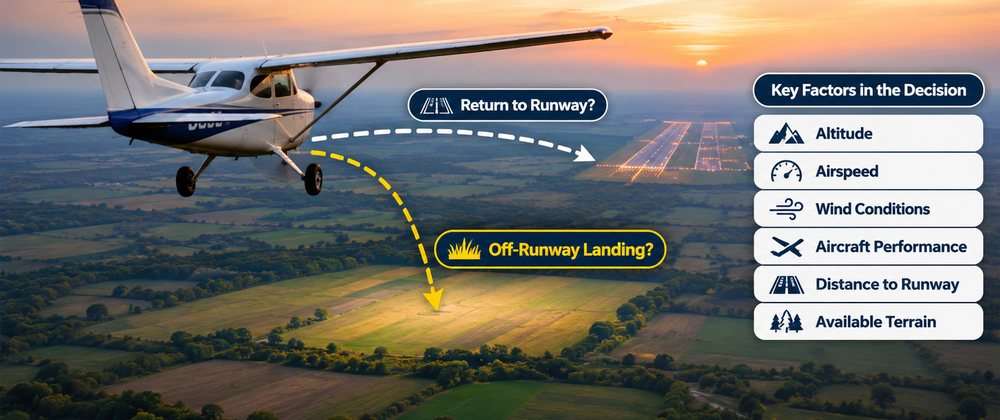
A common question in aviation is whether pilots should attempt a 180-degree turn to return to the runway or choose an off-runway emergency landing. The answer depends on several factors, including altitude, airspeed, aircraft performance, wind conditions and the surrounding terrain.
The primary objective is to maintain control of the aircraft and achieve the safest possible landing.
Why Is Engine Failure After Take-Off So Dangerous?
During take-off, an aircraft uses substantial engine power to accelerate and climb. If the engine suddenly stops producing power, the aircraft loses its ability to maintain the climb.
However, an engine failure does not mean the aircraft immediately stops flying. An aircraft can continue moving through the air without engine power by converting its altitude and existing energy into forward movement.
This is known as gliding.
The pilot must maintain the appropriate airspeed to keep the aircraft under control. Allowing the airspeed to decrease excessively can lead to an aerodynamic stall, which becomes particularly dangerous when the aircraft is close to the ground.
Unlike an engine failure at cruising altitude, an emergency immediately after take-off leaves limited time and altitude for decision-making.
Why Don't Pilots Always Turn Back to the Runway?
Returning to the departure runway might appear to be the obvious solution. However, attempting a 180-degree turn at low altitude can be extremely dangerous.
When an aircraft banks into a turn, its wings must generate additional lift to support the aircraft's weight. This increases the load factor and raises the stall speed.
If the pilot attempts a steep turn without sufficient airspeed and altitude, the aircraft could enter an aerodynamic stall.
This manoeuvre is commonly associated with the term "impossible turn" in flight training.
The term does not mean that turning back is physically impossible in every situation. Instead, it highlights the danger of attempting a runway return without sufficient altitude, appropriate aircraft performance and proper training.
A successful turnback requires enough altitude to change direction, manage the aircraft's energy and align with the runway for landing.
When Can a Pilot Attempt to Return to the Runway?
A pilot may consider returning to the departure runway when the aircraft has sufficient altitude and the runway remains within its achievable gliding range.
Several conditions influence this decision.
Aircraft altitude: The aircraft needs enough height to complete the turn and establish an appropriate approach.
Airspeed: Maintaining the recommended glide speed is essential to prevent a stall and preserve the aircraft's available energy.
Wind conditions: Wind direction and strength affect the aircraft's ground distance and the possibility of reaching the runway.
Aircraft performance: Different aircraft have different glide characteristics, handling limitations and performance capabilities.
Runway position: The distance travelled after take-off and the aircraft's position relative to the runway determine whether a return is practical.
Pilots should not rely on a universal turnback altitude. The appropriate limits must be established through aircraft-specific performance information, training and approved procedures.
When Is an Off-Runway Landing the Safer Choice?
If the aircraft does not have sufficient altitude to return safely, the pilot may need to select another landing area.
This is known as a forced landing.
Depending on the aircraft's position and surrounding environment, possible landing areas include open agricultural fields, flat terrain and other unobstructed locations.
The pilot must assess potential hazards such as trees, buildings, power lines, vehicles and uneven surfaces.
A suitable landing area is not necessarily the closest available piece of ground. The pilot must consider whether the aircraft can reach it while maintaining a controlled flight path.
In some circumstances, accepting an off-runway landing may provide a better chance of survival than attempting to return to the airport.
What Do Pilots Practise During Engine Failure Training?
Engine-failure procedures form an important part of pilot training. Student pilots learn how to respond to simulated emergencies while maintaining aircraft control.
Training generally covers maintaining the appropriate glide speed, identifying potential landing areas, following the aircraft's emergency checklist and understanding the aircraft's performance limitations.
Pilots also learn that decision-making must account for the actual situation rather than relying on assumptions.
The exact procedures vary according to aircraft type and the applicable flight training syllabus.
For aspiring commercial pilots, understanding aircraft performance and emergency procedures is an important part of building sound flying knowledge. Those interested in the training pathway can read this guide to becoming a commercial pilot in India.
The Final Decision: Safety Over Returning to the Airport
There is no single answer that applies to every engine failure after take-off. A runway return may be achievable in one situation but extremely dangerous in another.
The pilot must consider altitude, airspeed, wind, aircraft performance and available landing areas before deciding how to respond.
Most importantly, returning to the runway should never become more important than maintaining control of the aircraft.
A controlled emergency landing away from the airport may be the safer option when a runway return is not achievable.
Ultimately, successful emergency decision-making is not about saving the aircraft at any cost. It is about protecting the lives of everyone onboard and giving them the best possible chance of a safe outcome.






Top comments (0)