

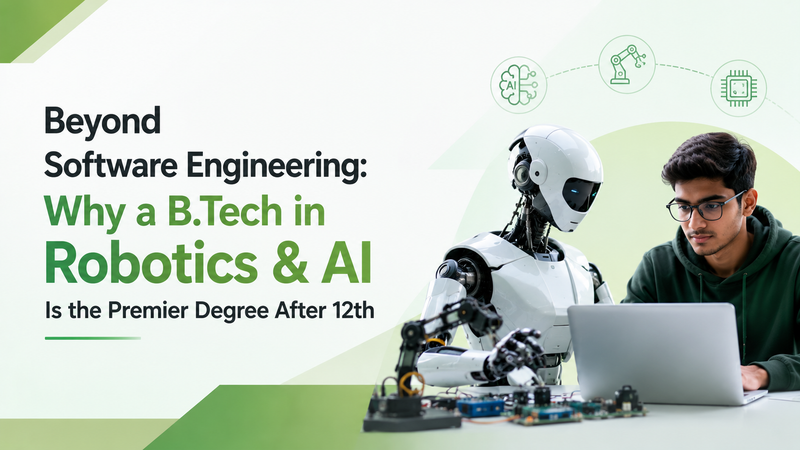
For decades, the standard path for high-school graduates in the science stream was straightforward: take Physics, Chemistry, and Mathematics, achieve competitive entrance marks, and enroll in traditional Computer Science or Mechanical Engineering.
However, as global automation transforms manufacturing, healthcare, logistics, and automotive sectors, relying solely on broad software or pure mechanical hardware is no longer enough.
Today's technology ecosystem demands engineers who understand how digital algorithms interact with physical machines. If you're an ambitious student evaluating your higher education options after Class 12, choosing a specialised BTech in Robotics and AI provides the exact interdisciplinary training required to build and control smart autonomous systems.
The Problem with Single-Domain Engineering Degrees
Traditional engineering programs were designed for an era when hardware and software existed in isolation.
The CS Graduate's Limitation
A traditional computer science graduate excels at:
- Writing cloud software
- Building mobile applications
- Managing databases
- Web development and APIs
But they rarely handle:
- Physical actuators and motors
- Embedded microcontrollers
- Motor torque dynamics
- Sensor integration
- Real-time hardware constraints
Result: Software expertise without understanding physical constraints
The Mechanical Engineer's Limitation
A mechanical engineering graduate understands:
- Physical structures and design
- Thermodynamics and energy systems
- Material properties and stress analysis
- Manufacturing processes
But they often lack:
- Deep learning and neural networks
- Computer vision and image processing
- Embedded programming
- Real-time decision-making algorithms
Result: Hardware expertise without intelligent control
The Industry Shortage
This gap is precisely where the modern industry experiences its greatest shortage.
Industrial facilities, electric vehicle manufacturers, and surgical tech developers require cross-functional engineers who can:
- Design a physical machine from scratch
- Integrate its sensor network seamlessly
- Program its artificial intelligence brain from day one
- Deploy autonomous systems in production environments
Single-domain engineers can't do this. Hybrid engineers are rare. Demand is massive.
What Makes BTech Robotics & AI the Best Choice After 12th?
Choosing a dedicated 4-year undergraduate degree in robotics and artificial intelligence bridges the gap between hardware engineering and intelligent code.
The Unique Value Proposition
Before shortlisting your target universities, understanding the fundamental concepts behind what is AI and robotics helps clarify how this specialised branch combines:
- Mechanical kinematics — how machines move and interact with physical world
- Electronics and sensor networks — gathering real-world data
- Embedded systems — running AI at the edge, not in the cloud
- Predictive machine learning algorithms — making autonomous decisions
...into a single unified discipline.
Core Practical Technologies You'll Master
When enrolled in a future-ready curriculum, your learning revolves around core practical technologies:
Robot Operating System (ROS2)
The industry-standard open-source framework used to manage communications between robotic sensors, controllers, and motor drives. Every modern robot runs ROS2. Understanding it means you can work with any robot in the world.
Computer Vision & Spatial Intelligence
Implementing frameworks like OpenCV, YOLO, and SLAM (Simultaneous Localization and Mapping) so machines can perceive and navigate dynamic environments. Your robot can see, understand, and move through the world.
Embedded Hardware & Edge Computing
Programming low-latency microcontrollers and platforms like NVIDIA Jetson to process AI algorithms directly on physical devices. Real-time decisions without cloud latency.
Industrial Automation & Collaborative Cobots
Designing collaborative robotic systems that work safely alongside human operators in smart manufacturing plants. The future of manufacturing isn't robots replacing humans—it's humans and robots working together.
Comparing Engineering Pathways
| Factor | Traditional CS | Traditional Mechanical | BTech Robotics & AI |
|---|---|---|---|
| Software Skills | Excellent | Limited | Strong |
| Hardware Understanding | Limited | Excellent | Strong |
| Real-time Systems | Basic | Minimal | Advanced |
| Computer Vision | Theoretical | Not taught | Practical |
| Embedded Systems | Basic | Limited | Advanced |
| Autonomous Systems | Not covered | Not covered | Core focus |
| Robotics Frameworks | Not taught | Basic | Production-level |
| Industry Readiness | 6-12 months | 12-18 months | Immediate |
| Entry-Level Roles | Software dev | Mechanical design | Roboticist, Automation Engineer |
| Starting Salary | ₹4-6 LPA | ₹4-6 LPA | ₹6-10 LPA |
| Salary Premium | None | None | 40-60% higher |
| Career Ceiling | Software architect | Engineering manager | AI architect, Research scientist |
Exploring Educational Pathways and Regional Tech Hubs
Location plays a massive role in engineering education.
Why Chennai Matters for Robotics
Enrolling in an industrial hub gives students immediate access to:
- Corporate internships with real companies
- Research facilities and innovation centers
- Live industrial projects solving production problems
- Networking with engineering professionals
- Real robotics deployment opportunities
When reviewing academic options in Tamil Nadu, evaluating specialised BTech courses in Chennai shows how the city's dense concentration of:
- Automotive plants — Tamil Nadu is India's automotive hub
- Hardware manufacturing zones — production and assembly facilities
- Technology parks — innovation centers and startup ecosystems
- Research institutions — AI and automation research labs
...creates an ideal environment for robotics engineering students.
Why This Matters for Your Career
Chennai Advantage:
- Access to Hyundai, BMW, Maruti, Ashok Leyland facilities (internships, projects)
- 3000+ manufacturing plants offering real deployment opportunities
- Startup ecosystem actively building autonomous systems
- Talent concentration — already where robotics jobs cluster
Contrast with other regions:
- Northern cities focus on software (saturated market)
- Western cities focus on finance (less robotics)
- Chennai is where physical automation is actually happening
Industry-Aligned Academic Partnerships
Furthermore, exploring institutional partnerships across top universities reveals how industry-aligned academic programs are changing the educational landscape.
Exploring the top options for a BTech in Robotics and AI in Chennai highlights how leading campuses offer students:
- Direct access to advanced robotics labs — not just simulations
- Cloud simulation tools — Gazebo, V-REP, Webots for testing
- Direct industry placement training — from companies that hire
- Corporate partnerships — guest lectures, internships, projects
- Faculty with real experience — engineers who built production systems
Institutions like Vels University (VISTAS) in partnership with MH Cognition exemplify this model — combining academic rigour with practical industry focus.
Long-Term Career Scope and Opportunities
Graduating with a specialised degree in physical AI positions you for high-growth, future-proof roles that are insulated from generic automation.
The Competition Reality
Generic Software Engineering:
- Millions of graduates globally
- Highly competitive job market
- Salary pressure from offshore competition
- Commoditised skill set
Robotics & AI Engineering:
- Thousands of graduates globally
- Massive talent shortage (demand 3-4x supply)
- Salary premium due to scarcity
- Specialised, high-value skills
Instead of competing with millions of general software applicants, specialised robotics graduates enter the job market as rare, valuable talent.
Actual Career Paths Available
Robotics & Automation Engineers
Design autonomous mobile robots (AMRs) for smart logistics and automated supply chains.
- Companies: Flipkart, Amazon Robotics, Stryker, Welbot
- Starting salary: ₹7-10 LPA
- Growth: ₹15-25 LPA by mid-career
Computer Vision Specialists
Develop spatial recognition algorithms for autonomous vehicles, drones, and quality inspection systems.
- Companies: Tesla, Uber, Mobileye, IIT research labs
- Starting salary: ₹8-12 LPA
- Growth: ₹18-30 LPA by mid-career
Embedded Systems Engineers
Write low-level firmware for smart medical devices and IoT infrastructure.
- Companies: Medtronic, Philips Healthcare, Boston Scientific
- Starting salary: ₹7-10 LPA
- Growth: ₹15-25 LPA by mid-career
Controls & Mechatronics Architects
Manage complex industrial automation lines across manufacturing plants.
- Companies: ABB, Siemens, Rockwell Automation, Bosch Rexroth
- Starting salary: ₹8-12 LPA
- Growth: ₹20-35 LPA by mid-career
AI Research Scientists (Robotics)
Advance algorithms for perception, planning, and decision-making in autonomous systems.
- Companies: Google Robotics, Meta AI, DeepMind, IIT research
- Starting salary: ₹10-15 LPA
- Growth: ₹25-50+ LPA by mid-career
Market Demand and Salary Trajectory
Current Market Reality (2026)
The robotics and automation market is experiencing explosive growth:
- Market Growth Rate: 25%+ CAGR through 2035
- Talent Shortage: Demand exceeds supply by 3-4x
- Salary Trend: Rising annually as companies compete for talent
- Job Security: Extremely high (companies can't find talent)
Salary Comparison: BTech Robotics & AI vs. Other Engineering
| Role | Entry Salary | 3-Year Salary | 5-Year Salary | 10-Year Salary |
|---|---|---|---|---|
| Software Engineer | ₹4-6 LPA | ₹8-12 LPA | ₹15-25 LPA | ₹40-70 LPA |
| Mechanical Engineer | ₹4-6 LPA | ₹8-12 LPA | ₹15-25 LPA | ₹35-60 LPA |
| Robotics & AI Engineer | ₹7-10 LPA | ₹15-22 LPA | ₹30-45 LPA | ₹60-100+ LPA |
| Salary Premium | 40-60% | 25-50% | 25-50% | 40-50% |
Why the Salary Premium?
- Scarcity: Far fewer graduates than positions
- Complexity: Requires mastery of multiple domains
- Business impact: Automation affects millions in productivity
- Retention: Companies pay premium to keep talent
- Global demand: Opportunities worldwide, not just India
Why 2026 is Critical for BTech Robotics & AI
The Timing Window
2026-2030: Peak demand, minimal competition, maximum salary growth
2030-2035: Strong demand, growing competition, stabilising salaries
2035+: Market matures, competition intensifies, requirements increase
The Career Timeline Advantage
Starting BTech Robotics & AI in 2026:
- Graduate in 2030 into peak market demand
- Enter workforce before peak competition
- Build early experience in emerging field
- Reach mid-level roles by 2033-2034
Waiting Until 2027:
- Start 4-year degree (graduates 2031)
- Market more competitive by graduation
- Fewer early-mover advantages
- Play catch-up with 2026 cohort
The perfect time to start was yesterday. The second-best time is now, in 2026.
Getting Started: Your Action Plan
Step 1: Confirm Eligibility
BTech Robotics & AI programs typically require:
- ✅ 10+2 completion from recognised board
- ✅ Physics, Chemistry, Mathematics core subjects
- ✅ Competitive entrance exam score (JEE, state-level tests)
- ✅ Strong foundation in maths and physics
Bridge programmes available for students needing to strengthen fundamentals.
Step 2: Research Top Institutions
Look for programs offering:
✅ Modern robotics labs with real robots (not just simulations)
✅ ROS2 and industry tools taught in curriculum
✅ Computer vision and AI as core subjects
✅ Embedded systems and real-time programming
✅ Industry partnerships with automation companies
✅ Faculty with production experience (not just academic)
✅ Internship guarantees with leading companies
✅ Capstone projects deploying real robotic systems
Step 3: Evaluate Chennai Options
BTech in Robotics and AI in Chennai highlights institutions with:
- Direct access to manufacturing facilities (internships)
- Partnerships with Hyundai, BMW, Maruti (projects)
- MH Cognition industry-aligned curriculum
- Advanced robotics laboratories
- Strong placement record with premium salaries
Step 4: Prepare Now
While waiting for admission:
- Learn Python basics (used in robotics)
- Study calculus and linear algebra (essential for controls)
- Explore ROS tutorials online
- Build simple projects (Arduino-based robotics)
- Join robotics communities (FIRST Robotics, local clubs)
The Economics Make Sense
Return on Investment
4-Year BTech Cost: ₹8-20 LPA (depending on institution)
Salary Premium Over Traditional Engineering:
- Entry-level premium: ₹2-4 LPA annually
- Over career: ₹40-50+ LPA difference by mid-career
- Total career earnings advantage: ₹50-100+ LPA by age 40
Plus:
- ✅ Faster skill accumulation (hybrid domain expertise)
- ✅ Better job offers (companies competing for talent)
- ✅ Career security (demand insulated from outsourcing)
- ✅ Leadership opportunities sooner
The investment is recovered in 3-4 years through salary premium alone.
The Industry Transformation is Accelerating
What's Happening Right Now (2026)
- Autonomous vehicles being deployed globally
- Surgical robots performing complex procedures
- Warehouse automation replacing manual labor
- Manufacturing robots becoming collaborative
- Agricultural drones optimising crop yields
- Healthcare robots assisting in patient care
- Inspection drones monitoring infrastructure
Every one of these applications needs roboticists and AI engineers. That's not a future scenario. That's today's job market.
Conclusion: Making a Future-Ready Decision
The transition toward physical computing is accelerating rapidly. For 12th-grade students passionate about physics, mathematics, and hands-on technology, settling for a broad, generic degree can delay specialised career entry.
By choosing a dedicated, industry-backed undergraduate pathway in Robotics and Artificial Intelligence, you invest in:
- Technical skillset that will drive industrial innovation for decades
- Career insulation from software commoditisation and offshore competition
- Premium compensation reflecting genuine market scarcity
- Global opportunities — robotics expertise valued everywhere
- Leadership positions — rare talent rises to top quickly
- Meaningful work — building systems that solve real problems
The Choice is Clear
✅ Generic engineering degree → Commoditised role, competitive market, standard salary
✅ BTech Robotics & AI → Specialised role, seller's market, premium salary + career security
Launch Your Robotics Career After 12th
Ready to become one of the rare engineers building the future of automation?
Our comprehensive B.Tech in Robotics and Artificial Intelligence program combines:
- Mechanical engineering fundamentals — design, kinematics, dynamics
- Advanced AI and machine learning — perception, decision-making, autonomy
- Embedded systems and robotics — ROS2, firmware, real-time systems
- Computer vision and sensing — cameras, lidar, sensor fusion
- Hands-on lab experience — building and deploying real robots
- Industry mentorship — from engineers leading robotics teams at scale
- Career acceleration — direct connections to robotics employers
What You'll Achieve
- Master robotics architecture from mechanical design to AI integration
- Build autonomous systems solving real-world problems
- Launch careers with ₹7-10 LPA+ (40-60% premium over traditional engineers)
- Access opportunities across manufacturing, healthcare, logistics, automotive
- Lead the automation revolution reshaping industries
Located in Chennai — India's automotive and manufacturing hub with direct access to:
- Hyundai, BMW, Maruti facilities (internships and projects)
- 3000+ manufacturing plants (deployment opportunities)
- Thriving robotics startup ecosystem
- Research institutions advancing automation
Your 12th Pass Turning Point
You're at a critical decision point. The next few months determine whether you:
Path A: Graduate with generic engineering degree into competitive market
Path B: Graduate with BTech Robotics & AI into seller's market with premium salary
The physical automation revolution is happening right now. The talent shortage is acute right now. The opportunity is yours right now.
The physical AI revolution is here. The question is: will you build the robots, or will someone else? The time to decide is now, after your 12th exams.
Contact MH Cognition
📞 Phone: +91 7305952831 | +91 9884807480
🌐 Website: mhcognition.com
📚 Program: B.Tech Robotics and AI
📖 Learn More: What is AI and Robotics
🏙️ Chennai Options: BTech Robotics & AI in Chennai
In 2026, the premier engineering degree after 12th isn't the broadest. It's the one that bridges hardware and intelligence. That's BTech Robotics & AI. Build the future. Start now.
Related Articles
- The Physical AI Revolution: A Complete Career Guide to Robotics & AI
- The Infrastructure Shift: Why BCA Cloud Computing Is the Smartest Tech Degree
- Launching Your Tech Career Early: Why an AI Degree After 12th Is the Ultimate Move
Published by: MH Cognition
Category: Engineering | Robotics | Career Guide
Tags: #BTech #Robotics #AI #Engineering #Automation #India #CareerGuide
This blog is part of MH Cognition's educational content series. For more information about our BTech Robotics & AI program and supporting students in building careers in automation and robotics, visit mhcognition.com






Top comments (0)