

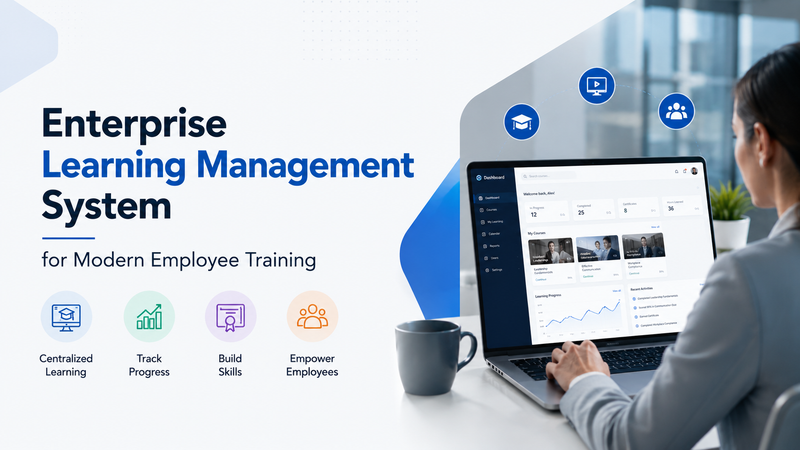
Enterprise Learning Management System: How Organizations Can Modernize Employee Learning
Employee learning is no longer limited to classroom training or occasional workshops. Organizations now need flexible ways to deliver training, manage learning resources, assess employee knowledge, and understand how training programs are progressing.
An enterprise learning management system can provide a centralized digital environment for managing these activities. Instead of relying on spreadsheets, emails, shared folders, and disconnected training tools, organizations can use an LMS to organize learning programs in one place.
What Is an Enterprise Learning Management System?
An enterprise LMS is a digital platform designed to help organizations manage employee learning and training at scale.
It can support activities such as:
- Course creation
- Employee training
- Learning material management
- Assessments and quizzes
- Employee progress tracking
- Training completion records
- Certifications
- Learning reports
- Communication
- Training administration
The exact capabilities depend on the platform, but the main purpose is to make organizational learning more structured and manageable.
Organizations exploring the fundamentals can also review:
https://mhcognition.com/blogs/what-is-an-online-lms
This provides additional context about how online learning management platforms work.
Why Do Organizations Need an Enterprise LMS?
As organizations grow, managing employee training manually can become increasingly difficult.
HR and learning teams may need to train employees across different departments, locations, roles, and experience levels. Keeping track of who completed which training can become challenging when information is spread across multiple systems.
An enterprise LMS can centralize learning activities and provide a structured environment for managing employee development.
This can be particularly useful for organizations with large or distributed workforces.
Centralizing Employee Training
One of the main advantages of an enterprise LMS is centralized learning management.
Organizations can organize courses according to departments, roles, skills, or training requirements.
For example, a company might create separate learning paths for:
- New employees
- Managers
- Sales teams
- Technical teams
- Customer support
- Compliance training
- Leadership development
Employees can then access the learning resources relevant to their roles.
Organizations looking at broader LMS capabilities can also explore:
https://mhcognition.com/blogs/lms-features
Understanding the available LMS features can help businesses determine which capabilities are important for their training requirements.
Supporting Employee Onboarding
Employee onboarding is another area where an LMS can be useful.
New employees often need to understand company policies, processes, tools, workplace expectations, and role-specific responsibilities.
An LMS can organize onboarding courses into a structured learning path.
Instead of sending new employees multiple documents and links, organizations can provide a centralized learning environment where required training can be completed systematically.
This can make onboarding more consistent across different teams and locations.
Employee Training and Skill Development
Organizations need employees to continuously develop their skills as technology, processes, and business requirements change.
An LMS can support ongoing learning by providing access to training materials and structured courses.
Employees can learn new technical skills, improve professional capabilities, or complete role-specific training.
Training teams can also organize learning programs around specific skills or business objectives.
Assessments and Learning Progress
Training is more useful when organizations can understand whether employees are completing courses and assessments.
An LMS can provide information about learning activity, course completion, assessment results, and other training indicators.
This information can help training teams identify areas where employees may require additional support.
For example, if employees consistently struggle with a particular assessment, the organization may decide to review the training material or provide additional learning resources.
Supporting Corporate Training
Corporate training can involve employees from multiple departments and locations.
An LMS can help centralize corporate training programs and provide employees with access to learning resources through a structured platform.
Organizations interested specifically in this use case can explore:
https://mhcognition.com/blogs/lms-for-corporate-training
This can help businesses understand how LMS technology can support employee training and organizational learning.
Cloud-Based LMS for Modern Organizations
Cloud-based learning platforms can provide organizations with access to training systems through internet-connected devices.
This can be useful for companies with remote employees, multiple offices, distributed teams, or hybrid work environments.
A cloud-based LMS can also support centralized management while allowing employees to access training according to organizational policies.
Businesses exploring this approach can learn more about:
https://mhcognition.com/blogs/cloud-based-lms-platforms
AI and the Future of Enterprise Learning
Artificial intelligence is also becoming increasingly relevant to learning technology.
AI-enabled LMS platforms can potentially support personalized learning recommendations, automated insights, intelligent content discovery, and other learning-related capabilities.
For example, an AI-enabled platform could potentially recommend learning resources based on an employee's role, previous activity, or identified skill requirements.
Organizations exploring this direction can learn more about:
https://mhcognition.com/blogs/ai-powered-lms-platform
AI should complement trainers and learning professionals rather than completely replace human guidance.
Important Features to Consider
Organizations evaluating an enterprise LMS should focus on practical requirements rather than simply choosing the platform with the largest feature list.
Important considerations can include:
- Course management
- Employee management
- Learning paths
- Assessments
- Progress tracking
- Reporting
- Certifications
- Mobile accessibility
- User management
- Content management
- Integration capabilities
- Security
- Scalability
The right combination will depend on the organization's workforce size, training objectives, technical environment, and long-term learning strategy.
LMS for Different Types of Organizations
An LMS is not limited to large multinational companies.
Educational organizations, training providers, growing businesses, professional organizations, and other institutions can use learning platforms to organize digital training.
Organizations evaluating LMS solutions for institutional environments can also explore:
https://mhcognition.com/blogs/lms-software-for-institutions
The implementation approach should be based on the organization's users, learning objectives, content, and operational requirements.
How an Enterprise LMS Can Improve Training Management
A centralized learning environment can make it easier for organizations to manage training activities.
Instead of maintaining separate records for different courses, teams can potentially manage learning information through one platform.
This can help reduce repetitive administrative tasks and make training information easier to organize.
It can also provide employees with a clearer learning experience because courses, resources, assessments, and progress information can be brought together.
Conclusion
An enterprise learning management system can help organizations create a more structured approach to employee training and development.
From onboarding and corporate training to assessments, skill development, reporting, and learning management, an LMS can bring multiple activities into one digital environment.
Organizations should evaluate LMS platforms based on their actual learning requirements, workforce structure, scalability needs, security considerations, and long-term training strategy.
As workplace learning continues to become more digital, a well-planned LMS can provide a foundation for more organized and accessible employee development.
visit
https://mhcognition.com/blogs/enterprise-learning-management-system







Top comments (0)