

Introduction
Managing employees involves more than maintaining a list of names and job titles. HR teams must handle attendance records, leave requests, employee information, payroll-related data, and everyday staff queries. When these activities are managed through separate spreadsheets and manual processes, information can become difficult to maintain and update.
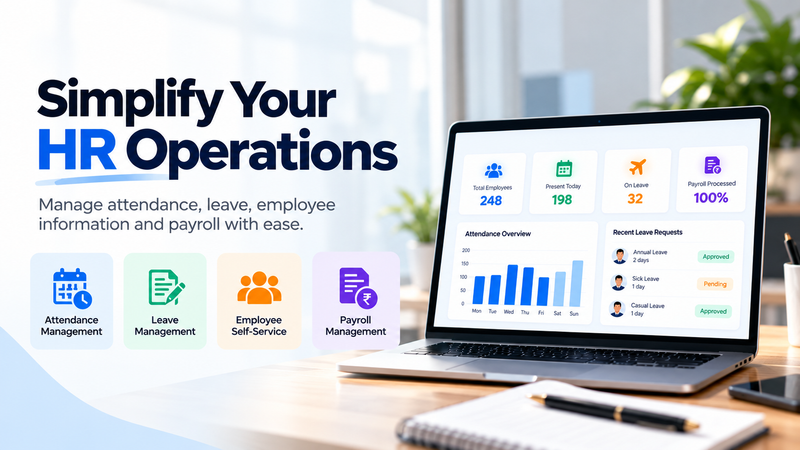
A Human Resource Management System (HRMS) helps businesses organize these activities through a centralized digital platform. Depending on the system and its configuration, it can connect employee records, attendance, leave management, and payroll workflows.
For growing businesses, the goal is to reduce repetitive administrative work, improve record accuracy, and make essential HR information easier to access.
1. Simplify Employee Attendance Management
Attendance tracking is an important part of workforce administration. Manual registers and disconnected spreadsheets can make it difficult to review attendance records, track working hours, and identify missing entries.
An HRMS can help by organizing attendance records and providing structured workflows for employees and managers.
Common capabilities may include:
- Recording employee attendance and working hours
- Reviewing attendance history
- Managing attendance correction requests
- Supporting configured shift and attendance policies
- Making attendance information available for payroll processing
Businesses should evaluate whether a system supports their actual attendance requirements, including shift patterns, approval procedures, and reporting needs.
Learn more about employee attendance management systems:
https://mhcognition.com/blogs/employee-attendance-management-system
2. Organize Leave Requests and Approvals
Managing leave through email messages or spreadsheets can create unnecessary back-and-forth between employees, managers, and HR teams.
An HRMS can provide a structured process for submitting leave requests, reviewing approvals, and maintaining leave balances according to company policies.
A typical workflow includes:
- An employee submits a leave request.
- The designated manager reviews the request.
- The request is approved or declined.
- The leave record is updated.
- Relevant attendance or payroll processes use the updated information where configured.
This creates a clearer record of leave activity and helps employees understand the status of their requests.
3. Keep Employee Information Organized
Employee information may include contact details, job roles, department information, employment records, and other documents required by the organization.
When these records are scattered across different files, HR teams may spend time searching for information and updating multiple copies.
A centralized HRMS can help maintain employee records in one system, subject to appropriate access permissions. This makes it easier for authorized users to retrieve current information and manage routine employee administration.
For more information, read about employee management systems in HRMS:
https://mhcognition.com/blogs/employee-management-system-in-hrms
4. Connect HR Processes With Payroll
Payroll preparation often depends on accurate employee information, attendance records, approved leave, and configured salary rules.
If these details are maintained separately, HR and finance teams may need to transfer data manually and reconcile differences before processing salaries.
An HRMS with suitable payroll capabilities or integrations can help connect these workflows. Businesses should check which calculations, statutory requirements, approvals, and reports the selected system actually supports.
The aim is to improve consistency and reduce avoidable manual data entry, not to assume that software removes the need for payroll review.
Explore HRMS with payroll:
https://mhcognition.com/blogs/hrms-with-payroll
5. Improve Employee Self-Service
Employees often contact HR to check leave balances, access payslips, review attendance records, or find routine employment information.
An employee self-service portal can allow authorized employees to access supported information and submit requests themselves. The exact functions depend on the platform and company configuration.
Self-service can help employees find information more conveniently while allowing HR teams to spend less time responding to repetitive queries.
6. Use HR Information to Support Better Decisions
Organized HR records can help managers review workforce information and identify operational patterns.
Depending on the system, reports and dashboards may help businesses review attendance, headcount, leave usage, and other workforce indicators.
These reports are most useful when the underlying data is accurate, access is controlled, and managers interpret the information in context. Metrics should support fair and informed decisions rather than replace communication with employees.
7. Choose an HRMS That Fits Your Business
Before selecting HR software, businesses should understand their current processes and identify the tasks that consume the most time.
Consider these questions:
- Can the system manage the organization's attendance policies?
- Does it support the required leave approval process?
- Can authorized employees access relevant records?
- How does the platform handle payroll information or integrations?
- What reports and dashboards are available?
- Are user permissions and data protection controls suitable?
- What implementation, training, and support are provided?
A careful evaluation helps businesses choose a solution based on practical requirements rather than an unnecessarily long feature list.
Businesses planning a rollout can also review this HRMS implementation checklist:
https://mhcognition.com/blogs/hrms-implementation-checklist
8. Explore MH Connekt HRMS
MH Connekt is MH Cognition's HRMS product for workforce management. Its product information describes features supporting attendance tracking, employee self-service, leave requests, payroll information, and workforce administration.
Businesses considering an HRMS can review the product to understand its capabilities and determine whether they align with their processes, access requirements, and operational needs.
Explore MH Connekt:
https://mhcognition.com/connekt
Conclusion
HRMS software can help businesses organize employee attendance, leave management, employee records, and payroll-related workflows. The benefits depend on selecting suitable features, configuring policies correctly, maintaining accurate information, and training employees to use the system.
Before choosing a platform, map existing HR processes, identify recurring administrative problems, and compare the available capabilities against those needs.
A well-matched HRMS can help reduce unnecessary manual work and make everyday workforce administration more organized.
Explore MH Connekt:






Top comments (0)