

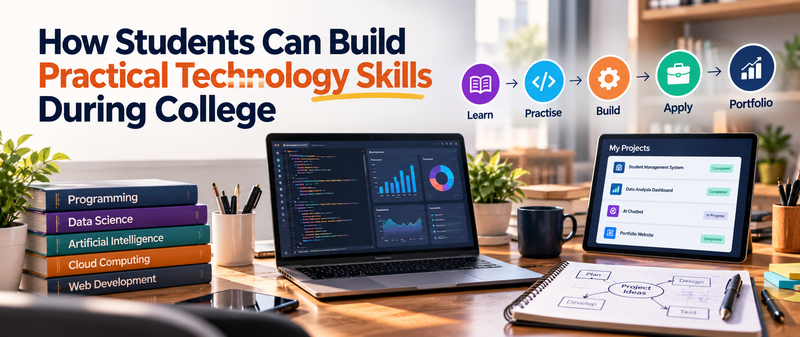
A technology degree can provide students with an academic foundation, but classroom learning is only one part of becoming comfortable with technology. Students can strengthen their understanding by practising concepts, building projects, exploring tools, and working on problems outside regular coursework.
Programming, Artificial Intelligence, Data Science, Cloud Computing, software development, and other technology areas require regular practice. Students who gradually combine academic knowledge with practical work can develop a clearer understanding of the technologies they are studying.
Start With Strong Fundamentals
Before moving into advanced technologies, students should develop a strong understanding of the basics.
Depending on their degree, these fundamentals may include:
- Programming
- Computer science concepts
- Databases
- Data structures
- Networking
- Operating systems
- Web technologies
- Problem-solving
Strong fundamentals make it easier to understand more specialized areas later.
For students who are still deciding which technology path to follow, comparing different technology degree options can help them understand the areas they may want to explore.
Practise Programming Regularly
Programming improves through practice rather than simply reading about programming concepts.
Students can start with small exercises involving variables, functions, loops, conditions, data structures, and basic problem-solving.
Once they become comfortable, they can build simple applications instead of following tutorials only.
For example, a student can create:
- A student management application
- A basic calculator
- A personal portfolio website
- A simple expense tracker
- A quiz application
- A basic data dashboard
Small projects can gradually lead to more complex applications.
Build Projects Around Real Problems
Projects become more valuable when they solve a practical problem.
Instead of building a project only because it is commonly available online, students can identify a problem around them and think about how technology could help.
For example, students could build a system for organizing academic information, analysing data, managing tasks, or visualizing information.
The project does not need to be complicated. Understanding the problem, developing the solution, testing it, and explaining the result are important parts of the learning process.
Explore Your Area of Interest
Students do not need to learn every technology available.
After developing basic technical skills, they can explore areas that match their interests.
A student interested in data can explore Data Science and analytics. Someone interested in intelligent applications can explore AI and Machine Learning. Students interested in infrastructure can explore Cloud Computing, while students interested in automation can explore Robotics.
Exploring different areas can help students identify the technology path that suits their interests.
Work on Academic Projects Seriously
College projects should not be treated only as assignments that need to be submitted.
Students can use academic projects as opportunities to learn how to plan, develop, test, document, and present a technology solution.
A good project can also become part of a student's technical portfolio.
Students working toward AI and Data Science can explore BCA AI and Data Science project ideas, while students interested in AI and Machine Learning can explore B.Sc. CS AI and ML project ideas.
Learn Tools Alongside Concepts
Knowing concepts is important, but students should also become familiar with the tools used to apply those concepts.
For example:
| Area | Tools or Technologies to Explore |
|---|---|
| Programming | Python, Java, JavaScript |
| Data | SQL, spreadsheets, data visualization tools |
| AI and ML | Python libraries and ML frameworks |
| Development | Git, GitHub, code editors |
| Cloud | Cloud platforms and basic deployment tools |
| Web | HTML, CSS, JavaScript |
Students do not need to master everything listed above. The right tools depend on their course and specialization.
Create a Technical Portfolio
A technical portfolio can help students document their progress.
It can include:
- Personal projects
- Academic projects
- GitHub repositories
- Data analysis work
- Websites
- Applications
- AI experiments
- Certifications
- Internship projects
Students can start with one project and gradually add more as their skills improve.
The portfolio should explain what problem was solved, which technologies were used, and what the student learned.
Learn From Mistakes
Technical learning involves making mistakes.
A program may not work as expected. A database query may return incorrect results. A machine learning model may produce poor predictions. A website may have unexpected bugs.
Instead of avoiding these problems, students can use them as learning opportunities.
Debugging and troubleshooting are valuable technical skills because real software development rarely happens without errors.
Explore Internships and Practical Experience
Once students have developed basic skills, they can look for internships, workshops, competitions, technical communities, and project opportunities.
Practical experience can help students understand how technology is applied outside the classroom.
Students can also use internships to identify which areas of technology they enjoy and which skills they need to improve.
Use Structured Learning Resources
Students can combine classroom education with additional learning resources.
The MH Cognition Learning platform provides technology-focused learning options covering areas such as AI, Data Science, Cloud Computing, Robotics and other technology disciplines.
Students can also use documentation, books, online courses, coding platforms, technical communities, and project-based resources.
The important thing is to choose resources that match the student's current level instead of jumping between too many topics.
Prepare for the Future Gradually
Students do not need to become experts in their first year.
A practical approach is to progress step by step:
Year 1: Build computer and programming fundamentals.
Year 2: Explore specialization areas and build small projects.
Year 3: Work on advanced projects, internships, and portfolio development.
Final Stage: Prepare for internships, interviews, higher education, or entry-level opportunities.
The exact timeline can vary depending on the degree, but consistent progress can make the learning process easier.
Final Thoughts
A technology degree can provide the academic foundation, but practical learning helps students understand how technology works in real situations.
Students can build their skills by practising programming, developing projects, exploring specialization areas, learning relevant tools, creating a portfolio, and gaining practical experience.
Instead of trying to learn everything at once, students can focus on one skill at a time and gradually expand their knowledge.
The goal is not simply to collect certifications or learn a long list of technologies. The goal is to understand what you learn, apply it to practical problems, and develop the confidence to keep learning as technology changes.







Top comments (0)