

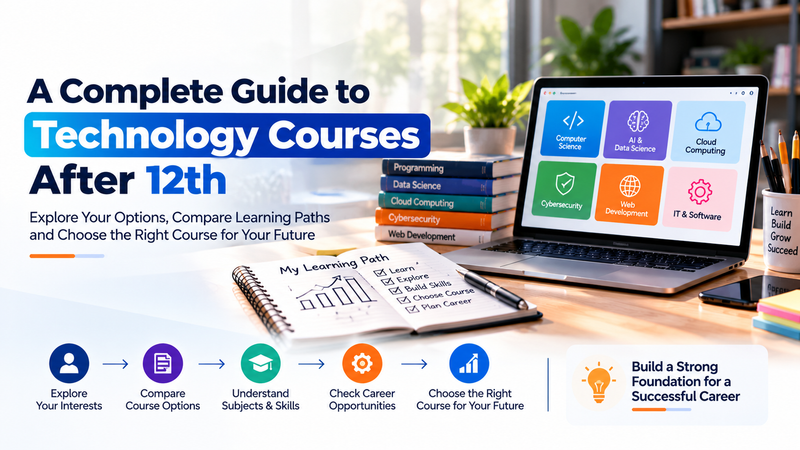
Preparing for a technology career involves more than earning a degree. Students also need practical skills, problem-solving abilities, communication skills, and an understanding of how technology solves real-world problems.
Whether a student is interested in software development, artificial intelligence, data science, cloud computing, or cybersecurity, starting career preparation during college can make the transition from education to employment more manageable.
Students do not need to learn every technology at once. A clear learning plan, consistent practice, and a few meaningful projects can help them build a strong foundation before graduation.
1. Build a Strong Foundation in Computer Science
Students should begin by understanding the fundamentals of their chosen field. These concepts provide the foundation for learning advanced technologies and solving technical problems.
Important areas include:
- Programming fundamentals and logical thinking
- Data structures and algorithms
- Database management and SQL
- Operating systems and computer networks
- Software development principles
- Basic cybersecurity practices
The exact subjects required depend on the student's degree and career interests. Understanding the fundamentals is generally more useful than collecting a long list of tools without knowing how they work.
2. Choose a Technology Specialization
Technology includes many career paths. Exploring a few areas can help students identify the subjects they enjoy and the skills they want to develop.
| Technology Field | Skills to Explore |
|---|---|
| Software Development | Programming, databases, APIs, testing |
| Artificial Intelligence | Python, mathematics, machine learning |
| Data Science | Statistics, SQL, data analysis, visualization |
| Cloud Computing | Networking, cloud platforms, deployment |
| Cybersecurity | Networks, security fundamentals, risk awareness |
| Web Development | HTML, CSS, JavaScript, backend development |
Students can explore these fields through introductory courses, practical exercises, and small projects before choosing a specialization.
Explore technology-focused learning paths:
https://mhcognition.com/learning
3. Learn by Building Practical Projects
Projects help students apply classroom concepts to realistic problems. They also provide evidence of what a student can do independently.
Beginner-friendly project ideas include:
- A personal portfolio website
- A student attendance tracking application
- A simple expense analysis dashboard
- A database-driven library management system
- A basic cloud-hosted application
- A machine learning project using a public dataset
Each project should have a clear purpose. Students should understand the problem, explain their design choices, test their work, and document what they learned.
Completing two or three well-developed projects can be more valuable than starting many projects and leaving them unfinished.
4. Develop a Technical Portfolio
A portfolio helps students demonstrate their skills to internship coordinators, recruiters, and potential employers.
A useful portfolio can include:
- A short introduction and career interests
- Technical skills and tools
- Two or three completed projects
- Links to code repositories where appropriate
- Project descriptions and screenshots
- Internship experience, certifications, or relevant achievements
Students can use GitHub to organize suitable code projects and maintain a record of their progress. They should ensure that their portfolio accurately represents their own contributions and does not disclose confidential information.
5. Gain Experience Through Internships
Internships allow students to see how technical work is performed in professional environments. They may learn how teams manage tasks, review code, test software, document decisions, and communicate with stakeholders.
Students should prepare for internship applications by developing basic technical skills, maintaining a portfolio, and practising explanations of their projects.
When a formal internship is not immediately available, collaborative college projects, hackathons, open-source contributions, and supervised practical assignments can also help students gain experience.
6. Improve Communication and Problem-Solving Skills
Technical knowledge is important, but students also need to explain ideas clearly, ask useful questions, and work with others.
They can practise these abilities by presenting projects, writing technical documentation, participating in group assignments, and explaining how they solved a problem.
During interviews, students should be able to describe what they built, why they selected a particular approach, what challenges they encountered, and how they tested the result.
7. Follow a Simple Career Preparation Plan
Students can organize their learning around a few manageable milestones.
| Stage | Suggested Focus |
|---|---|
| Early College | Learn programming fundamentals and core subjects |
| Middle of the Degree | Explore specializations and build small projects |
| Before Final Year | Develop a portfolio and seek internships |
| Final Year | Practise interviews, complete a substantial project, and apply for relevant opportunities |
This plan is a general guide rather than a fixed rule. Students should adapt it to their curriculum, available time, and chosen career path.
8. Keep Learning as Technology Changes
Technology tools and industry requirements change over time. Students can stay prepared by following reliable technical documentation, experimenting with new tools, reviewing foundational concepts, and improving existing projects.
They should avoid switching learning paths every time a new technology becomes popular. Building strong fundamentals and learning how to evaluate unfamiliar tools can provide more lasting value.
Conclusion
Preparing for a technology career before graduation requires a combination of academic knowledge, practical experience, focused specialization, and continuous improvement.
Students can make steady progress by strengthening their fundamentals, building meaningful projects, creating a technical portfolio, gaining experience, and practising communication skills.
The goal is not to know every technology before graduating. It is to develop the ability to learn, solve problems, and demonstrate practical skills with confidence.
Explore technology learning paths at:
https://mhcognition.com/learning







Top comments (0)