

Human resource teams manage many activities every day, including employee records, attendance, leave, payroll coordination, recruitment and performance management. As organisations grow, managing these activities manually can become difficult.
A Human Resource Management System (HRMS) can bring multiple HR processes together within a centralised digital environment. Different HRMS platforms provide different modules, allowing organisations to select functionality according to their workforce and operational requirements.
Understanding the major HRMS modules can help businesses identify the features they may need when evaluating HR software.
What Are HRMS Modules?
HRMS modules are individual functional areas within a Human Resource Management System. Each module focuses on a specific HR process while working as part of the broader HR platform.
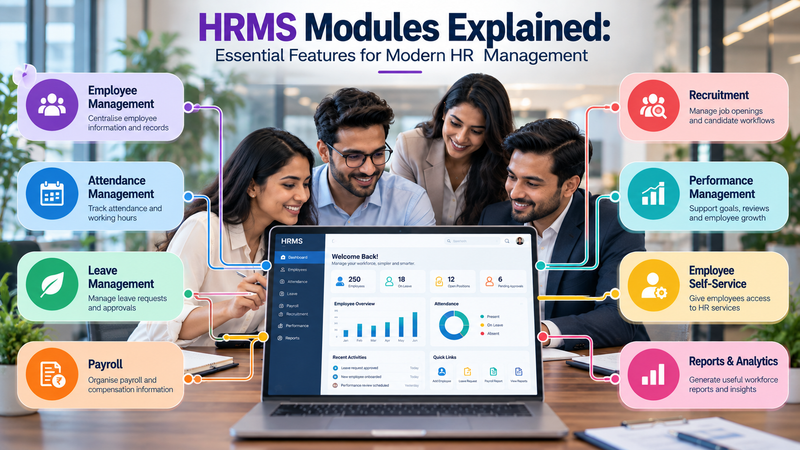
Common HRMS modules can include:
- Employee management
- Attendance management
- Leave management
- Payroll
- Recruitment
- Performance management
- Employee self-service
- Reporting and analytics
The exact modules available can vary between HRMS platforms.
1. Employee Management Module
Employee management is one of the fundamental areas of an HRMS.
This module can help HR teams maintain employee-related information in a centralised system.
Information may include:
- Employee details
- Contact information
- Department
- Job role
- Joining information
- Employment status
- Reporting structure
- Documents
Instead of maintaining employee information across multiple spreadsheets or physical files, organisations can use a centralised digital system.
Learn more about employee management in HRMS:
https://mhcognition.com/blogs/employee-management-system-in-hrms
2. Attendance Management Module
Attendance management helps organisations record and manage employee attendance.
Depending on the HRMS, organisations may be able to manage:
- Check-in and check-out
- Working hours
- Attendance records
- Late arrivals
- Early departures
- Absence records
- Attendance reports
Digital attendance management can make it easier for HR teams and managers to review workforce attendance information.
Read more about employee attendance management:
https://mhcognition.com/blogs/employee-attendance-management-system
3. Leave Management Module
Managing leave requests can involve employees, managers and HR teams.
An HRMS leave management module can provide a structured process for:
- Leave requests
- Leave approvals
- Leave balances
- Leave policies
- Leave history
- Approval workflows
Employees can submit requests while managers can review them according to organisational policies.
4. Payroll Module
Payroll involves calculating and managing employee compensation and related records.
An HRMS may connect employee information, attendance, leave and payroll-related processes within one platform.
Depending on the system, payroll functionality may include:
- Employee salary information
- Payroll processing
- Attendance inputs
- Leave inputs
- Payroll records
- Reports
Organisations should review the exact payroll capabilities of a platform before implementation.
5. Recruitment Module
Recruitment is another area that can be supported through HR technology.
A recruitment module may help organisations manage activities such as:
- Job openings
- Candidate information
- Applications
- Interview stages
- Candidate tracking
- Recruitment records
Centralising recruitment information can help HR teams organise candidate-related activities more efficiently.
6. Performance Management Module
Performance management helps organisations structure employee performance processes.
Depending on the HRMS, this module may support:
- Performance goals
- Reviews
- Feedback
- Evaluations
- Performance records
- Development discussions
A structured performance process can help managers and employees maintain clearer records of performance-related activities.
7. Employee Self-Service Module
Employee self-service allows employees to access or manage certain HR activities directly.
For example, employees may be able to:
- View personal information
- Submit leave requests
- Check attendance
- Access documents
- Update selected details
- Review HR-related information
Self-service functionality can reduce the need for employees to contact HR teams for routine requests.
8. Reporting and Analytics Module
HR teams often need reports to understand workforce information.
An HRMS can provide reporting capabilities for areas such as:
- Employee records
- Attendance
- Leave
- Recruitment
- Performance
- Workforce trends
The available reports depend on the HRMS platform and its configuration.
9. HR Workflow and Approval Management
Many HR processes require approvals.
For example, a leave request may need approval from a manager before HR records it.
Workflow functionality can help organisations define approval processes for different HR activities.
Common workflows can include:
- Leave approvals
- Attendance corrections
- Employee requests
- Recruitment approvals
- HR administration
Automated workflows can help create a consistent process for routine HR activities.
10. Document and Record Management
HR departments manage many documents and records throughout an employee's lifecycle.
An HRMS may provide functionality for organising employee-related documents and records digitally.
This can help HR teams locate information more easily and reduce dependence on physical paperwork.
Organisations should review the available storage, access controls and document management features before selecting a platform.
Why HRMS Modules Matter for Businesses
Different organisations have different HR requirements.
A small organisation may initially need employee management, attendance and leave management, while a larger organisation may require additional capabilities such as recruitment, performance management, payroll and analytics.
Choosing modules according to actual business requirements can help organisations avoid unnecessary complexity.
Businesses can learn more about the broader advantages of HRMS software here:
https://mhcognition.com/blogs/benefits-of-hrms-software
How to Choose the Right HRMS Modules
Before selecting HR software, organisations can evaluate their current HR processes and identify areas that need improvement.
Consider the following questions:
What HR processes need digital management?
Identify the processes currently handled through spreadsheets, email or manual paperwork.
How many employees will use the system?
User numbers can influence platform requirements and scalability considerations.
Which modules are essential?
Separate essential HR processes from features that may be useful later.
Does the system support integrations?
Organisations may need their HRMS to work with payroll, attendance devices, finance systems or other business applications.
What reporting capabilities are required?
HR teams should identify the reports and workforce information they need regularly.
How will employees use the platform?
Consider whether employees need self-service access for attendance, leave, documents or other HR activities.
MH Cognition and HR Management Solutions
MH Cognition provides technology solutions for organisations looking to adopt digital approaches across different business functions.
Its MH Connekt HR management solution can help organisations explore digital HR processes and workforce management capabilities.
Businesses interested in learning more can visit:
https://mhcognition.com/connekt
HRMS Modules Checklist
Before evaluating an HRMS, organisations can use this checklist:
- [ ] Employee management
- [ ] Attendance management
- [ ] Leave management
- [ ] Payroll functionality
- [ ] Recruitment management
- [ ] Performance management
- [ ] Employee self-service
- [ ] Reporting and analytics
- [ ] Workflow management
- [ ] Document management
- [ ] User permissions
- [ ] Integration capabilities
Conclusion
HRMS modules help organisations manage different areas of human resource operations through a centralised digital platform.
From employee records and attendance to leave, recruitment, performance management and reporting, each module can support a specific part of the employee management process.
Businesses should identify their requirements, compare available features and select an HRMS that fits their workforce and operational needs.
Organisations exploring digital HR management can also learn more about MH Cognition's MH Connekt:






Top comments (0)