

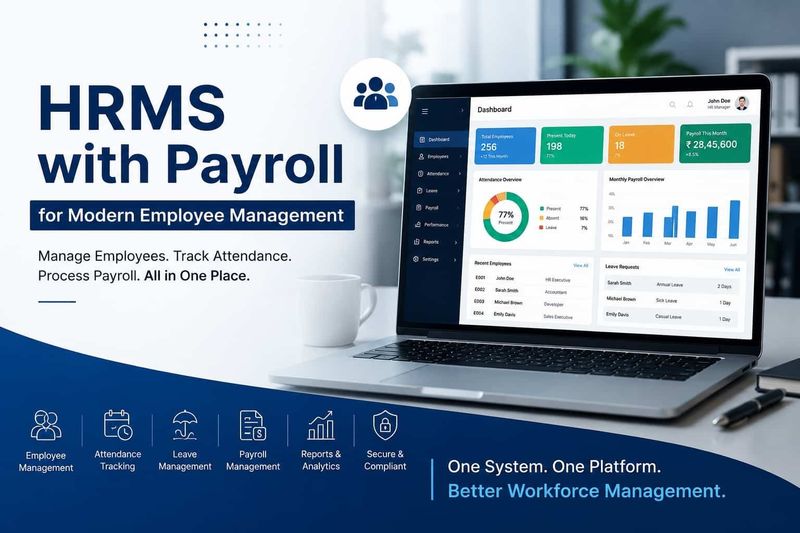
Managing employees involves several interconnected processes. Organizations need to maintain employee records, track attendance, manage leave, calculate salaries, and maintain accurate payroll information.
When these activities are handled through separate spreadsheets or disconnected systems, HR teams may spend significant time transferring and verifying information.
An HRMS with payroll can bring employee management and payroll-related processes together within a centralized digital environment. This can help organizations create more structured workflows and improve access to workforce information.
What Is an HRMS with Payroll?
An HRMS with payroll combines human resource management functionality with payroll-related capabilities.
An organization may use the system to manage employee information while also handling processes connected to salary administration.
Depending on the platform, an HRMS can include:
- Employee management
- Attendance management
- Leave management
- Payroll
- Employee records
- Performance management
- HR reports
- Employee self-service
Businesses that want to understand the fundamentals of HRMS can explore:
https://mhcognition.com/blogs/what-is-hrms-software
Understanding the basic functions of an HRMS can help organizations identify which modules they need.
Why Integrate HR and Payroll?
HR information and payroll information are closely connected.
Employee details, attendance, leave, and other workforce information can influence payroll-related processes. When these activities are maintained separately, HR teams may need to repeatedly transfer information between systems.
An integrated HRMS with payroll can help centralize relevant employee information and create a more connected workflow.
The goal is to reduce unnecessary duplication and make HR administration more organized.
Employee Information Management
Employee records form the foundation of many HR processes.
Organizations may need to maintain information such as employee profiles, job details, department information, joining dates, and other relevant workforce records.
A centralized HRMS can provide a structured environment for managing this information.
When employee information is maintained consistently, HR teams can potentially access the data they need more efficiently.
Organizations interested in employee management can learn more here:
https://mhcognition.com/blogs/employee-management-system-in-hrms
Attendance and Payroll
Attendance can be an important part of payroll administration.
Organizations may need to consider working days, attendance records, approved leave, and other applicable information when processing employee salaries.
An HRMS that connects attendance and payroll can reduce the need for HR teams to manually move information between separate systems.
Businesses exploring attendance-focused HR software can also read:
https://mhcognition.com/blogs/hr-software-with-attendance
The exact payroll rules and calculations depend on organizational policies and applicable requirements, so businesses should configure their systems accordingly.
Leave Management and Payroll
Employee leave is another HR process that can interact with payroll.
Organizations need to maintain accurate records of leave requests, approvals, and applicable leave balances.
When leave information is managed within the same HR environment, HR teams can have better visibility into employee records and related payroll processes.
A centralized system can also make it easier for employees to submit and track their leave requests according to company policies.
Payroll Management
Payroll involves more than simply calculating a monthly salary.
Organizations may need to manage employee salary information, attendance-related data, deductions, allowances, and other payroll components.
An HRMS with payroll can help organize these processes within a centralized system.
Businesses should carefully evaluate the payroll functionality of any platform and ensure that it supports their specific salary structures and operational requirements.
For organizations exploring HR and payroll software, this resource can provide additional information:
https://mhcognition.com/blogs/hr-and-payroll-software
Reducing Manual HR Administration
Manual HR administration can involve repetitive data entry and record maintenance.
For example, HR teams may have to update employee information in one spreadsheet, attendance information in another system, and payroll details somewhere else.
A centralized HRMS can help reduce this fragmentation by bringing related workforce processes into one environment.
This can allow HR professionals to spend less time managing repetitive administrative work and more time focusing on employee support and organizational priorities.
Improving HR Data Visibility
A centralized HR system can provide organizations with better visibility into workforce information.
HR teams can potentially access employee records, attendance information, leave details, payroll-related data, and reports from a connected platform.
Better visibility can support more informed HR administration and make it easier to identify missing or inconsistent information.
Reporting capabilities can also help organizations understand workforce trends and HR activities.
HRMS Features Businesses Should Consider
Organizations evaluating an HRMS with payroll should consider the features that are most relevant to their operations.
Important capabilities may include:
- Employee management
- Payroll management
- Attendance tracking
- Leave management
- Employee self-service
- Performance management
- Reporting
- Data management
- User access controls
- Integration capabilities
A detailed overview of HRMS functionality can be found here:
https://mhcognition.com/blogs/hrms-system-features
Businesses should prioritize practical requirements rather than selecting a system simply because it offers a large number of features.
Cloud-Based HRMS and Payroll
Cloud-based HRMS platforms can provide organizations with access to HR systems through internet-connected devices.
This can be useful for businesses with multiple locations, distributed teams, or hybrid work environments.
A cloud-based approach can also support centralized management of employee information while providing controlled access to authorized users.
Organizations exploring cloud-based HRMS can learn more here:
https://mhcognition.com/blogs/cloud-based-hrms-software
HRMS for Growing Businesses
As businesses grow, their HR processes often become more complex.
A small organization may initially manage employees using spreadsheets and basic payroll tools. As employee numbers increase, maintaining accurate information across multiple files can become more difficult.
An HRMS with payroll can provide a more structured foundation for managing workforce information.
Businesses should select a system that can accommodate their current requirements while providing room for future growth.
Organizations specifically researching HR software for smaller businesses can explore:
https://mhcognition.com/blogs/hrm-software-for-small-business
HRMS for Education Organizations
Educational institutions may manage teaching staff, administrative employees, support teams, and other workforce groups.
Managing employee records, attendance, leave, and payroll across these groups can require organized HR processes.
An HRMS can provide institutions with a centralized environment for managing workforce information.
More information about HRMS applications in education can be found here:
https://mhcognition.com/blogs/hrms-software-for-education-sector
Choosing the Right HRMS with Payroll
Before selecting an HRMS, businesses should identify the HR processes they want to improve.
Key considerations can include:
- Employee size
- Payroll requirements
- Attendance processes
- Leave policies
- Reporting requirements
- Performance management
- Security
- Scalability
- Integration requirements
- Employee usability
Organizations should also consider implementation, employee training, technical support, and long-term system requirements.
Benefits of a Connected HR System
An integrated HRMS can potentially provide several operational benefits.
These may include:
- Centralized employee information
- Reduced duplicate data entry
- More organized HR workflows
- Easier access to workforce information
- Better coordination between HR processes
- Improved reporting
- Scalable employee administration
Businesses interested in understanding the broader benefits of HRMS software can explore:
https://mhcognition.com/blogs/benefits-of-hrms-software
Conclusion
An HRMS with payroll can help businesses connect employee management and salary administration within a centralized digital environment.
By bringing employee records, attendance, leave, payroll, reporting, and other HR activities together, organizations can create more structured workforce management processes.
However, businesses should evaluate HRMS platforms based on their actual requirements. Payroll functionality, employee management, attendance integration, security, reporting, scalability, and ease of use should all be considered before implementation.
As organizations continue to digitize their HR operations, an integrated HRMS with payroll can provide a foundation for more organized and efficient workforce administration.




Top comments (0)