

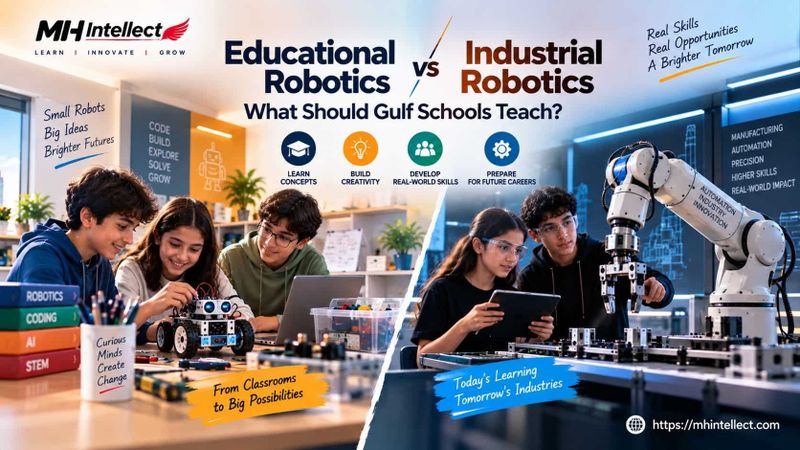
Imagine a Gulf school preparing to expand its robotics programme. The leadership team has access to modern robotics equipment, but one question remains: should students learn with educational robots or be introduced to industrial robotics? The answer begins with understanding that these two areas serve different purposes. Educational robotics vs. industrial robotics is not simply a comparison between two types of machines. It is about choosing the right learning experience for each stage of a student's development. Educational robotics focuses on learning, experimentation, and skill development, while industrial robotics focuses on automation, precision, and production.
What Is Educational Robotics?
Educational robotics uses programmable robots and platforms as learning tools. Students can programme a robot to detect obstacles, respond to sensors, or complete a defined challenge. During these activities, they are not simply learning how to operate a robot; they are practising programming logic, engineering, computational thinking and iterative problem-solving.
A structured robotics programme can help students develop:
- Coding and programming logic
- Electronics and sensor integration
- Mechanical design and engineering thinking
- Computational thinking
- Team-based problem-solving
- Design, testing and improvement skills
The complexity can increase as students progress. Younger learners might programme a robot to follow a path, while older students can develop autonomous systems using multiple sensors. The key principle is that the robot is a tool for learning, not the lesson itself.
Schools can also explore How Robotics Education Improves Student Learning Outcomes to understand how structured robotics activities can contribute to student development.
What Is Industrial Robotics?
Industrial robotics is designed for automation and production. Industrial robots are used in manufacturing, logistics, engineering, and other environments where precision, repeatability, speed, and productivity are important.
These systems can perform tasks such as assembly, welding, packaging, material handling and inspection. Unlike educational robots, industrial systems are designed primarily around production requirements rather than classroom learning.
This distinction is particularly important for school leaders. Educational robotics prioritises student development, while industrial robotics prioritises automated performance. Both have value, but they should be introduced at appropriate stages of a student's educational journey.
Educational Robotics vs Industrial Robotics in Schools
For Robotics education for schools, educational robotics provides the foundation for developing coding, engineering, and problem-solving skills. Industrial robotics concepts can then be introduced progressively when students have developed sufficient technical knowledge.
Primary students can begin with basic programming and movement challenges. Middle school students can progress into sensors, autonomous navigation and engineering design. Secondary students can explore Python, artificial intelligence, computer vision, robot arms and automation concepts.
This progression allows students to develop genuine capability instead of simply repeating similar robotics activities across different year groups.
Building Robotics Programs for Schools
Schools planning Robotics programs for schools should focus on the learning pathway rather than simply selecting equipment. A successful programme should answer an important question at every stage: What should students be able to understand or create after completing this activity?
At primary level, students can explore sequencing, basic coding and cause-and-effect relationships. Middle school programmes can introduce motor and sensor integration, text-based programming and engineering challenges. At secondary level, robotics can become more specialised through AI, Python, automation and computer vision.
This approach also helps schools avoid a common challenge: students following pre-built instructions without understanding the concepts behind the activity. Schools can explore Copy-Paste Robotics vs Concept-Based Robotics for more insight into why teaching methodology matters alongside robotics equipment.
When Should Schools Introduce Industrial Robotics?
Industrial robotics concepts can become more relevant at advanced secondary levels, once students have developed foundations in programming, engineering, and robotics systems. Students can then explore robot arms, end effectors, pick-and-place systems, production-line automation, machine vision, and human-robot collaboration.
The objective is not to recreate a factory inside a school. Instead, students can learn how robotics is applied to real engineering and automation challenges and understand the relationship between classroom learning and technical career pathways.
Why Robotics Education Matters in the Gulf
Robotics education is becoming increasingly relevant across Gulf education systems as schools focus on practical STEM learning, technology skills and future-focused education. For school leaders, the challenge is creating programmes that go beyond robotics clubs or isolated workshops.
Effective robotics education requires curriculum structure, teacher readiness, practical learning, assessment and appropriate industry relevance at advanced levels. Hardware alone cannot create a strong robotics programme.
Schools can view the Student's Gallery to see examples of practical student projects and robotics learning experiences.
How MH Intellect Supports Robotics Education
MH Intellect works with schools across the Gulf and India to develop structured robotics and STEM programmes based on student age groups, curriculum objectives, teacher capabilities and long-term learning goals. Support can include robotics curriculum design, teacher training, STEM lab development, student innovation programmes and ongoing implementation.
The focus is not simply on supplying robotics equipment. It is on helping schools develop a progressive learning pathway where students can build skills from foundational robotics through advanced applications.
Building a Progressive Robotics Learning Pathway
The distinction between Educational robotics vs industrial robotics becomes clearer when schools consider the student's learning journey. Educational robotics can establish the foundations, while advanced secondary learning can introduce industrial automation, robot arms, AI, and machine vision.
For Gulf schools, the most important consideration is creating continuity between year groups so that each stage builds on the previous one. A structured approach can help students move from learning with robots to understanding how robotics is applied in real-world engineering environments.
Ready to build a structured robotics learning pathway for your school? Book a free consultation with MH Intellect to discuss your school's robotics curriculum, student needs, and long-term STEM education goals.






Top comments (0)