

Drone technology is becoming an important part of modern education, connecting aviation, robotics, coding, engineering and artificial intelligence. Across the UAE, schools are exploring drone-based STEM activities to help students understand how autonomous systems work and how technology can solve real-world problems. However, introducing drones into education involves more than selecting equipment and planning flight activities. Schools must also understand safety, responsible use and the regulatory environment.
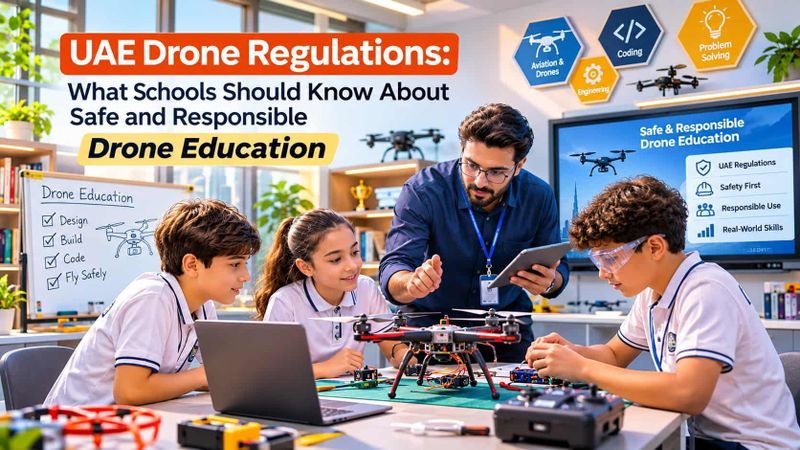
Understanding UAE drone regulations is an important starting point for schools planning to introduce drone education. By combining practical learning with regulatory awareness, educators can help students develop technical skills while understanding the responsibilities associated with operating unmanned aerial vehicles (UAVs).
Why Drone Regulations Matter in School Education
Drones can be used for learning activities involving flight control, navigation, coding, sensors and autonomous movement. However, their operation must be approached responsibly, particularly when activities involve outdoor flying, cameras or real-world applications.
Schools should introduce students to the importance of following GCAA drone regulations and understanding the rules governing drone operations in the UAE. Learning about aviation safety and responsible technology use helps students recognise that innovation must operate within established safety frameworks.
Educators should also explain why UAE drone laws matter when planning practical activities. This includes respecting restricted airspace, protecting privacy and following appropriate supervision procedures. Schools should consult the relevant authorities for current requirements before organising drone operations.
Understanding No-Fly Zones and Safe Drone Operations
One important aspect of responsible drone education is understanding where drones can and cannot operate. Students should learn that airspace restrictions exist to protect people, property, aircraft and sensitive locations.
Understanding drone no-fly zones UAE helps introduce the relationship between flight planning and safety. Before any outdoor activity, schools should verify the applicable restrictions and permissions through official channels rather than assuming that a location is suitable for flying.
For classroom learning, indoor training environments, flight simulations and controlled coding missions can provide practical experiences without requiring unrestricted outdoor operations. These activities allow students to explore navigation, movement, programming and mission planning in a supervised setting.
Building Drone Labs for Schools in the UAE
A structured drone lab can turn theoretical concepts into practical STEM experiences. Students can explore aerodynamics, distance, speed, direction, programming logic and engineering design through guided challenges.
However, a successful programme requires more than drones. Schools need age-appropriate activities, clearly defined learning outcomes, suitable equipment, trained teachers and a controlled learning environment.
A progressive approach can introduce younger learners to basic flight concepts and safety awareness before moving towards block-based coding, obstacle navigation, sensor-based activities and autonomous missions. Schools planning this type of learning environment can explore drone labs for schools in the UAE for further guidance on infrastructure, equipment, teacher readiness and programme implementation.
Connecting Drone Education with AI and Emerging Technologies
Modern drone systems increasingly connect with artificial intelligence, sensors, automation and autonomous navigation. These technologies create opportunities for students to understand how machines collect information, interpret instructions and respond to changing conditions.
For example, students can simulate a delivery route, identify obstacles and develop a programmed flight plan. More advanced activities can introduce sensor-based decision-making and AI-connected concepts.
Exploring drone technology and AI in UAE schools can help educators understand how these applications connect drone learning with robotics, coding and future-focused STEM education.
Preparing Students for Responsible Innovation
Drone education should develop more than technical confidence. It should encourage critical thinking, problem-solving, teamwork, communication and responsible technology behaviour.
Schools can strengthen these outcomes by combining curriculum-aligned projects with safety instruction, teacher training and practical assessment. Students should be encouraged to plan missions, test their ideas, identify mistakes and explain their decisions.
Conclusion
Drone education offers UAE schools an opportunity to connect aviation, engineering, coding and AI through meaningful practical learning. However, its success depends on balancing innovation with safety and regulatory awareness. By understanding applicable drone regulations, establishing controlled learning environments and introducing progressive STEM activities, schools can help students explore emerging technologies responsibly.







Top comments (0)