

Electronic circuits are part of almost every modern technology we use, from smartphones and computers to household appliances and robotics. But have you ever wondered what happens when you press a switch and a device starts working? Understanding how electronic circuits work begins with exploring how electrical energy moves through connected components to perform a specific function.
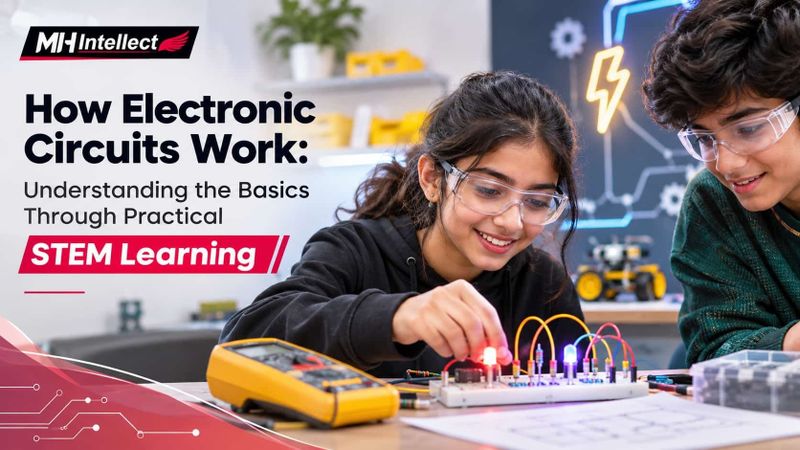
Learning about circuits introduces students to the relationship between electricity, electronic components, and practical engineering. It also creates a foundation for understanding robotics, automation and other technology-driven applications.
What Is an Electronic Circuit?
What is an electronic circuit? An electronic circuit is a connected arrangement of electrical and electronic components that allows current to flow through a pathway and perform a particular task.
A basic circuit usually includes a power source, connecting wires, and a component that uses electrical energy, such as a light-emitting diode (LED). For the circuit to operate continuously, it generally needs a complete, closed path.
When a switch is closed, the pathway is completed and current can flow. When the switch is opened, the pathway is interrupted, and the circuit stops operating. This simple principle helps students understand how everyday electrical devices function.
Electronic Circuit Basics: Understanding the Flow of Electricity
Learning electronic circuit basics involves understanding three important concepts: voltage, current, and resistance.
Voltage provides the electrical potential difference that drives current through a circuit. Current refers to the flow of electric charge, while resistance describes how a component opposes that flow.
These concepts work together to determine how a circuit behaves. For example, when students build a simple LED circuit, they can observe how the power source supplies energy, how the connecting wires provide a path, and how a resistor helps limit current through the LED.
Understanding these relationships gives learners a practical foundation for exploring more complex electronic systems.
Electronic Components Explained: What Does Each Part Do?
Understanding the function of individual components is an important part of learning electronics. Different components perform specific roles within a circuit, and their connections determine how the complete system operates.
Some common components include:
- Battery or power supply: Provides the electrical energy required to operate the circuit.
- Resistor: Controls the flow of current and helps protect sensitive components.
- LED: Produces light when current flows through it in the correct direction.
- Switch: Opens or closes the circuit to control the flow of current.
- Connecting wires: Provide the conductive paths between different components.
- Breadboard: Allows students to assemble and test simple circuits without permanent soldering.
When students explore electronic components explained through practical activities, they begin to understand how individual parts work together to produce a useful output.
Why Hands-On Circuit Building Matters in STEM Education
Reading about electrical circuits provides theoretical knowledge, but building one allows students to observe how the concepts work in practice.
For example, students can connect a battery, resistor, and LED using a breadboard to create a simple lighting circuit. They can then open the switch, change connections, or investigate why an LED does not illuminate. These activities encourage observation, logical reasoning and systematic problem-solving.
Circuit-building activities also introduce students to the engineering design process. They learn to assemble, test, identify errors, and improve their designs rather than simply follow instructions to produce a finished result.
Schools can explore practical learning opportunities through structured STEM education programmes, where electronics and engineering concepts can be connected with broader classroom learning.
Connecting Electronics Learning with Future Technology
Electronic circuits provide the foundation for understanding more advanced technologies, including robotics, sensors, microcontrollers, and automation systems. As students progress, they can explore how circuits interact with programming and respond to inputs from the surrounding environment.
This kind of practical learning supports the UAE's focus on innovation, technology, and future-ready education under UAE Vision 2031.
A structured learning approach, supported by an experienced STEM Implementation Partner, can help schools connect foundational electronics with progressive robotics and technology education.
Building Practical Electronics Knowledge Through STEM
Understanding electronic circuits is not limited to learning how wires and components connect. It helps students develop the confidence to investigate how technology works, identify problems, and create practical solutions. Through its educational programmes, MH Intellect supports schools in developing hands-on STEM learning experiences that connect theoretical concepts with practical applications. Schools can also explore the Students Gallery to see examples of student learning and project activities.
By introducing electronics through structured, practical experiences, schools can help students build the foundational knowledge needed to explore engineering, robotics, and future technologies.





Top comments (0)