

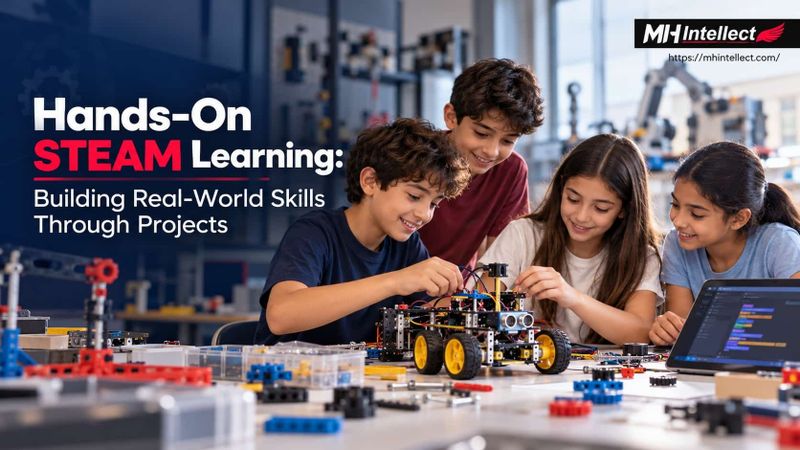
How can schools help students turn classroom knowledge into practical skills? The answer lies in learning experiences that encourage learners to investigate, experiment, create and solve real-world problems. Hands-on STEAM learning combines science, technology, engineering, arts, and mathematics through meaningful projects instead of relying solely on textbook explanations. By connecting theory with practical application, schools can nurture curiosity, creativity, and critical thinking while preparing students to approach unfamiliar challenges with confidence.
Why Hands-On Learning Matters in Modern Education
Textbooks provide essential knowledge, but students also need opportunities to apply what they learn. Understanding an engineering principle becomes more meaningful when learners use it to construct a working model, test its performance, and explain why their design succeeds or fails. These experiences encourage students to ask questions, analyse evidence and improve their ideas through experimentation.
For educators, STEAM education in the Gulf offers an opportunity to connect academic objectives with practical learning across different subjects and grade levels. Schools can develop learning environments where students investigate authentic problems, collaborate with classmates and present solutions. This approach supports deeper understanding while developing communication, teamwork, and independent problem-solving skills that students can apply beyond the classroom.
How Project-Based Learning Develops Essential Skills
Project-based learning in schools gives students a clear challenge to investigate over a structured period. Instead of simply following instructions to produce a predetermined result, learners explore possible solutions, make decisions, test ideas, and reflect on their progress.
For example, students might design a model bridge that can support a specific load. They must consider materials, measurements, structural stability, and design limitations before testing their creation. If the bridge fails, they can investigate the reasons and make improvements. The activity connects mathematics and science with engineering while encouraging perseverance and evidence-based reasoning.
Well-planned STEAM education for schools should therefore include activities that align with curriculum objectives and provide opportunities for students to explain their thinking. Assessment can consider the reasoning behind a solution, collaboration during the project and improvements made throughout the process, rather than focusing exclusively on the final result.
The Role of Robotics in Practical STEAM Education
Robotics provides an engaging way to connect multiple STEAM disciplines through one learning experience. When students build and programme robots, they apply logical thinking, mathematics, engineering design and computational concepts. They also learn that successful outcomes often require repeated testing, debugging and refinement.
Effective robotics education for schools should focus on understanding how systems work rather than simply assembling components by following instructions. Students benefit when they can explain their code, predict how sensors will respond and modify their designs to overcome challenges.
Teachers can explore the difference between Educational Robotics vs Industrial Robotics to understand how classroom robotics differs from automation systems designed for industrial production. Similarly, understanding Copy-Paste Robotics vs Concept-Based Robotics highlights why developing conceptual understanding is important for meaningful student learning.
What Schools Need for Successful STEAM Implementation
Practical learning becomes more effective when it is supported by a structured curriculum, appropriate resources and confident teachers. Schools should select projects according to student age, subject objectives and available learning time. Activities should become progressively more challenging as students develop their knowledge and independence.
The following elements can strengthen STEAM implementation:
- Curriculum alignment: Connect every project with clear science, mathematics, engineering or technology learning objectives.
- Progressive learning pathways: Build skills from foundational exploration to increasingly complex design and problem-solving challenges.
- Teacher training: Help educators facilitate inquiry, guide experimentation and assess practical understanding.
- Meaningful assessment: Evaluate student reasoning, collaboration, creativity and the ability to improve solutions.
- Long-term planning: Review learning outcomes regularly and adapt activities as student needs evolve.
These elements help schools establish sustainable programmes instead of treating STEAM as an occasional classroom activity.
How MH Intellect Supports Practical Learning
MH Intellect works with schools to integrate STEAM, robotics, coding and technology-based activities into structured educational programmes. Through curriculum planning, teacher development and practical implementation, schools can connect classroom concepts with meaningful projects across different year groups.
Schools can also explore the Student's Gallery to see examples of hands-on learning activities and student projects. These examples illustrate how practical experiences can encourage learners to experiment, collaborate and communicate their ideas.
Prepare Students for Real-World Challenges
Hands-on STEAM learning helps students develop the confidence to investigate problems, test ideas and apply their knowledge beyond textbooks. With curriculum-aligned projects, appropriate teacher support and progressive learning experiences, schools can create stronger connections between academic understanding and practical capability.
Ready to strengthen practical learning at your school? Book a free consultation with MH Intellect to explore structured STEAM and robotics education programmes that support your curriculum goals and help students develop future-ready skills.






Top comments (0)