

From smart home appliances and fitness bands to agricultural monitoring systems, connected devices are becoming part of everyday life. These technologies collect information, process data, and communicate with other systems to perform useful tasks. Understanding IoT hardware and software helps students explore how connected technology works and how it is applied in real-world environments.
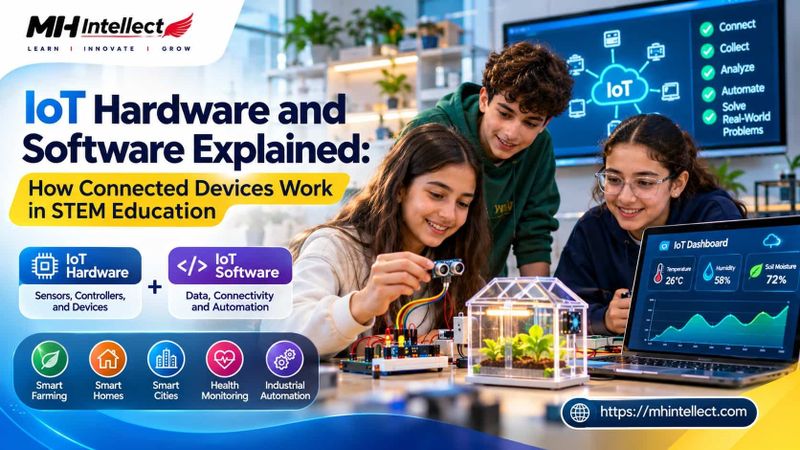
For schools developing STEM and technology programmes, learning about the Internet of Things (IoT) provides practical opportunities to connect electronics, programming, sensors, and data processing through hands-on activities.
Understanding the Main Components of an IoT Device
An IoT device is a physical object equipped with electronic components, software, and network connectivity. It collects information from its surroundings and exchanges data with other devices or platforms. Depending on its purpose, it can also respond to commands or perform automated actions.
To understand how IoT devices work, it is useful to explore the components that enable them to operate together.
The main components include:
- Sensors: Detect physical conditions such as temperature, humidity, light, motion, and pressure.
- Microcontrollers: Process sensor readings and control the device's operations.
- Connectivity modules: Transfer information through Wi-Fi, Bluetooth, Zigbee, LoRaWAN or cellular networks.
- Actuators: Perform physical actions, such as switching on lights, operating motors, or opening water valves.
- Power systems: Supply and regulate the energy required for device operation.
These components work together to help connected devices interact with the physical world.
The Role of IoT Hardware and Software
IoT hardware refers to the physical components that collect information, process signals, and perform actions. IoT software provides the instructions that control these components and manage communication between connected systems.
Hardware includes sensors, microcontrollers, circuit boards, batteries, and connectivity modules. Software includes firmware, embedded operating systems, communication protocols, cloud applications, and user interfaces.
For example, a smart irrigation system uses soil moisture sensors to measure water levels. A microcontroller processes the readings, while software determines whether irrigation is required. The system can then activate a water valve through an actuator.
This demonstrates how hardware and software work together to create an automated solution.
How IoT Sensors Collect and Process Information
IoT sensors are essential because they allow connected devices to detect changes in their surroundings. Temperature sensors monitor environmental conditions, motion sensors detect movement, and soil moisture sensors help monitor agricultural environments.
Students can explore these concepts through classroom activities, basic programming, and data collection. For example, they can build a simple environmental monitoring project that measures temperature and displays the readings on a connected dashboard.
Such activities help students understand the relationship between physical inputs, programming instructions, and digital outputs.
Understanding IoT Architecture
IoT architecture explains how different components communicate and operate within a connected system. It has four main layers: the perception layer, network layer, processing layer, and application layer.
The perception layer collects information through sensors and hardware. The network layer transfers data between devices and platforms. The processing layer stores and analyses information, while the application layer presents results through dashboards, alerts and mobile applications.
Understanding this structure helps students see how individual components contribute to larger systems used in smart agriculture, healthcare, smart cities and industrial automation.
Bringing IoT Education into Gulf Schools
IoT education can introduce students to practical technology applications while developing computational thinking, engineering knowledge, and problem-solving skills. Schools can connect these concepts through projects involving environmental monitoring, smart irrigation, automation and sustainability.
Through structured IoT Education for Schools, students can progress from understanding individual components to designing and testing connected systems.
MH Intellect supports schools across the Gulf and India through structured STEM and IoT education programmes, curriculum-focused learning activities, teacher support and practical technology integration.
Schools can explore the Students Gallery to see examples of student participation in hands-on STEM and technology-based learning activities.
Building Future-Ready IoT Learning Experiences
Understanding IoT hardware and software gives students a foundation for exploring connected technologies that influence everyday life. By learning how sensors, microcontrollers, programming and connectivity work together, students can develop practical knowledge and engineering skills.
MH Intellect helps schools build structured STEM learning pathways that connect classroom concepts with real-world technology applications.
Contact MH Intellect to discuss how your school can introduce or strengthen its IoT and STEM education programmes.





Top comments (0)