

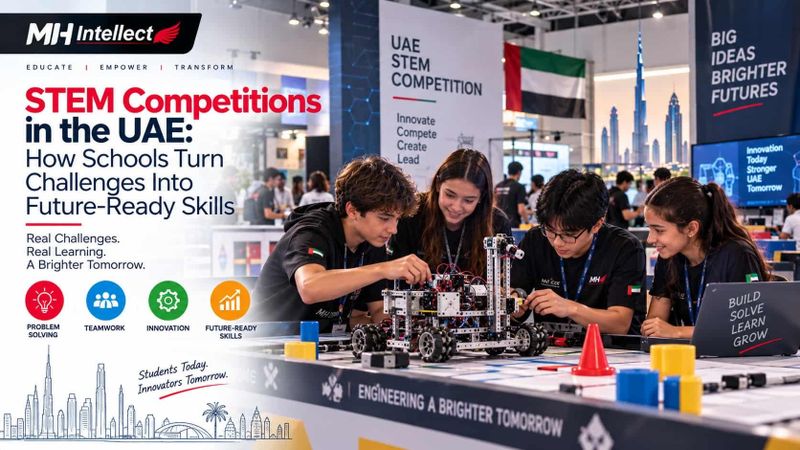
Picture a robotics team standing beside its competition table. The robot worked perfectly during practice, but moments before the challenge begins, a sensor behaves differently, and the team has only minutes to respond. Students cannot simply look for the “right answer.” They must diagnose the problem, communicate, test an idea, make a decision, and try again. This is what makes STEM competitions in UAE valuable for schools: they turn STEM knowledge into an experience where students must apply what they know under real conditions.
Why STEM Competitions Matter to Schools
Classroom learning provides students with important concepts and foundations, but competitions introduce another layer of learning: application. Students may understand sensors, programming, engineering design, or scientific investigation during lessons, yet competitions challenge them to use those skills when something unexpected happens.
For school leaders, this creates an opportunity to connect STEM education with practical outcomes. Competitions can encourage students to develop technical abilities alongside communication, teamwork, resilience, analytical thinking, and structured problem-solving. These capabilities are difficult to develop through theory alone because students need opportunities to make decisions, experience failure, and improve their solutions.
The UAE competition landscape also gives schools multiple pathways. Students can explore robotics, scientific research, mathematics, coding, and emerging AI disciplines depending on their interests, age, and technical experience.
Choosing the Right Competition for Students
Not every competition suits every learner. A younger student may benefit from an introductory robotics experience, while an experienced secondary student may be ready for autonomous robotics, scientific research, or AI-focused challenges.
STEM competitions for kids UAE can introduce younger learners to teamwork, design, curiosity, and practical problem-solving. More advanced opportunities can challenge students to develop autonomous systems, conduct scientific investigations, or apply computational thinking. Schools and parents should consider age, interests, technical experience, preparation requirements, and the learning outcomes associated with each event.
What Students Actually Learn Through Competition
The strongest value of STEM competitions is often found beyond the competition result. A student who encounters a technical failure must investigate rather than guess. A team facing a time constraint must prioritise tasks. Students must explain technical decisions to teammates and judges while learning to remain productive when their first solution does not work.
Through UAE competitions for students, learners can develop skills such as autonomous robotics programming, mechanical design, sensor integration, scientific research, computational thinking, data analysis, communication, and iterative problem-solving.
These experiences also demonstrate why STEM competition should not be viewed simply as an extracurricular activity. When properly integrated into education, competition becomes an applied learning environment where students practise the same habits used in engineering, research, technology development, and innovation.
From FIRST LEGO League to Scientific Research
Different competitions provide different learning experiences. FIRST LEGO League, for example, combines robotics, programming, research, teamwork, and presentation. Students work on defined challenges while developing and programming robots to complete missions. The experience also places importance on collaboration and reflection rather than technical performance alone.
Other UAE competitions focus on autonomous robotics, scientific research, multidisciplinary STEM challenges, coding, or AI. This diversity allows schools to create pathways that accommodate different student interests and strengths. The Emirates Young Scientist Competition, for instance, gives students opportunities to develop research projects, investigate questions, and communicate findings, demonstrating that STEM competition does not always require building a robot.
Preparing Students Beyond the Last-Minute Sprint
One of the biggest mistakes schools can make is treating competition preparation as a short-term activity. Students who begin building and testing only a few weeks before an event may struggle when their designs fail because they have not developed systematic testing and reflection habits.
A stronger approach starts with foundational STEM concepts, progresses into regular hands-on projects, and eventually introduces competition-style challenges. Students should repeatedly build, test, troubleshoot, modify, and explain their decisions. This creates a culture where iteration is viewed as part of learning rather than as failure.
For schools, working with a STEM implementation partner for schools can help connect classroom learning with competition preparation. A structured approach can align robotics, coding, engineering, AI, teacher development, and project-based learning with the school's broader STEM objectives.
Making Competition Part of a Stronger STEM Strategy
The best competition programs do not focus exclusively on winning. They create opportunities for students to experience authentic challenges and develop capabilities that remain valuable long after an event ends. Schools can use competition preparation to strengthen STEM learning pathways, encourage collaboration, and provide students with visible opportunities to demonstrate what they can create.
Schools developing structured STEM Education Programs for Schools can integrate competitions into a wider learning strategy rather than treating them as isolated events. Student projects, exhibitions, internal challenges, and competition preparation can work together to create a more continuous STEM experience.
Examples of practical student work can also provide valuable evidence of learning and innovation. Schools and families can explore the Student's Gallery to see how hands-on STEM experiences can translate into tangible student outcomes.
The Real Value of STEM Competitions
A trophy may be the visible outcome of a competition, but the deeper educational value is found in the process. Students learn to troubleshoot, collaborate, communicate, handle uncertainty, and continue improving when their first solution fails. These are capabilities that support academic development, future careers, and lifelong learning.
For schools seeking to make competition-based learning part of a sustainable STEM strategy, MH Intellect supports structured robotics, coding, STEM learning, and competition preparation designed around meaningful student outcomes. Book a free consultation to explore how your school can build a stronger pathway from classroom STEM learning to real-world challenges.






Top comments (0)