

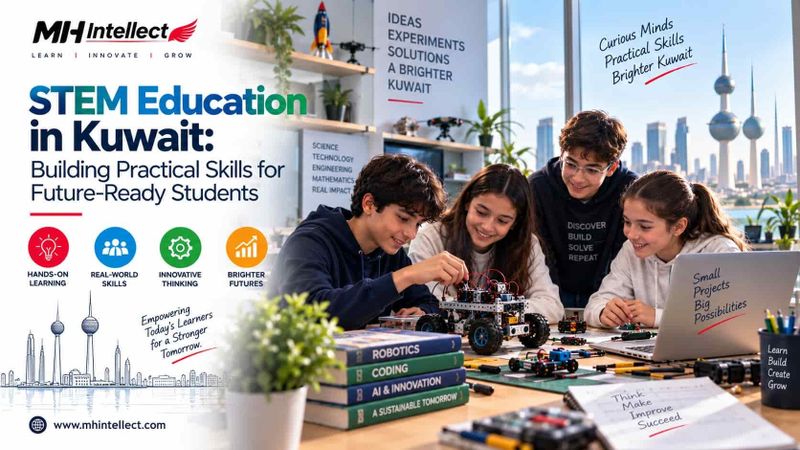
Imagine a Kuwait school introducing robotics and coding with a simple goal: give students more exposure to technology. At first, the activities generate excitement. Students build models, experiment with sensors, and write basic programs. But school leadership soon faces a more important question: Are these activities actually developing skills that students can use beyond the classroom? This is where structured STEM Education in Kuwait becomes important. Rather than treating science, technology, engineering, and mathematics as separate subjects or occasional activities, an effective STEM approach connects them through practical problems, projects, experimentation, and measurable learning outcomes.
Why STEM Education Is Becoming Important in Kuwait
Kuwait's education landscape is increasingly focused on applied learning, problem-solving, technology, and 21st-century skills. The country's education initiatives have highlighted problem-based approaches and cross-subject learning, while robotics and technology pathways are creating additional opportunities for students to develop scientific, engineering, and innovation capabilities.
For schools, this creates an opportunity to move beyond traditional classroom instruction. A well-designed STEM program can help students connect concepts with practical situations. Instead of simply learning how circuits, forces, data, or algorithms work, students can use those concepts to design, test, and improve solutions to defined challenges.
What Makes an Effective STEM Curriculum?
A strong STEM curriculum should be progressive, age-appropriate, and connected to clear learning objectives. It should also build complexity over time rather than repeating similar activities for different year groups.
A comprehensive approach can include robotics and engineering design, coding, AI concepts, IoT projects, electronics, science experiments, mathematical modelling, environmental projects, and design-thinking activities.
The important factor is not the number of technologies introduced. It is how effectively students use those technologies to investigate problems and develop transferable skills. A robotics kit, for example, becomes much more educational when students must determine why their robot failed, modify the design, retest it, and explain their reasoning.
STEM Learning Across Different School Stages
Effective STEM learning should evolve as students grow. In the early years, learning can focus on curiosity, observation, exploration, simple building challenges, materials, forces, and guided discovery. At the primary level, students can progress toward structured challenges involving circuits, coding, engineering design, and experimentation.
Middle school can introduce more complex robotics, electronics, sensors, data interpretation, and engineering processes. Students gradually take greater ownership of decisions instead of simply following step-by-step instructions. At the secondary level, projects can become more advanced, incorporating AI, programming, robotics, engineering challenges, research, and interdisciplinary problem-solving.
This progression is important for school leaders because a successful STEM initiative should provide continuity across grade levels rather than isolated experiences.
Turning STEM Concepts Into Real Projects
Projects are where STEM becomes tangible. Students can investigate challenges such as water conservation, renewable energy, smart classrooms, autonomous robotics, or structural engineering. These projects require learners to combine knowledge from multiple disciplines and move through a process of research, design, testing, refinement, and presentation.
A strong project does not need to produce a perfect result on the first attempt. Failure provides valuable information. When students identify what went wrong and improve their solution, they develop the iterative problem-solving habits used by engineers and scientists.
Schools can also showcase practical outcomes through the Student's Gallery, giving educators, parents, and school leadership greater visibility into what students can create through applied STEM learning.
What Schools Should Consider Before Choosing a STEM Program
For school leadership, implementing STEM involves more than purchasing equipment. The program should connect curriculum objectives, teacher readiness, student progression, practical projects, and meaningful assessment. Schools should ask whether students are genuinely solving problems, whether learning increases in complexity across year groups, and whether teachers receive appropriate support.
This is where a STEM implementation partner for schools can provide structure. A dedicated partner can support curriculum planning, lesson delivery, teacher development, project design, and long-term implementation rather than leaving schools to manage these elements independently.
Schools exploring structured STEM Education Programs for Schools can therefore consider STEM as a long-term learning pathway rather than a collection of technology workshops.
Building a Sustainable STEM Culture
The goal of STEM education is not to turn every student into an engineer or programmer. It is to help students become better thinkers, confident problem-solvers, capable collaborators, and informed users and creators of technology. Strong STEM teaching encourages students to ask questions, experiment, analyse results, communicate ideas, and learn from mistakes.
For schools in Kuwait, developing this foundation early can help create a learning environment where technology supports meaningful education rather than simply adding more activities to the timetable.
Build a STEM Pathway Designed for Your School
A successful STEM initiative needs the right combination of curriculum planning, practical learning, teacher support, infrastructure, and long-term implementation. MH Intellect works with schools to support structured, curriculum-aligned STEM programmes across different age groups and technology areas. Book a free consultation to discuss your school's STEM goals and explore a practical pathway for developing stronger STEM learning outcomes.





Top comments (0)