

Imagine a school introducing a new robotics kit into a classroom. The students are excited, but the academic coordinator asks an important question: “What are students actually learning from it?” This is a common challenge for schools investing time and resources into practical STEM learning. A product alone does not create meaningful education. The real value comes from how teachers use the equipment to help students explore concepts, solve problems, and build projects. This is why STEM Education products should be viewed as learning tools that support structured educational experiences rather than products simply placed in a classroom.
What Are STEM Education Products?
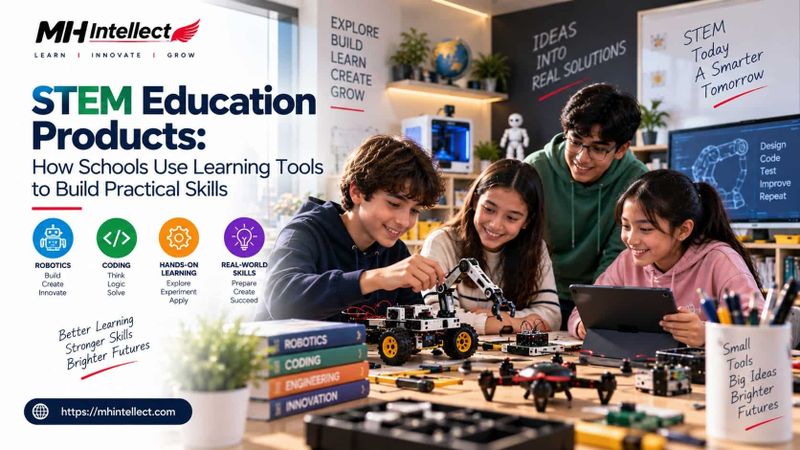
STEM Education products are educational tools, kits, and technology platforms used to help students understand Science, Technology, Engineering, and Mathematics through practical learning. Instead of learning only through textbooks or demonstrations, students can use robotics kits, coding systems, engineering materials, sensors, and other learning resources to experiment with ideas.
For schools, the purpose is not simply to introduce technology. It is to create opportunities where students can design, build, test, observe results, and improve their solutions. This makes learning more interactive while helping students connect theoretical concepts with practical applications.
Schools can explore STEM Education products to understand the range of educational tools that can support different age groups and STEM learning objectives.
Why Do Schools Need STEM Education Products?
A major challenge for schools is making STEM learning practical without losing alignment with educational goals. Teachers may understand the importance of hands-on learning but need appropriate resources to turn concepts into meaningful activities. STEM Education products for schools can provide the physical and digital tools needed to support this process.
Well-selected resources can help students:
- Explore engineering and scientific concepts through practical activities.
- Develop coding, logic, and computational thinking skills.
- Build and test prototypes while learning from mistakes.
- Understand how technology can be applied to real-world problems.
- Work collaboratively on structured STEM challenges.
The effectiveness of these tools depends on how they are integrated into learning. A robotics kit, for example, becomes more valuable when students are challenged to solve a problem rather than simply follow instructions.
Robotics as a STEM Learning Tool
Robotics provides a strong example of how educational products can turn abstract concepts into practical experiences. Students can learn about programming, sensors, movement, engineering design, and logical thinking while building and controlling robots.
For younger learners, the LEGO SPIKE Essential can support early STEM and robotics learning through age-appropriate building and coding activities. As students develop more advanced skills, LEGO SPIKE Prime can introduce more complex robotics and coding challenges.
For schools seeking alternative approaches to robotics learning, the Whalesbot U10 Pro can support screen-free robotics experiences and practical exploration.
These resources are not valuable because of the equipment itself. Their educational value comes from the learning experiences teachers create around them.
From Products to Meaningful STEM Learning
School leaders often face another challenge: purchasing equipment does not automatically create a successful STEM programme. Teachers need guidance on selecting activities, connecting projects with learning objectives, and increasing the complexity of challenges as students progress.
This is why schools benefit from thinking about STEM tools as part of a wider learning strategy. A primary student might explore simple construction and movement, while a middle school student could investigate sensors and coding. Older students can progress toward robotics, engineering design, automation, and complex problem-solving.
The article What Are STEM Education Products and Why Do Gulf Schools Need Them provides further insight into how schools can connect educational products with structured STEM learning.
How MH Intellect Supports Practical STEM Education
The challenge for schools is often not finding technology but knowing how to use it effectively. MH Intellect helps schools integrate STEM learning tools into structured educational experiences, using robotics, coding, engineering, and other technologies to encourage hands-on learning.
The focus is on education rather than selling equipment. Students use learning tools to investigate concepts, complete projects, and develop skills through guided activities. This approach helps schools create meaningful STEM experiences while teachers can progressively introduce more complex challenges.
For schools building a wider STEM learning pathway, structured STEM Education can help connect individual activities with broader learning outcomes.
Building Future-Ready Skills Through STEM Tools
The real purpose of STEM Education products is to give students opportunities to learn by doing. When a student builds a robot, writes code, tests a design or investigates why a prototype does not work, the learning goes beyond the equipment. Students practise questioning, reasoning, collaboration, creativity and problem-solving.
For school leaders, the key consideration should therefore be how each learning tool contributes to a structured educational objective. The right resources, combined with effective teaching and progressive activities, can turn STEM classrooms into environments where students actively explore how technology and engineering work.
Ready to create more meaningful hands-on STEM learning in your school? Book a free consultation with MH Intellect to discuss how educational STEM tools and structured learning programmes can support your students and curriculum goals.







Top comments (0)