

What if students could understand scientific concepts by building something, testing an idea and solving a real problem? Instead of learning only through textbooks and classroom explanations, practical STEM activities allow students to explore how knowledge is applied in everyday life. From designing simple machines to developing sensor-based systems, project-based learning makes education more interactive, meaningful, and connected to the world around us.
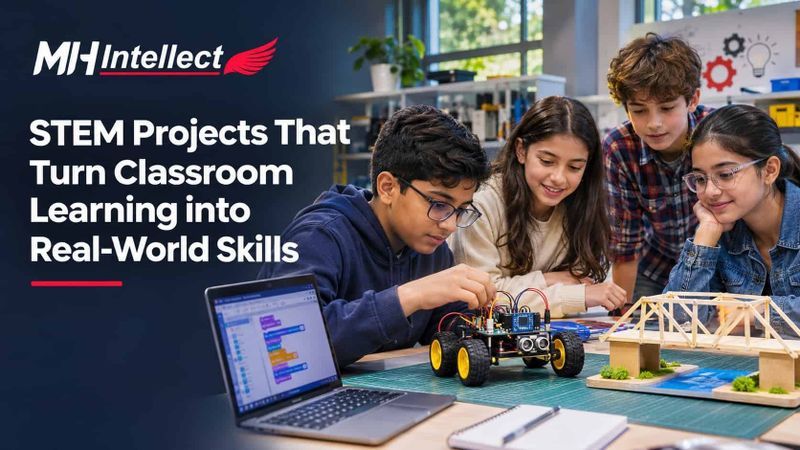
For schools, introducing structured STEM Education creates opportunities to connect Science, Technology, Engineering and Mathematics through practical experiences that develop technical knowledge and essential problem-solving skills.
Why Practical STEM Learning Matters in Schools
Students understand concepts more effectively when they have opportunities to apply what they learn. A well-designed STEM Program encourages learners to investigate questions, experiment with solutions, and understand the relationship between different subjects.
Rather than focusing only on completing activities, schools can use practical projects to develop:
- Critical thinking and logical reasoning
- Creativity and engineering design
- Collaboration and communication
- Scientific observation and experimentation
- Programming and computational thinking
These skills help students become active participants in their learning while building confidence in approaching unfamiliar challenges.
How STEM Projects Connect Theory with Practice
A successful STEM learning experience begins with a meaningful challenge. Students identify a problem, explore possible solutions, create a design, and test whether their ideas work.
A suitable STEM education project can combine several learning areas within one activity. For example, students designing a smart irrigation model can explore plant science, connect moisture sensors, develop basic programming logic, and interpret data to understand when watering is required.
Other engaging project ideas include:
- Robotics challenges: Build and programme robots to complete specific tasks using sensors and motors.
- Smart city models: Explore connected systems, automation and environmental monitoring.
- Engineering structures: Design and test bridges or buildings to understand stability and structural principles.
- Electronic circuits: Connect components to investigate electrical energy and circuit behaviour.
- Environmental projects: Develop simple monitoring systems to understand temperature, light or moisture conditions.
These activities allow students to learn through designing, testing, identifying mistakes and improving their solutions.
Building Age-Appropriate STEM Learning Pathways
STEM education should develop progressively as students gain knowledge and confidence. A single project approach cannot address the learning requirements of every age group.
Schools can introduce different levels of practical learning:
Early Years: Construction activities, patterns, observation and guided exploration help develop curiosity and foundational problem-solving.
Primary School: Simple robotics, introductory coding and guided engineering challenges introduce students to practical technology.
Middle School: Programming, sensors, automation and design-based projects help learners apply concepts through more structured challenges.
Secondary School: Advanced robotics, artificial intelligence, IoT and engineering projects provide opportunities to explore complex applications and future academic interests.
A structured STEM project for schools should therefore match the students' abilities, curriculum objectives and expected learning outcomes.
Connecting STEM Education with the UAE's Future
Practical STEM learning also supports broader educational priorities. The UAE's focus on innovation, technology and knowledge development creates opportunities for schools to prepare students for emerging industries and future challenges.
Through UAE Vision 2031, UAE Vision 2031 education and We the UAE 2031, schools can connect technology-focused learning with wider national ambitions for development and innovation.
Introducing relevant projects helps students explore how engineering, automation, sustainability and digital technologies contribute to real-world progress.
Why Schools Need a Structured STEM Implementation Approach
Having robotics kits, electronic components or a dedicated laboratory does not automatically create meaningful learning. Schools need curriculum alignment, appropriate resources, teacher training and clear learning objectives.
Working with a STEM Implementation Partner can help institutions plan and implement practical programmes that connect classroom activities with educational goals.
MH Intellect supports schools across the UAE, Gulf region and India through STEM education, robotics, coding, AI, IoT and practical technology-based learning. Its approach focuses on structured implementation, teacher development and progressive student learning experiences.
Conclusion
STEM projects help transform classroom concepts into practical learning experiences. By encouraging students to design, build, experiment and improve their ideas, schools can develop technical understanding alongside creativity, collaboration and problem-solving.
The goal is not simply to introduce more activities or equipment into classrooms. It is to create a structured learning environment where students understand how knowledge works in practice and gain the confidence to apply it to real-world challenges.







Top comments (0)