

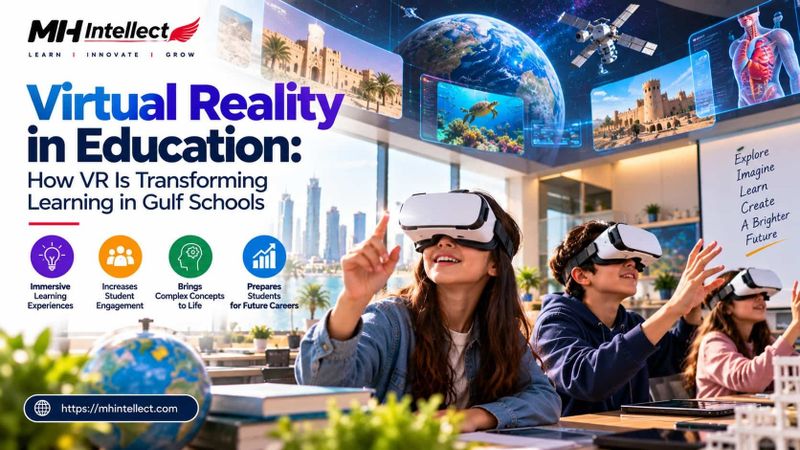
Students often learn complex concepts through textbooks, diagrams, and memorisation. Virtual reality in education changes this experience by allowing learners to explore digital environments and interact with concepts in three dimensions. Instead of simply reading about a scientific system, students can examine it from different perspectives, explore how it works, and connect theoretical knowledge with practical experiences. For Gulf schools developing future-focused STEM programmes, immersive technology offers a way to make learning more visual, interactive and meaningful.
What Is Virtual Reality in Education?
VR in education places students inside simulated digital environments using virtual reality headsets and interactive content. Unlike augmented reality, which adds digital information to the physical environment, VR creates a fully immersive experience where students can explore places, systems and scenarios that may be difficult or impossible to access physically.
This makes Virtual reality education particularly useful for STEM subjects. Students can explore the human body, examine geological environments, investigate engineering structures or understand scientific processes through experiences that go beyond traditional two-dimensional diagrams.
Why VR Learning Works for STEM Education
One of the biggest challenges in STEM teaching is helping students understand concepts that are abstract, microscopic, extremely large or difficult to recreate inside a classroom. VR learning can help address this gap by giving students an opportunity to experience concepts spatially.
For example, biology students can explore cells and organ systems, physics students can investigate forces and fields, chemistry students can examine molecular structures, while engineering students can explore virtual structures and test design variables. The technology does not replace the teacher or curriculum; instead, it provides another learning tool that can make difficult concepts easier to visualise and understand.
Where Virtual Reality Learning Can Make a Difference
Virtual reality learning can support several STEM areas by turning theoretical content into interactive experiences. Students can explore scientific processes, investigate environmental systems, understand engineering principles, and visualise mathematical concepts.
The strongest results occur when the VR activity is connected to a specific learning objective. Rather than using VR simply because it is engaging, teachers can introduce an experience that addresses a particular concept students are struggling to understand. Students can then observe, investigate, and discuss what they experienced before applying that knowledge to a classroom task.
VR Education for Schools: Practical Applications
VR education for schools can also expand the experiences available to students without requiring traditional field trips. Virtual environments can provide access to locations, laboratories and scenarios that may be difficult to visit because of distance, cost, safety or scheduling.
Students can explore:
- Historical sites and global landmarks
- Marine ecosystems and deep-ocean environments
- Space and planetary environments
- Scientific laboratories
- Engineering and industrial facilities
- Natural ecosystems and geological environments
Virtual field trips can provide more than an exciting experience. When connected to classroom objectives, they give students a visual and contextual reference that can strengthen discussions, research and follow-up activities.
Making VR Meaningful in Gulf Schools
For schools across the Gulf, the educational value of VR depends heavily on implementation. Simply providing students with headsets does not guarantee meaningful learning. Schools need appropriate content, teacher preparation, curriculum alignment and assessment strategies.
A practical VR lesson might begin with a specific learning challenge. The teacher selects an immersive experience that addresses that challenge, gives students an observation or investigation task, facilitates discussion afterwards and then assesses whether students can apply what they learned. This process turns VR from a technology demonstration into a structured learning experience.
Teacher confidence is equally important. Educators need to understand not only how to operate VR tools but also when immersive learning can genuinely improve understanding. Content should be selected according to educational objectives rather than visual quality or novelty.
Challenges Schools Should Consider
VR implementation can involve hardware investment, teacher training, content selection, physical space and accessibility considerations. Schools also need to ensure that assessment measures actual conceptual understanding rather than simply student excitement or participation.
These considerations do not prevent schools from using VR. Instead, they highlight why a carefully planned implementation strategy is important. When technology is introduced gradually and connected to curriculum objectives, schools can create sustainable immersive learning experiences.
Building Future-Ready Learning With VR
The future of Virtual reality in education is not about replacing traditional teaching. It is about expanding what students can experience. When combined with STEM projects, robotics, coding, and hands-on activities, VR can help students investigate problems from new perspectives and connect classroom concepts with real-world applications.
Schools can also explore the Student's Gallery to see examples of practical student learning and hands-on STEM experiences.
The Role of MH Intellect in Immersive STEM Education
MH Intellect supports schools across the Gulf and India with structured STEM and immersive learning programmes. The approach focuses on curriculum planning, practical learning, teacher development, and meaningful technology integration rather than simply introducing hardware into classrooms.
For schools, the goal should always be clear: use emerging technology to improve learning outcomes, develop practical skills and help students become confident problem-solvers.
Ready to introduce immersive STEM learning into your school? Book a free consultation with MH Intellect to explore practical VR education, STEM integration and future-focused learning programmes aligned with your school’s objectives.







Top comments (0)