

Traditional classroom learning often depends on textbooks, diagrams and explanations to help students understand complex concepts. However, some scientific and technical topics are difficult to visualise through two-dimensional materials alone. Virtual reality in education offers a more immersive approach, allowing students to explore scientific concepts, engineering systems and real-world environments through interactive three-dimensional experiences.
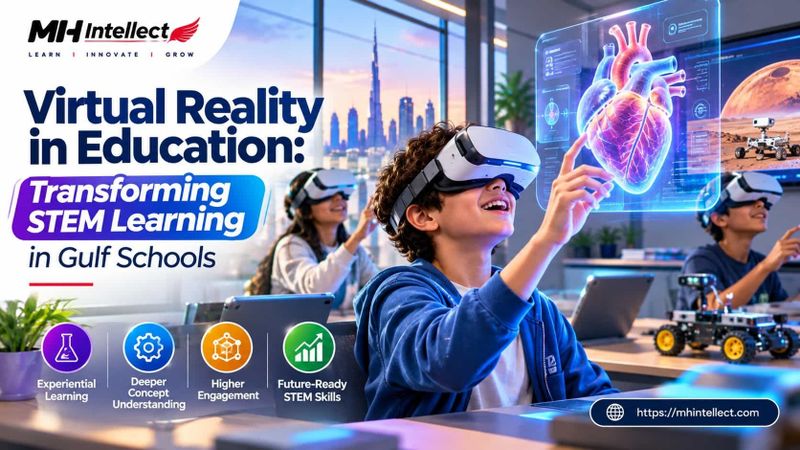
For schools across the Gulf, VR in education creates opportunities to make STEM subjects more engaging, practical and easier to understand. When integrated with curriculum objectives, immersive technology can help students move beyond memorising information towards exploring concepts and developing deeper understanding.
How Virtual Reality Changes Classroom Learning
Virtual reality education places students inside simulated digital environments where they can explore and interact with different concepts. Instead of simply reading about the human circulatory system, students can explore how blood moves through the body. They can also examine planetary systems, geological structures and engineering environments from perspectives that traditional classroom resources cannot easily provide.
This makes immersive technology particularly useful in subjects where spatial understanding and visualisation are important. Teachers can use virtual experiences to introduce difficult topics, encourage observation and connect theoretical knowledge with practical exploration.
Why VR Learning Matters for STEM Education
VR learning can support several STEM subjects by making abstract ideas easier to visualise. It gives teachers another way to explain concepts that students may find difficult to understand through textbooks or static diagrams.
Some practical applications include:
- Biology: Exploring cells, organs and biological processes through immersive environments.
- Physics: Visualising forces, gravitational effects, electromagnetic fields and wave behaviour.
- Chemistry: Understanding molecular structures, atomic relationships and chemical reactions.
- Engineering: Exploring structural designs and testing variables in virtual environments.
- Environmental Science: Observing ecosystems, climate systems and geological processes.
These experiences do not replace teachers or traditional instruction. Instead, they provide additional learning opportunities that can strengthen classroom explanations and encourage students to investigate concepts.
Virtual Reality Learning Through Virtual Field Trips
One of the practical applications of Virtual reality learning is the virtual field trip. Students can explore historical locations, marine ecosystems, scientific laboratories, geographical environments and even space without physically travelling to these destinations.
For Gulf schools, these experiences can expand learning opportunities beyond the classroom. Teachers can introduce a virtual environment before a lesson, ask students to observe specific details and follow up with discussions or classroom activities.
The educational value comes from connecting the experience to a clear learning objective rather than simply allowing students to explore without direction.
Combining AR and VR in Education
Schools can also explore the complementary roles of augmented reality and virtual reality. While VR creates fully immersive digital environments, augmented reality adds digital information to real-world surroundings.
Understanding AR and VR in Education helps school leaders identify how both technologies can support interactive learning. The right approach depends on the subject, curriculum requirements and intended student learning outcomes.
Making Immersive Learning Effective in Gulf Schools
Successful implementation requires more than investing in headsets or introducing new technology. Schools need curriculum-aligned content, confident teachers, appropriate learning spaces and activities that encourage students to apply what they discover.
Teachers should identify a specific learning objective, select a suitable VR experience and guide students through observation, discussion and practical application. This ensures immersive learning contributes to meaningful educational outcomes rather than becoming a standalone activity.
How MH Intellect Supports Schools
MH Intellect works with schools across the Gulf and India to develop structured STEM and immersive learning programmes. Its approach includes curriculum-focused programme planning, teacher training, immersive learning integration, STEM lab setup and ongoing implementation support.
Schools can explore the Students Gallery to see examples of student engagement with STEM and technology-based learning activities.
By combining virtual reality, augmented reality, robotics and hands-on STEM experiences, schools can create learning environments that encourage curiosity, creativity and practical understanding.
Building Future-Ready Learning Environments
Virtual reality becomes most valuable when it supports clear curriculum objectives and helps students understand concepts that are difficult to experience through traditional teaching methods. For Gulf schools, integrating immersive technology into structured STEM programmes can create more interactive and meaningful learning experiences.
Explore MH Intellect to learn about its STEM education and immersive learning programmes. Contact MH Intellect to discuss how your school can develop a structured, future-focused learning environment.







Top comments (0)