

Robots are designed to perform tasks with speed and precision, but they do not always produce the expected results. From inaccurate movements to incorrect object detection, even advanced robotic systems can make mistakes. Understanding Why do robots make mistakes helps students and educators explore the engineering principles behind robotic performance, accuracy and reliability.
What Causes Robots to Make Mistakes?
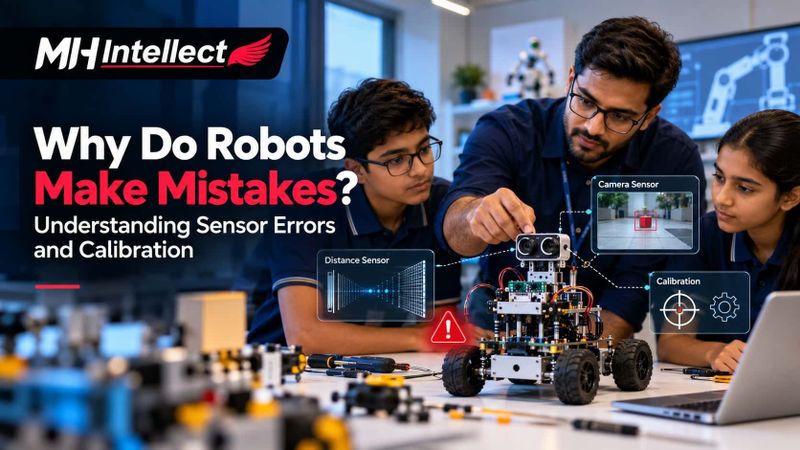
Robots depend on sensors, programmed instructions and mathematical models to understand their surroundings and perform tasks. When the information received from these systems is inaccurate, the robot may respond incorrectly. Common causes include sensor noise, mechanical wear, environmental interference, incorrect measurements and calibration problems.
For example, a robot using a colour sensor may struggle to identify an object when classroom lighting changes. Similarly, a robotic arm may repeatedly miss its target because of incorrect positioning measurements. These situations demonstrate why understanding the technology behind robotic systems is essential for effective troubleshooting.
Understanding Robot Sensor Errors
Robot sensor errors occur when sensors provide inaccurate, delayed or inconsistent information about the physical environment. Cameras, ultrasonic sensors, infrared sensors, encoders and other sensing devices help robots detect objects, measure distances and control movement.
Some common sensor problems include:
- Sensor noise: Random fluctuations that affect measurement accuracy.
- Sensor drift: Gradual changes in readings over time.
- Environmental interference: Changes in lighting, temperature, humidity or vibration that affect sensor performance.
- Mounting errors: Incorrect sensor positioning that produces inaccurate measurements.
- Resolution limitations: Inability to detect small changes in physical measurements.
Recognising these problems helps students understand that a robot's failure does not always indicate a software problem. Sometimes, the issue begins with the information the robot receives.
Why Sensor Calibration in Robotics Matters
Sensor calibration in robotics is the process of comparing sensor readings with known physical references and correcting measurement differences. It helps robotic systems interpret their surroundings more accurately and perform tasks with greater consistency.
Calibration is important because sensor performance can change due to installation conditions, temperature variations, vibration and regular use. For example, students can test an infrared sensor under different lighting conditions, compare its readings and adjust its detection threshold to improve performance.
It is also important to understand the difference between sensor calibration and robot calibration. Sensor calibration improves measurement accuracy, while Robot calibration focuses on correcting the robot's positioning and movement model. Both contribute to reliable robotic operation.
Why Concept-Based Robotics Learning Is Important
Learning robotics should involve more than assembling components and following programming instructions. Students need opportunities to investigate problems, understand how different components work and develop solutions independently.
The difference between Copy-Paste Robotics vs Concept-Based Robotics becomes clear when students encounter unexpected robot behaviour. Instead of simply repeating instructions, concept-based learning encourages them to identify errors, test possible solutions and improve their designs.
These activities develop computational thinking, logical reasoning, creativity and practical engineering skills.
Ethics and the Future of Robotics
As robots become increasingly common in education, healthcare, manufacturing and other industries, understanding their limitations is equally important. Questions surrounding Ethics of Robotics: Will Robots Replace Humans encourage students to consider human responsibility, safety, decision-making and the role of automation in society.
Robotics education should therefore develop both technical knowledge and responsible thinking. Students need to understand not only how robots operate but also how their decisions and applications can affect people.
Building Practical Robotics Skills with MH Intellect
MH Intellect supports schools in developing structured STEM and robotics education programmes through hands-on learning experiences. Students explore robotics concepts, experiment with educational tools, understand sensor behaviour and develop practical problem-solving abilities.
By introducing activities involving sensor testing, calibration and troubleshooting, schools can help students move beyond basic robot construction towards a deeper understanding of engineering and technology.
Explore MH Intellect to discover robotics and STEM learning opportunities for schools. Contact MH Intellect to discuss how structured robotics education can support your school's learning objectives.






Top comments (0)