

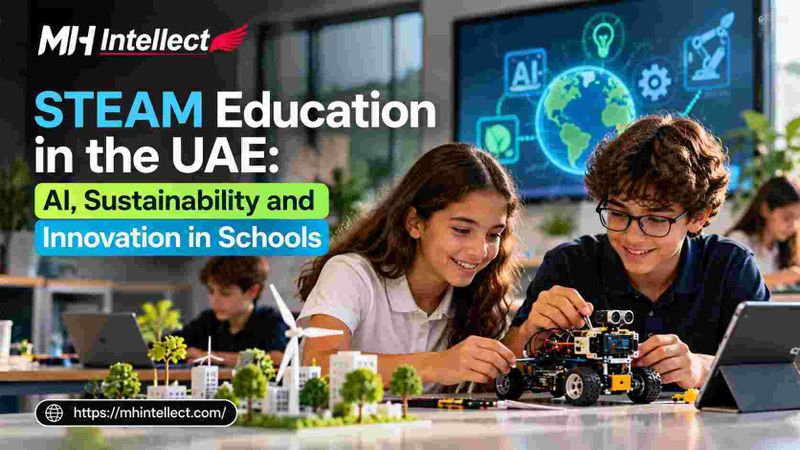
Education is evolving as schools prepare students for a future shaped by artificial intelligence, robotics, sustainability, and technological innovation. Students need more than theoretical knowledge; they need opportunities to experiment, solve problems, and apply classroom concepts to real-world challenges. STEAM education in the UAE combines Science, Technology, Engineering, Arts, and Mathematics through interdisciplinary learning that encourages creativity, critical thinking, and practical problem-solving.
Why STEAM Education Matters for UAE Schools
STEAM education connects different subjects through projects that encourage students to investigate questions, design solutions, and test their ideas. For example, students can combine mathematics and engineering to build a bridge, use coding to programme a robot, or apply science and design to develop a sustainable model. These activities help learners understand how different disciplines work together to solve meaningful problems.
For schools, STEAM education UAE offers an approach to making classroom learning more engaging and relevant. By connecting academic knowledge with practical applications, educators can help students develop the confidence to explore new technologies and approach unfamiliar challenges with curiosity.
Connecting STEAM Learning with UAE Vision 2031
The UAE continues to focus on innovation, knowledge development, and future-ready capabilities. UAE Vision 2031 provides a national framework for the country's development priorities, making education and skills development important considerations for schools preparing students for the future.
Through practical STEAM activities, schools can encourage scientific understanding, digital literacy and creative thinking. Students can explore robotics, investigate environmental data, programme automated systems and design solutions to everyday problems. These experiences help connect classroom learning with the broader ambition of developing a knowledgeable, innovative and capable generation.
For school leaders and academic coordinators, the priority is to translate these goals into meaningful educational experiences supported by curriculum alignment, teacher preparation and clear learning outcomes.
How STEAM Education Supports AI, Robotics and Sustainability
Artificial intelligence and robotics provide engaging opportunities for interdisciplinary learning. Students can programme robots to navigate obstacles, use sensors to collect information, or investigate how automated systems respond to changing conditions. These projects combine engineering, mathematics, coding, and logical reasoning while showing learners how technology operates in practice.
Sustainability offers another valuable context for STEAM projects. Students can design water-saving irrigation models, compare materials for insulation, or explore ways to improve energy efficiency. These activities connect scientific investigation with environmental awareness and encourage students to consider how their ideas could benefit their communities.
Understanding the Benefits of STEAM education helps educators recognise the value of creative problem-solving, collaboration, communication, and analytical thinking. These skills develop through consistent, well-designed learning experiences rather than simply introducing equipment into classrooms.
Practical Ways to Strengthen STEAM Learning
Schools can create more effective STEAM experiences by connecting practical projects with clear learning objectives and opportunities for students to reflect on their progress.
- Integrate subjects: Connect science, technology, engineering, arts, and mathematics through shared projects.
- Introduce emerging technologies: Use age-appropriate robotics, coding, AI, and sensor-based activities.
- Encourage project-based learning: Give students opportunities to design, test, and improve their solutions.
- Support teachers: Provide training that builds confidence in delivering hands-on activities.
- Assess learning outcomes: Evaluate student understanding, reasoning, collaboration and project development.
A phased implementation strategy helps schools begin with manageable activities, evaluate their effectiveness and expand programmes according to students' needs and available resources.
Building a Sustainable STEAM Programme
Successful STEAM implementation requires curriculum alignment, appropriate learning resources, teacher development and a clear progression of activities across school stages. When students move from foundational experiments to more advanced engineering and technology projects, they can gradually develop their knowledge and practical abilities.
MH Intellect supports schools through structured STEM and STEAM education approaches that connect practical learning with curriculum objectives. Schools can explore the Student's Gallery to see examples of hands-on projects and understand how practical activities can support student engagement. Working with a STEM Implementation Partner can also help schools plan programmes, support educators, and establish a structured approach to implementation.
Ready to strengthen STEAM learning at your school? Contact MH Intellect to explore curriculum-aligned programmes that integrate AI, robotics, sustainability, and engineering projects to help students develop the skills needed for a technology-driven future.





Top comments (0)