
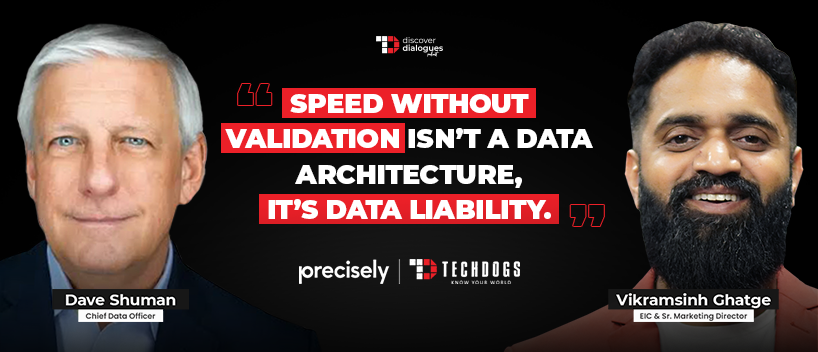

In this episode of TechDogs’ Discover Dialogues, host Vikramsinh Ghatge speaks with Dave Shuman, Chief Data Officer at Precisely, about why enterprise AI readiness is fundamentally a data challenge. According to Dave, organizations need more than advanced AI models to succeed. Trusted data, consistent definitions, strong governance, data lineage, quality, and disciplined decision-making form the foundation for responsible and effective AI adoption. Drawing from his career across broadcasting, e-commerce, analytics, big data, IoT, smart cities, and enterprise data leadership, Dave emphasizes one recurring lesson: data creates value when it enables people to make better decisions faster.
Dave explains that organizations should begin their AI journey with the fundamentals that are often overlooked, including data catalogs, semantic layers, governance, and continuous data quality. He uses the OODA loop—observe, orient, decide, and act—to explain how enterprises can structure their data and AI strategies. Visibility into where data exists, how it is defined, who owns it, and whether it can be trusted is essential. Without this foundation, even the most sophisticated AI systems can produce confident but incorrect answers, creating risks that traditional software failures typically make easier to detect.
The conversation in Discover Dialogues also explores the importance of semantic layers, runtime governance, shadow AI, and measuring AI ROI through tangible business outcomes. Dave argues that governance must work in real time as AI-driven decisions are made, while ROI should be linked to measurable results such as risk avoidance, automation-driven labor savings, and revenue impact. He also highlights the difference between real-time data and reliable data, explaining that zero ETL can accelerate access to information but does not eliminate the need for transformation, cleansing, enrichment, or quality management.
For future data leaders, Dave offers three key principles: own the outcome rather than simply the output, translate technical concepts into language that business leaders can understand, and remain technically curious without allowing technical expertise to become the entirety of their professional identity. Ultimately, AI readiness starts with trusted, fit-for-purpose data. Organizations that combine strong data foundations with continuous quality, clear governance, business context, and outcome-focused leadership will be better positioned to turn AI investments into meaningful business value.







Top comments (0)