


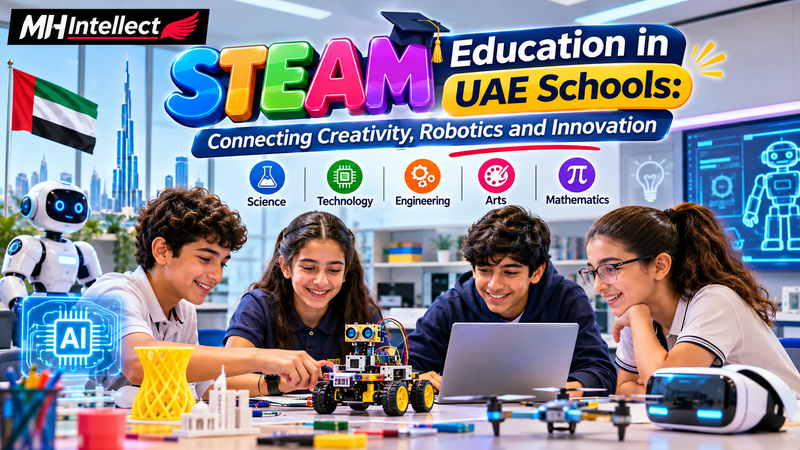
Education is evolving to meet the demands of a world driven by technology, creativity, and innovation. Schools are increasingly exploring practical teaching approaches that encourage students to think critically, experiment with ideas, and solve real-world problems. STEAM education combines Science, Technology, Engineering, Arts, and Mathematics to create meaningful learning experiences that prepare students for future academic and professional opportunities.
The Growing Importance of STEAM Education in UAE Schools
The UAE continues to emphasise educational innovation, technological development, and future-ready skills. Integrating STEAM education in UAE schools helps students connect theoretical knowledge with practical applications through interdisciplinary learning.
Rather than studying subjects independently, students can explore how science, mathematics, engineering, technology, and creative design work together. Activities such as building prototypes, programming robots, conducting experiments, and designing innovative solutions encourage active participation.
This approach helps learners develop curiosity, collaboration, communication, analytical thinking, and problem-solving abilities while making classroom experiences more engaging.
How Robotics Education Supports Practical Learning
Robotics is an effective way to introduce students to engineering, programming, automation, and computational thinking. The growing interest in robotics education UAE reflects the importance of providing students with opportunities to explore emerging technologies through hands-on activities.
Students can design robotic models, programme sensors, develop automated systems, and experiment with different solutions. These activities encourage learners to identify problems, test ideas, and improve their designs.
Robotics projects also promote teamwork and perseverance, helping students understand that experimentation and continuous improvement are essential parts of innovation.
Exploring Aviation Through STEAM Education
Aviation provides an exciting opportunity to connect classroom concepts with real-world engineering and technology. Through aviation STEAM education, students can explore aerodynamics, flight mechanics, aircraft design, navigation, and mathematical principles.
Practical activities such as constructing model aircraft, experimenting with different wing designs, and investigating flight simulations help students understand how scientific and engineering concepts influence aviation.
These experiences can inspire learners to explore future opportunities in aerospace engineering, aviation technology, robotics, and other technology-focused industries.
Understanding the STEM vs STEAM Model
The STEM vs STEAM model highlights two closely connected educational approaches. STEM focuses on Science, Technology, Engineering, and Mathematics, while STEAM incorporates Arts to encourage creativity, design, and imaginative thinking.
For example, a STEM bridge-building project may focus on structural strength, material selection, and mathematical calculations. A STEAM approach can extend the same project by incorporating architectural design, visual presentation, and user experience.
Both approaches provide valuable learning opportunities. Schools can select or combine them according to their educational objectives, curriculum requirements, and students' learning needs.
Moving Beyond Traditional Textbook Learning
Textbooks provide an important foundation for academic knowledge, but practical activities allow students to apply what they learn in meaningful ways. Hands-on STEAM education encourages learners to investigate challenges, develop prototypes, and discover solutions through experimentation.
The article Why Gulf Schools Are Moving From Textbook Learning to Hands-On STEAM explores the importance of combining traditional instruction with interactive and project-based educational experiences.
This learning approach can strengthen student engagement, encourage independent thinking, and develop confidence in applying knowledge to unfamiliar situations.
Preparing Future-Ready Students with MH Intellect
Effective STEAM education requires structured learning programmes, appropriate resources, teacher support, and age-appropriate practical activities.
MH Intellect supports schools in introducing engaging STEM and STEAM learning experiences through robotics, coding, engineering, creative design, and emerging technologies. These educational opportunities encourage students to explore their interests, develop technical knowledge, and transform creative ideas into practical solutions.
By integrating structured STEAM activities into classrooms, schools can help students build essential skills for an increasingly technology-driven future.
Conclusion
STEAM education offers a valuable approach to developing creativity, technical knowledge, and practical problem-solving skills. By incorporating robotics, aviation, engineering, and creative design into classroom learning, UAE schools can provide meaningful educational experiences that inspire innovation. Investing in hands-on STEAM learning today can prepare students to become confident learners, creative thinkers, and future technology leaders.




Top comments (0)