
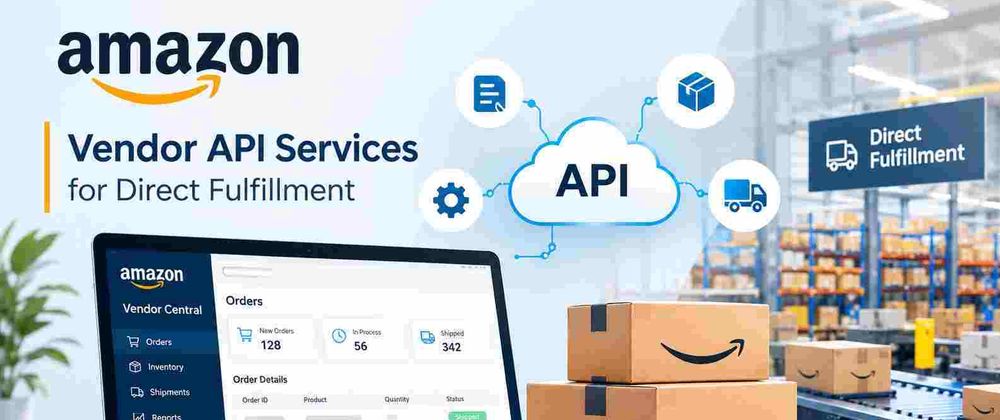

Managing purchase orders efficiently is one of the most important aspects of selling through Amazon Vendor Central. As businesses grow and order volumes increase, manually handling purchase orders can become time-consuming, error-prone, and difficult to scale. This is where Amazon Vendor API Services play a crucial role.
Amazon Vendor APIs help automate the entire purchase order lifecycle, allowing vendors to exchange data directly with Amazon systems in real time. From receiving purchase orders to sending acknowledgments, updating shipment details, and tracking invoices, the process becomes faster, more accurate, and highly efficient.
For manufacturers, distributors, wholesalers, and large-scale suppliers, integrating Amazon Vendor API Services can significantly improve operational efficiency while reducing manual workload. Understanding how these APIs manage purchase orders from start to finish can help businesses maximize their Amazon Vendor Central performance.
Understanding Amazon Vendor API Services
Amazon Vendor APIs are a collection of programmatic interfaces that enable vendors to communicate directly with Amazon systems. Instead of manually downloading purchase orders and uploading shipment information through Vendor Central, businesses can automate these tasks through API integrations.
The primary goal of Amazon Vendor API Services is to streamline data exchange between a vendor's internal systems, such as ERP, inventory management software, warehouse management systems, and Amazon Vendor Central.
This automation helps ensure that critical information is exchanged accurately and without delays, reducing the risk of missed orders, shipment errors, and inventory discrepancies.
Step 1:Amazon Generates a Purchase Order
The purchase order process begins when Amazon identifies demand for specific products. Based on inventory levels, sales forecasts, customer demand, and replenishment requirements, Amazon automatically creates a purchase order.
Once generated, the purchase order becomes available through Amazon Vendor APIs. Instead of logging into Vendor Central multiple times a day to check for new orders, businesses using Amazon Vendor API Services can automatically retrieve purchase orders as soon as they are issued.
The API integration continuously monitors new orders and sends them directly to the vendor's internal systems for processing.
This real-time communication helps vendors respond quickly and maintain efficient supply chain operations.
Step 2:Automated Purchase Order Retrieval
One of the most valuable features of Amazon Vendor API Services is automated purchase order retrieval.
When Amazon issues a purchase order, the API automatically downloads detailed information, including:
- Purchase order number
- Product identifiers
- Ordered quantities
- Requested delivery dates
- Shipping destination details
- Payment terms
- Packaging requirements
The information is immediately synchronized with the vendor's ERP or inventory management platform.
This automation eliminates manual data entry and reduces the risk of human errors that can occur when handling large volumes of orders.
Businesses can process hundreds or even thousands of purchase orders efficiently without increasing administrative workload.
Step 3: Purchase Order Validation and Acknowledgment
After receiving a purchase order, vendors must review and acknowledge it.
Using Amazon Vendor API Services, the validation process can be automated based on predefined business rules.
The system can automatically verify:
- Product availability
- Inventory levels
- Delivery capabilities
- Pricing accuracy
- Packaging compliance
If the order can be fulfilled, the vendor sends an acknowledgment back to Amazon through the API.
The acknowledgment confirms whether the order will be accepted fully, partially, or rejected due to inventory constraints or other issues.
Timely acknowledgments are important because Amazon uses this information to plan inventory replenishment and customer demand fulfillment.
Automating this step improves response times and helps vendors maintain strong operational performance metrics.
Step 4: Inventory Synchronization and Order Planning
Once the purchase order is acknowledged, inventory planning becomes the next critical stage.
Integrated Amazon Vendor API Services allow businesses to synchronize inventory data between Amazon and their internal systems.
Warehouse teams can instantly view incoming orders and begin preparing inventory allocation.
This visibility helps prevent stock shortages and enables better production planning for manufacturers.
Real-time inventory synchronization also supports more accurate forecasting and replenishment decisions.
As order volumes increase, automated inventory updates help maintain smooth operations across multiple warehouses and distribution centers.
Step 5: Shipment Preparation and Label Generation
After inventory allocation is completed, warehouse teams begin preparing shipments.
At this stage, Amazon Vendor API Services assist with shipment management by exchanging shipping-related information between vendors and Amazon.
The API integration can support:
- Shipment creation
- Carton information submission
- Pallet details
- Carrier selection
- Routing requests
- Shipping label generation
Automated shipment preparation reduces administrative tasks and ensures compliance with Amazon's shipping requirements.
Proper shipment planning helps vendors avoid chargebacks and shipping delays.
This level of automation is particularly valuable for businesses managing large numbers of daily shipments.
Step 6: Advance Shipment Notification (ASN) Submission
Before products arrive at Amazon fulfillment centers, vendors must notify Amazon about incoming shipments.
This is done through an Advance Shipment Notification (ASN).
Using Amazon Vendor API Services, shipment data is transmitted automatically to Amazon, including:
- Shipment tracking information
- Carton contents
- Product quantities
- Carrier details
- Expected delivery dates
The ASN allows Amazon to prepare receiving operations before inventory arrives.
Accurate and timely ASN submissions improve receiving efficiency and reduce the risk of inventory discrepancies.
Automating ASN creation also eliminates repetitive manual work for logistics teams.
Step 7: Shipment Tracking and Delivery Confirmation
As products move through the transportation process, shipment status updates can be monitored through integrated systems.
Amazon Vendor API Services enable vendors to track shipment progress and maintain visibility throughout the delivery journey.
Businesses can receive updates regarding:
Shipment dispatch
Transit status
Delivery schedules
Receiving confirmations
This visibility helps logistics teams proactively address potential delays and improve communication across the supply chain.
Real-time shipment tracking contributes to better operational planning and customer satisfaction.
Step 8: Invoice Submission and Payment Processing
After Amazon receives and verifies the shipment, the invoicing stage begins.
Traditionally, invoice management can involve extensive manual work and documentation. However, Amazon Vendor API Services automate much of this process.
Invoices can be generated directly from shipment and purchase order data.
The API transmits invoice information to Amazon, ensuring that all relevant details match the corresponding purchase order and shipment records.
Automated invoice submission reduces processing errors and accelerates payment workflows.
This streamlined approach improves cash flow management while minimizing administrative overhead.
Step 9: Reporting and Performance Monitoring
The final stage of the purchase order lifecycle involves performance monitoring and reporting.
Modern Amazon Vendor API Services provide access to valuable operational data that businesses can use to optimize performance.
Companies can analyze:
- Order fulfillment rates
- Shipment accuracy
- Inventory performance
- Invoice processing efficiency
- Delivery timelines
- Operational compliance metrics
These insights help vendors identify improvement opportunities and make data-driven decisions.
By continuously monitoring performance, businesses can strengthen relationships with Amazon while improving overall supply chain efficiency.
The Role of Amazon Business API Services
While Vendor APIs focus primarily on purchase order management and vendor operations, Amazon Business API Services provide additional capabilities for organizations serving business buyers through Amazon Business.
These APIs support automation for procurement workflows, business purchasing processes, account management, reporting, and order management.
When combined with Amazon Vendor API Services, businesses gain a comprehensive automation ecosystem that improves operational efficiency, data accuracy, and scalability across Amazon sales channels.
Conclusion
The purchase order lifecycle within Amazon Vendor Central involves multiple interconnected steps, from order generation and acknowledgment to shipment management, invoicing, and reporting. Managing these processes manually becomes increasingly difficult as business volume grows.
Amazon Vendor API Services automate each stage of the workflow, enabling faster order processing, improved accuracy, better inventory management, and enhanced operational visibility. Businesses can reduce manual effort, minimize errors, and scale their Amazon operations more effectively.
By integrating both Amazon Vendor API Services and Amazon Business API Services, organizations can build a robust automation framework that supports long-term growth, operational efficiency, and stronger performance within the Amazon ecosystem.






Top comments (0)