
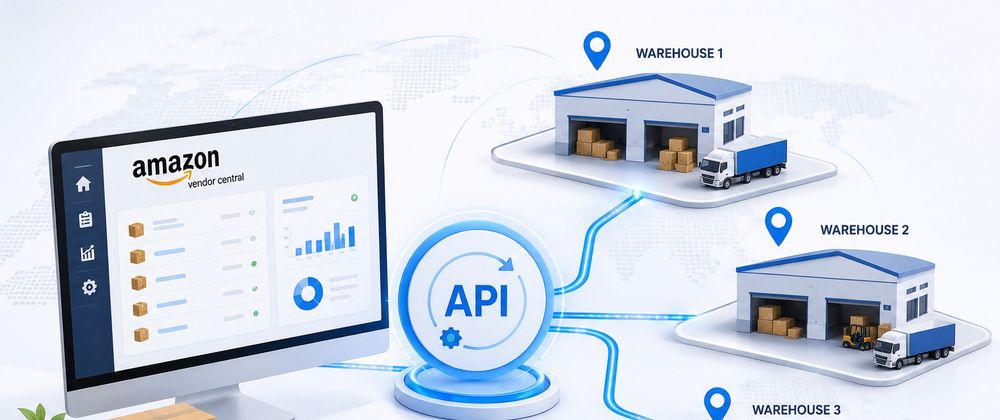

Managing one warehouse is difficult enough. Operating a single warehouse efficiently is already a challenge. Throw in two, three, or a dozen more distribution centers, and visibility of inventory, routing of orders, and the accuracy of order fulfillment can become out of control.
This complexity is amplified for 1P sellers who sell directly to Amazon. In addition to this complexity, there are strict compliance requirements, chargebacks, and delivery windows for 1P sellers. That's where Amazon Vendor API Services come into play, providing businesses with the automation, visibility, and control they need to oversee multiple warehouses and avoid drowning in manual processes.
Let's delve into why multi-warehouse management can be challenging, how Amazon Vendor API Services can meet those problems, and what to consider when integrating with or choosing an Amazon Vendor API Services provider for such integration.
Why Multi-Warehouse Management Is Complex
If the vendor does business only from one place, it's relatively easy to keep track of inventory, purchase orders and shipment confirmations by hand or using a simple spreadsheet. However, as a business grows to operate in several warehouses, either because of geographical demand, 3PL relationships, or diversification in the supply chain, they will discover some issues:
Fragmented inventory:
Stock levels vary from location to location, and it's difficult to find the actual inventory available at a particular store.Order misrouting:
Purchase orders from Amazon may not automatically get assigned to the nearest or most cost-effective warehouse.
Manual shipment confirmation across multiple systems poses a risk of delayed and/or incorrect ASN (Advance Ship Notice) submissions.Compliance risk:
Amazon has stringent vendor scorecards, and failure to fulfil chargebacks or loss of vendor status can result due to errors while fulfilling across the warehouses.Data silos:
Different systems are used at each warehouse, and centralised reporting is almost impossible without integration.
Ultimately, if there is no system in place, vendors feel forced to deal with problems rather than prevent them. Amazon Vendor API Services is the solution to fill this gap.
What Are Amazon Vendor API Services?
Amazon Vendor API Services is a suite of integrations that enable vendors to connect their systems (ERP, WMS, or OMS) with Amazon's vendor ecosystem through the APIs provided by Amazon Vendor Central. Businesses can automate these workflows at scale, instead of manually logging into Vendor Central to review order logs or update inventory.
These APIs become the "glue" required to integrate Amazon's needs with a company's operations for vendors running multiple warehouses. They enable real-time data exchange, which means that with any number of warehouses involved, all data is kept within Amazon's system of record.
Key Ways Amazon Vendor API Services Simplify Multi-Warehouse Operations
1. Centralized Inventory Visibility
Some of the greatest things about these Amazon Vendor API Services are that they permit you to have a single source of fact for your inventory from multiple warehouses. Using the Inventory API, companies can send new inventory updates from each store, so Amazon can always have up-to-date inventory availability data. This helps prevent overselling, stockouts, and not having the right inventory on hand.2. Automated Purchase Order Routing
Amazon creates a purchase order; it has to be delivered promptly and correctly. Using API-driven automation, purchase orders can be automatically sent to the warehouse that is best suited for the job, whether due to stock availability, proximity, or cost efficiency. This takes away the manual push and pull of checking which location's inventory is correct.3. Streamlined Shipment and ASN Management
Amazon requires consistent and accurate ASNs from any warehouse, but will send different parts of an order from each. By leveraging the Amazon Vendor API Services, businesses can achieve seamless and efficient ASN creation and submission from their own warehouse management systems, mitigating the risk of manual entry inaccuracies and ensuring compliance on time at all locations.4. Real-Time Order and Invoice Syncing
It's common for multi-warehouse companies to experience problems reconciling invoices with multiple shipment sources. Through the Invoicing API, vendors can automatically create and send invoices with the right warehouse and shipment, reducing the risk of discrepancies and payment delays or chargebacks.5. Performance Monitoring Across Locations
The Analytics API lets vendors monitor key stats like fill rate, on-time shipment percentage, chargeback frequency, and more at the warehouse level. Such visibility enables identification of the locations where the performance is not satisfactory and where improvements in operations are necessary.
Benefits of Using Amazon Vendor API Services
Reduced manual errors:
Automation minimizes the human error that often comes with juggling multiple systems.Faster order fulfillment:
Real-time data exchange speeds up the entire order-to-shipment cycle.Improved compliance scores:
Accurate, timely data submission helps maintain a healthy vendor scorecard.Scalability:
As new warehouses are added, API-based integration scales far more easily than manual processes.Better decision-making:
Centralized data gives leadership a clear view of performance across the entire network.
Choosing the Right Approach to Implementation
Businesses generally have two paths when adopting Amazon Vendor API Services: building an in-house integration or partnering with a specialized API integration provider.
In-house development offers full control and customization but requires dedicated engineering resources, ongoing maintenance, and a deep understanding of Amazon's API documentation, rate limits, and authentication protocols (such as OAuth and Selling Partner API credentials).
Third-party integration providers offer pre-built connectors between Amazon Vendor Central and common ERP/WMS platforms, along with ongoing support and updates as Amazon's API specifications evolve. For many mid-sized and enterprise vendors managing several warehouses, this route offers faster time-to-value and lower long-term maintenance burden.
Whichever path is chosen, it's important to prioritize:
- Support for multi-location inventory mapping
- Robust error handling and retry logic for failed API calls
- Real-time or near-real-time data sync frequency
- Detailed logging for audit and compliance purposes
- Scalability to accommodate future warehouse additions
Conclusion
Manual processes simply can't keep pace with Amazon's speed and accuracy, as vendor networks become more complex. Amazon Vendor API Services enable automation on the back end and support the management of multiple Amazon Warehouses in a single, efficient way, such as inventory synchronization, automatic order routing, and compliance across all warehouses. The right API integration strategy isn't a luxury for vendors aiming to scale, but the very competitive must-have.
Whatever you choose to do, whether you build it yourself or hire an experienced integration provider, it's all about creating a cohesive, unified, and well-coordinated system that both customers and Amazon are pleased with, and that can operate in a multi-warehouse environment.







Top comments (0)