
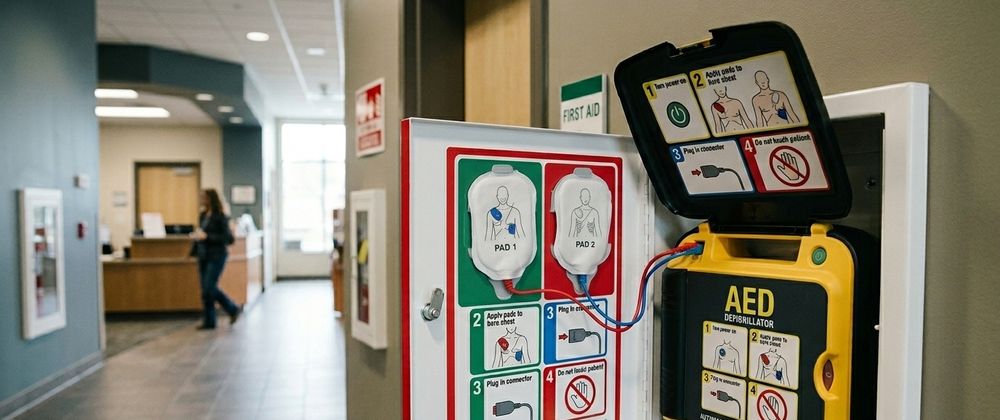

Quick answer: An AED, or automated external defibrillator, is a portable device that can restart a normal heartbeat during sudden cardiac arrest. It reads the heart rhythm through pads on the chest and, if needed, delivers a controlled electric shock. It guides the user step by step with voice prompts, so even an untrained bystander can use one to help save a life.
When a heart suddenly stops beating properly, every minute without help cuts the chance of survival sharply. An automated external defibrillator exists for exactly that emergency. It is designed so that an ordinary person, not just a doctor, can use it. Knowing what it is and how it works is genuinely useful, because in a cardiac arrest the nearest person, not the ambulance, is the one who can act first.
What is an AED?
AED stands for Automated External Defibrillator. It is a compact, portable machine that checks the heart's rhythm and, when the rhythm is dangerous, delivers a measured electric shock to help it reset. The word automated is the key. The device itself analyses the heart and decides whether a shock is needed, then tells the user what to do with clear voice prompts. A modern AED machine is built to be foolproof under pressure, which is why you now see them in airports, malls, offices, gyms and schools around the world.
How does an AED work?
The process is simpler than people expect, because the machine carries the difficulty. You place two sticky pads on the bare chest as shown in the pictures on the pads. The AED then reads the heart's electrical activity through those pads. If it detects a shockable rhythm, a chaotic pattern where the heart quivers instead of pumping, it charges up and tells you to stand clear and press the shock button, or in fully automatic models it delivers the shock itself. The controlled jolt stops the chaotic activity for an instant, giving the heart a chance to restart a normal beat. If no shock is needed, the AED will say so and will not allow one, which is an important safety feature.
Sudden cardiac arrest and why minutes matter
It helps to be clear about what an AED treats. Sudden cardiac arrest is not the same as a heart attack. In cardiac arrest the heart's electrical system fails and it stops pumping blood, so the person collapses, stops breathing normally, and becomes unresponsive within seconds. Without blood flow to the brain, survival falls fast with every passing minute. Early CPR keeps some blood moving, and an early shock from an AED is often the only thing that can restore a normal rhythm. This is why public AEDs and quick action matter so much.
Who can use an AED?
Almost anyone can. AEDs are designed for use by untrained bystanders as well as trained responders. The voice prompts walk you through each step, the pads show where to place them, and the machine refuses to shock a heart that does not need it. You cannot easily shock someone by mistake. That said, a short CPR and AED course builds the confidence to act without freezing, and many workplaces in Pakistan are starting to train staff. A defibrillator placed where people gather, paired with a few trained hands, saves lives that would otherwise be lost waiting for an ambulance.
Looking after an AED
An AED only works in an emergency if it has been cared for between emergencies, and this part is quietly important. The electrode pads carry an expiry date and dry out over time, so they must be replaced before they lapse. The battery has a shelf life too and needs checking on a schedule. Most modern units run a self test and show a green ready indicator, so a quick daily glance confirms it is good to go. Keep a spare set of pads with the device, and make sure everyone in the building knows where it lives. Treat it like a fire extinguisher, something you hope never to use but must be able to trust instantly. You can see how it sits beside other essential devices in the wider electro medical equipment range, but the rule is simple, an unmaintained AED is a false sense of safety.
AED and CPR work together
An AED is not a replacement for CPR, it is a partner to it. The ideal response to a collapse is to call for emergency help, start chest compressions immediately, and get an AED on the chest as soon as one arrives. CPR keeps blood and oxygen moving to the brain, and the AED resets the rhythm. One without the other is weaker. The simple chain is to recognise the emergency, call for help, push hard and fast on the chest, and use the AED the moment it is available.
Choosing and placing an AED
If you are responsible for a workplace, gym, school or clinic, an AED is one of the highest value safety devices you can have. Look for clear voice guidance, a visible readiness indicator, pads that are in date, and a model suited to your setting, with paediatric pads available if children may be present. Mount it somewhere obvious and unlocked, because a device no one can reach in seconds is no use. Compare options across the wider AED and defibrillator range, train a few people, and check the pads and battery on a schedule so it is always ready. An AED only saves a life if it is present, charged and reachable in the moment it is needed.
Medical disclaimer:
This article is for general information only and is not a substitute for professional medical advice, diagnosis or treatment. Always follow the guidance of a qualified doctor or trained health worker for your own situation.
Frequently Asked Questions
What does an AED do?
An AED reads the heart rhythm during cardiac arrest and, if needed, delivers a controlled electric shock to help restore a normal heartbeat.
Can anyone use an AED?
Yes. AEDs are made for untrained bystanders, with voice prompts that guide each step. The device will not shock a heart that does not need it.
Is an AED the same as treating a heart attack?
No. An AED treats sudden cardiac arrest, where the heart stops pumping. A heart attack is a blockage of blood flow, which is a different emergency.
Do I still need CPR if I have an AED?
Yes. CPR and an AED work together. Start chest compressions immediately and use the AED as soon as it arrives.
Can an AED shock someone by mistake?
It is very unlikely. The AED analyses the rhythm first and only allows a shock when one is truly needed, which is a built in safety feature.





Top comments (0)