
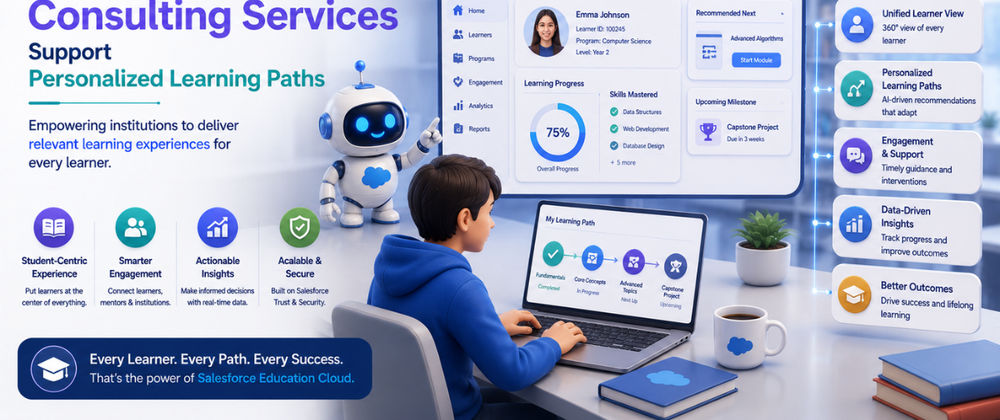

Students no longer accept generic advising or one-size-fits-all coursework. They expect institutions to know their goals, track their progress, and offer support before problems start. Salesforce Education Cloud Consulting Services help schools and universities meet that expectation with real technical infrastructure, not just good intentions.
Personalized Learning Has Become a Student Expectation
Salesforce surveyed over 2,000 students and staff worldwide for its Connected Education Report. The results show a clear shift in what students want. About 82% of students say they need more proactive and
personalized support than they did five years ago.
The stakes are high. Nearly one in four students still fail to make it past their first year of college. Institutions that fix this problem protect both student outcomes and tuition revenue.
AI-driven personalized learning shows real promise here. Research suggests these tools can raise student retention rates by up to 30%. That number explains why so many institutions now invest in platforms like Salesforce Education Cloud to build true personalization at scale.
What Salesforce Education Cloud Brings to Personalized Learning
Salesforce Education Cloud runs on the same CRM foundation businesses use to manage customer relationships. Instead of tracking customers, it tracks the full student lifecycle from prospect to alumnus.
The platform organizes around a few core modules:
- Recruitment and Admissions: Tracks prospective students and application progress.
- Academic Operations: Manages course catalogs, program plans, and scheduling.
- Student Success: Consolidates student data to flag students who need help.
- Student Financials: Handles billing, fees, and payment tracking.
- Advancement and Alumni Relations: Manages donor and alumni engagement after graduation.
Each module feeds into one unified student record. This structure makes personalized learning paths possible, since every interaction adds context to that single profile.
Salesforce has also added Einstein Skills Generator to the platform. This tool studies job market data and program descriptions to tag relevant skills automatically. Counselors then build skill-based learning plans that match real employment demand.
Why Institutions Need Salesforce Education Cloud Consulting
Most institutions run several disconnected systems before adopting Education Cloud. A student information system handles enrollment. A learning management system tracks coursework. A separate tool manages financial aid. None of these systems share data well.
Salesforce's own research confirms this pain point. About 53% of staff say they still struggle to find the data they need to do their jobs. An earlier Connected Student Report found that 31% of faculty and staff deal with multiple technology systems that make data access difficult.
This is exactly where Salesforce Education Cloud Consulting becomes necessary. A consulting team understands how to merge these scattered systems into one connected platform without losing historical data or breaking daily operations.
Common reasons institutions bring in consulting support include:
- Limited internal staff with Salesforce configuration experience.
- Legacy student information systems that resist clean data migration.
- Pressure to launch personalized advising tools within a single semester.
- Complex integration needs across LMS, finance, and admissions systems.
- Compliance requirements tied to student data privacy laws.
How Salesforce Education Cloud Consulting Services Build Personalized Learning Paths
Personalized learning paths do not appear automatically after installing software. They require careful technical setup, and this is the core value of Salesforce Education Cloud Consulting Services.
1. Unified Student Data Foundation
A consulting team starts by mapping data from every existing system into one student profile. This includes academic history, financial status, advising notes, and engagement signals from the LMS. Without this step, personalization stays shallow.
2. Automated Alerts for At-Risk Students
Consultants configure triggers that flag students showing warning signs. A drop in LMS login activity or missed assignments can automatically alert an academic advisor. Early intervention based on these triggers has shown strong results. One five-year study found that targeted academic support raised graduation rates for at-risk student groups by 55% to 60%.
3. AI-Generated Learning Roadmaps
Consultants configure Einstein Skills Generator and related AI tools to build personalized graduation roadmaps. These roadmaps factor in a student's declared major, completed courses, and career goals. Counselors review and adjust these AI-generated plans rather than building them from scratch.
4. Integration with Learning Management Systems
A personalized path needs real academic data, not just enrollment records. Consulting teams connect Education Cloud to LMS platforms so advisors see actual coursework engagement alongside enrollment status.
5. Self-Service Portals for Students
Many implementations include student-facing portals built on Education Cloud. Students check degree progress, register for classes, and message advisors directly. This reduces the manual workload on staff while giving students more control over their own path.
Core Technical Components Behind Personalized Paths
A few technical pieces consistently appear in strong Salesforce Education Cloud Consulting Services implementations.
- Data 360 integration: Pulls data from multiple campus systems into one real-time student record.
- Journey automation: Builds step-by-step communication and advising flows triggered by student behavior.
- Einstein AI tools: Generate skill tags, recommend courses, and support predictive analytics for retention risk.
- Agentforce capabilities: Power conversational AI agents that answer routine student questions instantly.
- Experience Cloud portals: Give students and staff a shared, branded interface for daily interactions.
These components work together rather than as separate tools. A consulting team configures them to pass data back and forth so no piece of the student journey operates in isolation.
A Practical Example of Personalized Path Design
Consider a mid-size university struggling with first-year retention. Academic advisors previously relied on end-of-semester grade reports to spot struggling students. By then, many students had already decided to leave.
A Salesforce Education Cloud Consulting team connects the LMS, attendance system, and financial aid records into one student record. The system flags students with declining engagement after just two weeks instead of a full semester. Advisors reach out early with tailored support options, from tutoring referrals to financial aid adjustments.
This approach matches a documented trend across higher education. Institutions that combine academic support with early intervention triggers consistently report stronger persistence and graduation numbers. The technology does not replace advisors. It gives them better timing and better information.
Measurable Impact of Personalized Learning Paths
Strong implementations should show results in tracked metrics, not just anecdotes. Institutions commonly measure:
- First-year retention rate before and after personalized advising rollout.
- Time-to-degree changes tied to better academic planning tools.
- Advisor caseload efficiency, since automated alerts reduce manual review time.
- Student satisfaction scores related to advising responsiveness.
- Graduation rate gains among flagged at-risk student groups.
Student preference data also supports the push toward AI-assisted personalization. About 54% of students say they would prefer interacting with an autonomous agent over a human if it answers their question faster. This does not eliminate the need for human advisors, but it shows students accept AI-driven support as part of their experience.
Common Challenges Solved by Salesforce Education Cloud Consulting Services
Institutions typically reach out for consulting support after running into one of these problems:
- Fragmented student records spread across admissions, academics, and finance systems.
- Reactive advising that only responds after a student already falls behind.
- Manual roadmap building that consumes hours of advisor time per student.
- Low adoption of new tools due to poor training or confusing interfaces.
- Data privacy gaps that create compliance risk around student records.
A consulting partner addresses these issues through proper architecture, not quick fixes. Configuration choices made early in an implementation determine how well personalization scales as enrollment grows.
Choosing the Right Salesforce Education Cloud Consulting Partner
Education technology projects carry higher stakes than typical business software rollouts. Student data, compliance rules, and academic operations all depend on getting the setup right.
Look for a consulting partner with:
- Direct experience in higher education or K-12 environments, not just general CRM work.
- Certified Salesforce Education Cloud consultants with hands-on implementation history.
- A clear data migration plan for moving records from legacy student information systems.
- Post-launch support to handle issues that surface after staff and students start using the system daily.
- Training programs for advisors, faculty, and administrative staff.
Institutions should ask for references from similar-sized schools. A firm experienced with small colleges may not handle the complexity of a multi-campus university system well.
The Future of Personalized Learning with Salesforce Education Cloud
AI adoption in higher education keeps accelerating. A 2025 survey of more than 800 institutions found that 57% now prioritize AI initiatives, up from 49% the year before. Personalized learning sits at the center of that priority shift.
Expect these trends to shape future implementations:
- Greater use of Agentforce-style AI agents for routine student questions.
- Skills-based program design driven by labor market data.
- Predictive analytics expanding from retention risk into career outcome forecasting.
- Tighter integration between academic systems and workforce development programs.
Institutions that build flexible, well-integrated Education Cloud foundations now will adopt these new capabilities faster than those still managing scattered systems.
Final Thoughts
Personalized learning paths depend on accurate data, timely alerts, and tools that fit into a student's daily routine. Salesforce Education Cloud provides the technical foundation for this work, but configuration quality decides the outcome.
Institutions that pair the platform with experienced Salesforce Education Cloud Consulting Services build personalization that actually changes student outcomes. The difference shows up in retention numbers, graduation rates, and the daily experience of every student the system is built to support.





Top comments (0)