
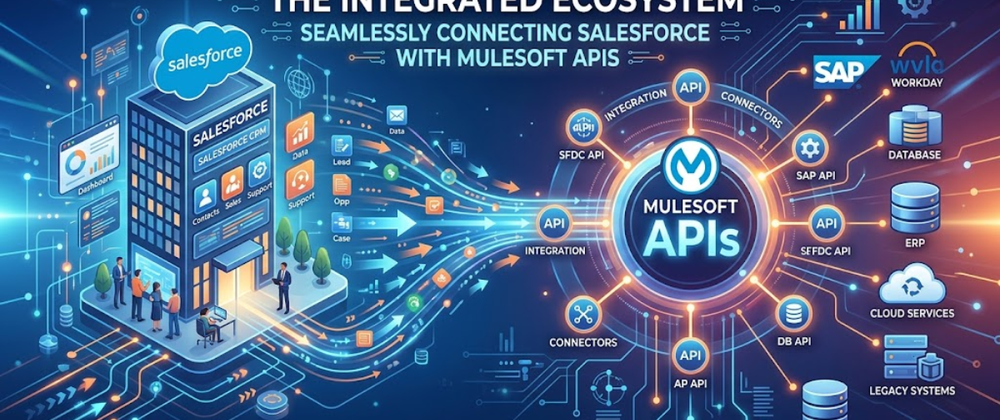

In the high-speed economy of 2026, data is the most valuable asset of any enterprise. However, data only provides value when it flows freely across the organization. Many businesses still struggle with "data gravity," where information remains stuck in isolated legacy systems. Disconnected systems represent a silent killer of efficiency. To solve this, industry leaders move away from fragile point-to-point connections. They now embrace an integrated ecosystem.
The combination of Salesforce and MuleSoft creates the gold standard for enterprise connectivity. Salesforce acts as the primary engagement hub for customers. MuleSoft serves as the universal engine that connects that hub to every other part of the business. This explores the technical framework of this partnership through the lens of Salesforce Consulting. We will examine how Salesforce Consulting Services help firms build resilient, API-led architectures.
The Architecture of Connectivity: API-Led Design
The secret to a successful Salesforce and MuleSoft integration is not just "connecting pipes." It is about a fundamental shift in architectural mindset. This shift is known as API-led connectivity. Unlike traditional middleware, this approach breaks integration into three distinct layers. Each layer serves a specific technical and business purpose.
1. System APIs: Standardizing the Core
System APIs sit at the bottom of the stack. They interact directly with your systems of record. These systems might include SAP ERP, Oracle databases, or legacy mainframes. The goal here is to insulate the rest of the business from the complexity of the underlying system. If you upgrade your ERP, the System API stays the same. This decoupling prevents "integration breakage" during major software updates.
2. Process APIs: Defining the Logic
Process APIs sit in the middle. They do not care where the data comes from. Instead, they focus on the business logic. For example, a "Process Order" API might pull customer data from Salesforce and inventory data from an ERP. It then combines them to create a fulfillment request. These APIs are highly reusable. One "Process Order" API can support your website, your mobile app, and your internal sales tools simultaneously.
3. Experience APIs: Customizing the Output
Experience APIs are the top layer. They format the data for a specific end-user or device. A mobile app needs a small, light data packet. A desktop dashboard needs a rich, complex dataset. Experience APIs allow you to serve both needs using the same underlying logic.
Why Enterprises Choose MuleSoft for Salesforce
Many tools can connect apps. However, MuleSoft offers a level of depth that others cannot match. Salesforce Consulting Services often recommend MuleSoft for large-scale operations for several technical reasons.
1. Massive ROI and Speed
Recent 2025 Forrester studies show that MuleSoft delivers an average ROI of 426% over three years. Organizations using the platform see a 60% acceleration in IT project delivery. This speed comes from "API reuse." Once a developer builds a System API for a database, every other project can use it. You stop building from scratch and start building with blocks.
2. Built-in Salesforce Connectors
MuleSoft is owned by Salesforce. This relationship results in highly optimized, "out-of-the-box" connectors. These connectors handle complex Salesforce-specific tasks. This includes managing Bulk API limits and handling Change Data Capture (CDC). Without these tools, developers would spend hundreds of hours writing custom code to manage Salesforce's internal governor limits.
3. Real-Time Resiliency
Modern retail and finance require sub-second updates. If a customer changes their address in a mobile app, it must reflect in Salesforce and the shipping system immediately. MuleSoft supports event-driven architecture. It uses message queues like Anypoint MQ to ensure data arrives even if a system is temporarily offline.
The Role of Salesforce Consulting in Integration
Building an integrated ecosystem is a complex task. It requires a blend of deep CRM knowledge and specialized middleware expertise. This is where Salesforce Consulting becomes essential.
A consultant does not just write code. They design the strategy. They ensure that the integration follows global security standards. For example, they implement OAuth 2.0 and token-based authentication across all API endpoints. They also manage "Data Governance." They define which system is the "Master" for specific data fields. If Salesforce and an ERP disagree on a customer's credit score, the consultant's architecture decides which one wins.
Experienced Salesforce Consulting Services also help with "Org Health." Over-integrating can slow down a Salesforce instance. A consultant ensures that only necessary data enters the CRM. This prevents the "Data Swamp" effect and keeps the user interface fast for sales reps.
Integrating AI with MuleSoft and Salesforce
By 2026, the integration conversation has shifted toward AI. Salesforce's "Agentforce" allows businesses to deploy autonomous AI agents. These agents can talk to customers, solve problems, and take actions. However, an AI agent is only as smart as the data it can access.
MuleSoft acts as the "hands and feet" of the AI agent. When an agent needs to check a refund status in a legacy financial system, it calls a MuleSoft API. Salesforce Consulting teams now focus on building "AI-ready" APIs. These APIs are fast, secure, and return data in formats that AI models can easily process.
According to market data, organizations using AI-augmented integration see a 50% deflection in routine service requests. This is because the AI can actually do things across different systems, rather than just answering questions.
Technical Pitfalls in MuleSoft Integration
Even with the best tools, things can go wrong. Experts avoid these common mistakes:
- Point-to-Point Shortcuts: Teams often skip the "Process API" layer to save time. This creates a "spaghetti" of connections that break during the next system update.
- Ignoring Error Handling: What happens if the ERP is down? A good architecture includes "Retry Logic." MuleSoft can hold the data in a queue and try again every five minutes until the system recovers.
- Security Afterthoughts: Security must be "Baked In," not "Bolted On." Developers should apply security policies—like rate limiting and IP whitelisting—at the API Manager level.
- Poor Data Mapping: If the "Phone Number" field in the ERP is 10 digits and Salesforce allows 20, the integration will fail. Developers must use "DataWeave"—MuleSoft's powerful transformation language—to map these differences.
Financial and Operational Impacts
The financial argument for a unified ecosystem is strong. Beyond the 426% ROI, the operational gains are significant:
- Maintenance Savings: Reusable APIs reduce ongoing management costs by 70%.
- Employee Productivity: Sales reps spend 25% less time on manual data entry.
- Market Agility: Companies with a "Composable Architecture" launch new digital products 40% faster.
- Error Reduction: Automated syncing reduces manual data errors by up to 80%. These stats show that integration is a profit center. It is an investment in the speed and accuracy of the entire business.
Case Study: Global Logistics Transformation
A mid-sized logistics firm managed its fleet in a legacy mainframe. They managed their customers in Salesforce. The two systems did not talk. Customer service agents had to log into the mainframe to find a package. This took five minutes per call.
They hired a firm for Salesforce Consulting Services. The team used MuleSoft to create a System API for the mainframe. They then built an Experience API for a custom Lightning Web Component (LWC) in Salesforce.
Now, when a rep opens a customer record, the package location appears instantly. The "Time-to-Resolution" dropped from 10 minutes to 3 minutes. The company handled 30% more calls without hiring more staff. This is the power of a seamlessly connected ecosystem.
The Future: Zero-Copy and Data Fabric
As we move deeper into 2026, the trend of "Zero-Copy" integration is rising. This allows Salesforce to "read" data from external sources like Snowflake or Databricks without actually moving the data. This reduces storage costs and ensures data is always live.
MuleSoft remains critical in this future. It acts as the governance layer. It ensures that the "Zero-Copy" connection is secure and that the data is formatted correctly for the Salesforce user. We are moving toward a "Data Fabric" where the physical location of the data no longer matters. The integrated ecosystem makes the entire enterprise feel like a single, unified app.
Conclusion
Connecting Salesforce with MuleSoft is more than a technical project. It is a commitment to business agility. It turns your IT department from a "cost center" into a "value enabler." By adopting an API-led approach, you build a foundation that can survive any market shift.
Whether you are automating a simple lead-to-cash process or powering complex AI agents, the integration layer is the key. Working with expert Salesforce Consulting ensures that your architecture is scalable, secure, and future-proof. Salesforce Consulting Services provide the roadmap you need to navigate this complex terrain.
In 2026, the most successful companies are the most connected ones. They have no silos. They have no "data graveyards." They have a living, breathing ecosystem where information flows at the speed of thought. Start building your integrated ecosystem today. Unlock your data,







Top comments (0)