

Why do ice cream sales and drowning incidents sometimes increase during the same months? Both patterns may appear connected, but does buying ice cream actually increase the risk of drowning? This question illustrates an important challenge in scientific reasoning.
Understanding the Difference Between Correlation and Causation
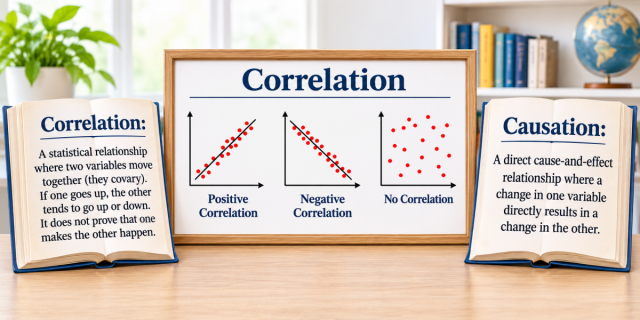
Correlation describes a relationship in which two variables change together, either in similar or opposite directions. When scientists identify this pattern, they can investigate whether the relationship deserves further attention.
Causation makes a stronger claim because it suggests that changes in one factor directly influence another. Establishing this connection requires evidence beyond observing that two events happen together.
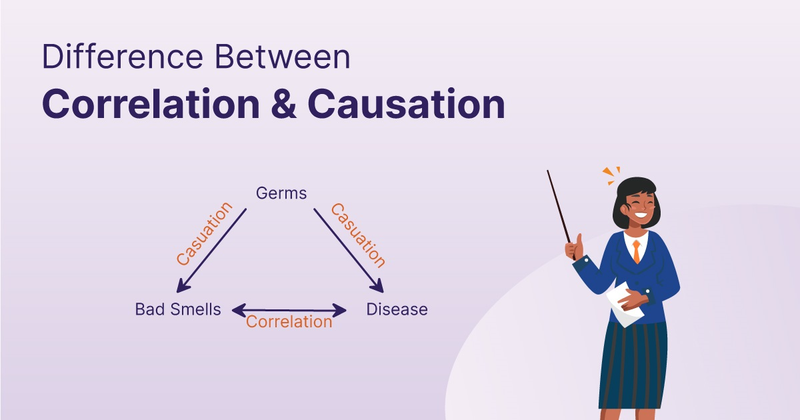
Consider ice cream sales and drowning incidents during summer. Both may increase because warmer weather encourages people to buy cold desserts and spend more time swimming. Temperature is a possible third factor influencing both observations.
Scientists call such an influence a confounding variable because it can create or distort an apparent relationship. Recognising these possibilities helps researchers avoid conclusions that the available evidence cannot support.
Examining Evidence Before Making Causal Claims
Researchers begin by identifying variables, collecting reliable measurements, and examining whether their relationship appears consistently. Statistical methods can describe the direction and strength of an association, but cannot independently explain its cause.
A positive correlation means two measured variables tend to increase together, while a negative correlation means one tends to decrease. Neither pattern automatically establishes that one variable produces changes in the other.
To investigate causation, researchers consider whether the proposed cause occurs before its supposed effect. They also examine alternative explanations, possible confounding factors, and whether other studies produce similar findings.
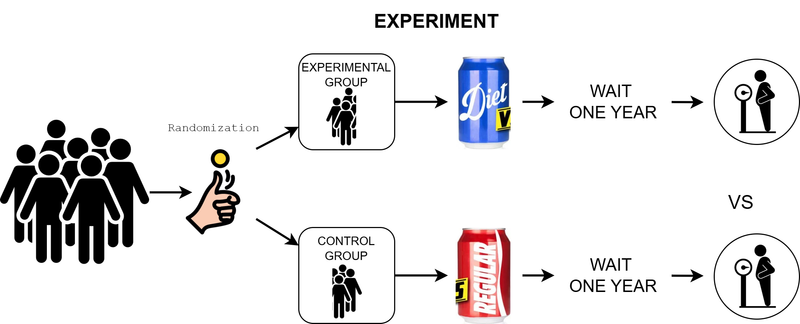
Controlled experiments can provide stronger causal evidence when researchers can safely manipulate one variable. Random assignment helps create comparable groups, reducing the influence of differences that might otherwise affect results.
However, experiments are not always ethical, practical, or possible in natural settings. Researchers therefore also use carefully designed observational studies, statistical adjustments, and evidence from different research methods.

Reaching Conclusions That Match the Evidence
Scientific conclusions should reflect the quality, consistency, and limitations of the available evidence. A single study may reveal an interesting relationship without establishing whether that relationship represents a genuine cause.
For example, researchers studying plant growth might observe that areas receiving more sunlight also contain taller plants. They must consider water availability, soil quality, plant species, and other environmental influences.
Repeated observations, controlled experiments, and biological explanations can gradually strengthen a proposed causal relationship. Researchers should still acknowledge uncertainty when important variables remain difficult to measure or control.
The National Academies' Reference Manual on Scientific Evidence explains why associations alone cannot establish causation. It highlights the importance of considering alternative explanations and identifying possible confounding variables.
Ultimately, correlation helps scientists recognise patterns, while causal investigation examines why those patterns occur. Strong conclusions emerge when several forms of evidence support the same reasonable explanation.






Top comments (0)