
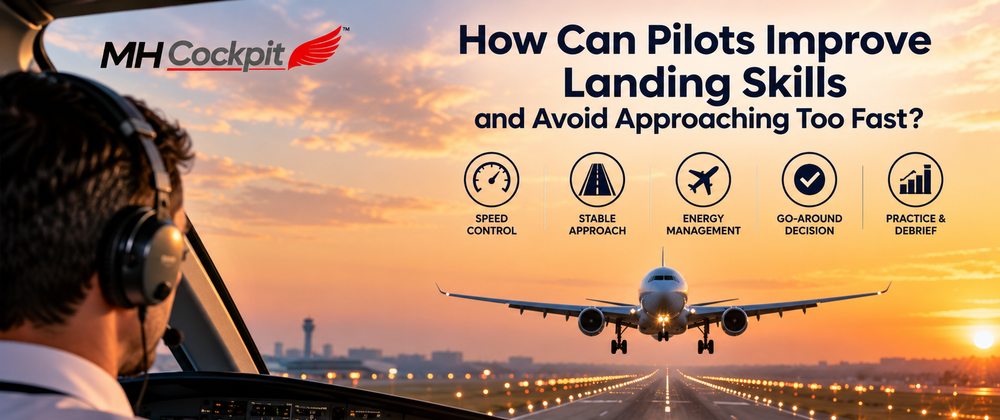

Landing an aircraft safely requires more than accurate flying. Pilots must manage airspeed, altitude, descent rate, aircraft configuration, and runway alignment throughout the final approach. Approaching too fast can cause an aircraft to float above the runway, touch down farther than intended, and require a longer landing distance.
For student pilots and experienced aviators alike, improving landing skills involves consistent practice, sound energy management, and following established operating procedures.
- Understand the Correct Approach Speed
Approach speed is one of the most important factors in a safe landing. Pilots must use the speed specified by the aircraft's operating procedures, considering aircraft weight, flap configuration, wind conditions, and other applicable factors.
Carrying excess speed increases the aircraft's kinetic energy. During landing, this can result in prolonged floating after the flare begins, delaying touchdown and reducing the runway available for stopping.
Pilots should monitor indicated airspeed throughout the approach and make corrections early. The objective is not simply to reduce speed, but to maintain the correct speed for the aircraft's configuration and conditions.
- Maintain a Stabilised Approach
A stabilised approach allows pilots to arrive at the runway with the aircraft under control and configured for landing. It generally involves maintaining the prescribed airspeed, descent path, landing configuration, and runway alignment.
Large corrections close to the ground can make the approach harder to manage. Pilots should therefore monitor deviations early and make smooth adjustments according to their training and operating procedures.
Airline operators establish stabilisation criteria for their aircraft and operations. If an approach does not meet the required criteria, pilots should execute a go-around rather than attempt to force the landing.
- Manage Aircraft Energy Before Final Approach
Energy management is an important part of avoiding excessive approach speed. An aircraft that is both high and fast may require corrections well before reaching the runway.
Pilots can reduce the likelihood of this situation by following the planned descent profile, configuring the aircraft at the prescribed stages, and monitoring thrust and vertical path.
Trying to lose excess altitude or speed through abrupt manoeuvres can create additional risks. The better approach is to identify deviations early and follow the aircraft's approved procedures.
Weather conditions also matter. Headwinds, tailwinds, gusts, and wind changes can affect the aircraft's approach performance. Pilots must account for these conditions using the applicable operating guidance rather than relying on a fixed speed or power setting in every situation.
- Practise Flare and Touchdown Techniques
The flare is the transition from the final approach to touchdown. It requires pilots to judge the aircraft's height, attitude, speed, and sink rate while maintaining runway alignment.
One common landing difficulty occurs when an aircraft approaches with excess speed. Even if the flare is initiated correctly, the aircraft may continue floating above the runway before touching down.
Simulator sessions and instructor-led practice can help pilots identify errors in flare timing, pitch control, and touchdown judgement. Reviewing these sessions also helps pilots understand how different approach speeds and configurations affect landing performance.
Pilots should follow the procedures appropriate to their aircraft rather than trying to copy a single technique across different aircraft types.
- Use Flight Debriefing to Identify Recurring Errors
Improving landing performance requires more than completing repeated approaches. Pilots also need to understand why a landing did not go as planned.
A structured debrief can review approach speed, descent rate, configuration timing, runway alignment, flare technique, and touchdown position. Simulator recordings and available flight data can help reveal recurring patterns.
For example, a pilot who repeatedly arrives above the target speed may need to review configuration timing and energy management earlier in the approach. A pilot who frequently floats beyond the intended touchdown area may need further supervised practice with speed control and flare judgement.
Specific feedback makes practice more focused and helps pilots track their progress.
- Know When to Go Around
A go-around is a normal safety procedure when an approach cannot be completed safely. An unstable approach, an unsuitable runway situation, or failure to meet required landing criteria may call for a go-around in accordance with the applicable procedures.
Pilots should not treat every approach as a landing that must be completed. Making a timely decision allows the crew to discontinue an unsafe approach and follow the prescribed procedure.
Good judgement is just as important as aircraft handling. A safe pilot knows when to continue and when to try again.
Building a Strong Foundation in Pilot Training
Landing proficiency develops through a combination of theoretical knowledge, practical flight experience, instructor feedback, and simulator practice. Students preparing for a commercial pilot career should understand aircraft performance, aerodynamics, weather effects, and standard operating procedures alongside hands-on flight training.
Aspiring pilots in India can learn more about the training pathway in this guide to how to become a commercial pilot in India. MH Cockpit Aviation Academy, based in Chennai, provides CPL ground training and DGCA exam preparation as part of the wider preparation required for a commercial pilot career.
Ultimately, pilots improve their landings by managing energy early, maintaining a stabilised approach, practising consistently, and making sound go-around decisions. These habits help reduce avoidable approach errors and support safer, more controlled landings.





Top comments (0)