
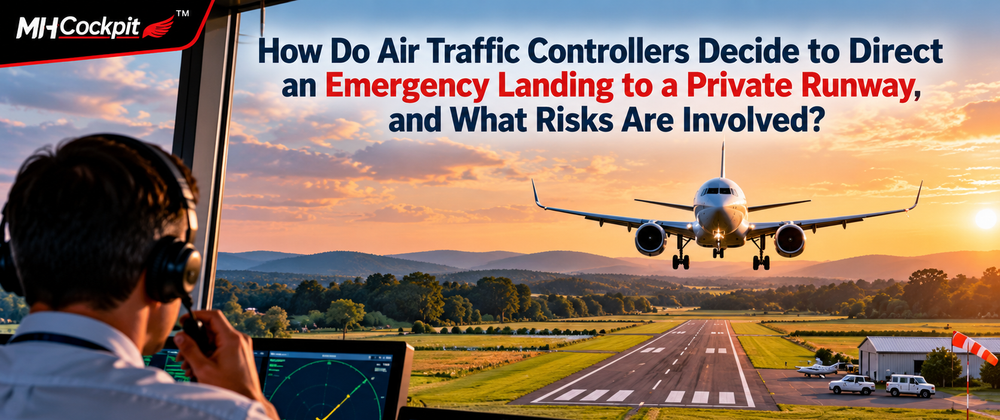

When an aircraft has an emergency and the nearest suitable landing option happens to be a private runway, the decision is not simply about finding the closest strip of pavement. The controller has to consider whether that runway can realistically accommodate the aircraft and whether using it is safer than continuing toward a normal airport.
In an emergency, ATC's role is to provide as much assistance as possible. The FAA's emergency procedures specifically say controllers should use the information available, obtain additional information when needed, and provide assistance consistent with the pilot's requests. If the controller believes another option would be better, that recommendation can be passed to the pilot.
The first question would usually be what the pilot actually needs. An aircraft with an engine problem may need a runway quickly, while an aircraft with a medical emergency may have more time to reach a suitable airport. The controller would look at the aircraft's position, remaining fuel, altitude, weather, wind, terrain, runway orientation, runway length and the nature of the emergency. The aircraft's size and performance matter too. A small training aircraft might be able to use a private grass strip that would be completely unsuitable for a large commercial aircraft.
A private runway can become an option when the normal airports are too far away or when reaching one would introduce greater risk. ATC may have information about private or restricted-use airfields, but the controller does not magically turn an unsuitable runway into a safe airport. The pilot remains responsible for the actual decision to land the aircraft. In the United States, emergency authority gives the pilot in command considerable discretion to deviate from normal rules when immediate action is necessary.
There are several risks with using a private runway. The runway may be shorter than the pilot expects, may not have adequate lighting, may have obstacles close to the approach or departure path, or may have a surface that is unsuitable for the aircraft. There could also be people, vehicles, agricultural equipment or other aircraft operating around the property. Unlike a major airport, there may be no fire and rescue service standing by.
Another issue is information. A controller may know that a private runway exists without having the same current information available for it as they would for a controlled airport. Weather conditions may have changed, the runway could be wet, or an obstacle could affect the approach. This is one reason why ATC would normally prefer a suitable established airport when there is enough time to reach one.
The pilot also has the final say. ATC can recommend a runway, provide headings, clear surrounding traffic and coordinate emergency services, but controllers do not take command of the aircraft. FAA procedures specifically refer to the pilot's responsibility and authority during an emergency.
So, if a controller directs an emergency aircraft toward a private runway, it is generally because the runway appears to offer a better chance of survival than the alternatives available at that moment. It is a risk-management decision rather than a normal landing clearance.
This is something we discuss at MH Cockpit when explaining emergency decision-making to aviation students. The important lesson is that emergency procedures are not about finding a perfect solution. They are about choosing the safest realistic option with the information available and giving the pilot enough support to make that decision.






Top comments (0)