
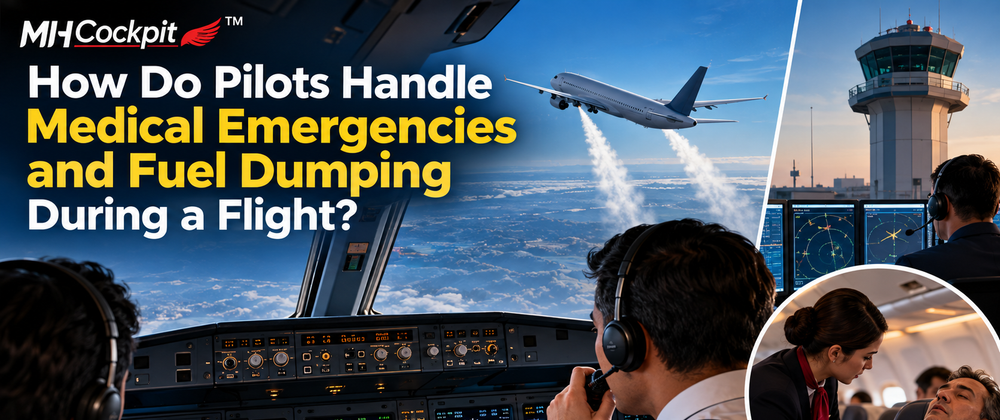

A medical emergency during a flight can require pilots to make several important decisions within a short period. Whether a passenger experiences a serious medical condition or a crew member becomes unwell, pilots must assess the situation, communicate with air traffic control (ATC) and decide whether the aircraft needs to divert.
In some situations, pilots may also need to consider fuel dumping, particularly when an aircraft has to land shortly after take-off. However, fuel dumping is not always necessary, and the decision depends on the aircraft type, fuel load and urgency of the emergency.
Understanding how pilots manage these situations provides a useful look at the communication and decision-making involved in airline operations.
How Do Pilots Communicate With Air Traffic Control During a Medical Emergency?
The first step is to assess the medical situation. Cabin crew members usually inform the flight deck about the passenger's condition, any symptoms they have observed and the assistance already provided.
If the situation requires an immediate landing, pilots contact ATC and explain the circumstances. They may declare a Mayday for a life-threatening emergency or use Pan-Pan for an urgent situation that does not present an immediate threat to the aircraft.
During the communication, pilots provide their aircraft identification, current position, the nature of the emergency and their intended course of action. They may request a diversion to a suitable airport and priority handling.
ATC can then help by providing a suitable route, coordinating with other aircraft and arranging priority landing. Depending on the airport's facilities, controllers may also coordinate with emergency services so medical assistance is available when the aircraft arrives.
How Do Pilots Decide Whether to Divert?
Not every medical emergency requires an immediate diversion. Pilots consider the information provided by the cabin crew, the passenger's condition and any advice available from ground-based medical support.
If the situation is serious, the crew may decide to land at the nearest suitable airport. However, the nearest airport is not always the most appropriate option. Runway length, weather, aircraft performance and the availability of medical facilities can all affect the decision.
Pilots also consider the aircraft's fuel level and current weight. These factors help determine whether the aircraft can land safely at the selected airport and whether any additional procedures are necessary.
The final decision rests with the pilots, who must consider both the medical emergency and the safe operation of the aircraft.
When Is Fuel Dumping Necessary?
Fuel dumping, also known as fuel jettison, is a procedure that allows certain aircraft to release excess fuel before landing. It is generally considered when an aircraft needs to land shortly after take-off and is still carrying a large amount of fuel.
Aircraft have a maximum take-off weight and a maximum landing weight. These limits are not necessarily the same. Some large aircraft can take off with considerably more weight than they are normally permitted to carry when landing.
For example, if a medical emergency occurs shortly after departure, the aircraft may still be carrying enough fuel to exceed its normal maximum landing weight. In such circumstances, pilots may consider fuel dumping if the aircraft is equipped with the necessary system and there is sufficient time.
However, fuel dumping is not compulsory. If the passenger's condition requires an immediate landing, pilots can land above the normal maximum landing weight when necessary, following the aircraft manufacturer's emergency procedures.
How Do Pilots Coordinate Fuel Dumping With ATC?
If fuel dumping is required, pilots inform ATC about their intention and follow the aircraft's prescribed procedures. ATC can help identify a suitable area, taking into account other aircraft and local airspace restrictions.
Pilots follow the required altitude and operating limitations while monitoring the fuel remaining. They stop dumping once the required fuel reduction has been achieved or when the situation calls for an earlier landing.
Not all passenger aircraft have fuel-dumping systems. Some aircraft are designed to land at higher weights when required, while others may need to remain airborne to burn fuel if the situation allows.
This is why pilots must understand the specific aircraft they operate rather than follow a single procedure for every emergency.
What Happens If Pilots Have to Land Without Dumping Fuel?
In a serious medical emergency, waiting to reduce fuel may not be appropriate. Pilots can choose to land with more fuel than the normal maximum landing weight if the circumstances require it.
An overweight landing may involve additional precautions and inspections after the aircraft reaches the ground. The exact requirements depend on the aircraft type and the manufacturer's instructions.
Throughout the approach and landing, pilots consider runway conditions, aircraft handling and available emergency services. ATC helps coordinate the arrival, but the flight crew remains responsible for operating the aircraft.
Why Is Emergency Communication Important for Pilots?
Medical emergencies demonstrate why clear communication between pilots, cabin crew and ATC is important. The cabin crew provides information about the passenger, pilots assess the situation and ATC helps arrange the necessary air traffic support.
Pilots must also make decisions without unnecessary delays. They need to balance the urgency of the medical situation with aircraft performance, fuel requirements and landing conditions.
For student pilots, learning about these situations helps connect theoretical knowledge of emergency procedures with practical flight operations. Training references from MH Cockpit can also help students learn more about aviation procedures and flight-related scenarios.
Conclusion
Managing a medical emergency involves more than requesting an immediate landing. Pilots must assess the situation, communicate with ATC, select a suitable airport and decide whether fuel dumping is necessary.
Fuel dumping can help reduce aircraft weight before landing, but it is not available on every aircraft or required in every emergency. When time is critical, pilots may choose to land without dumping fuel, following the appropriate emergency procedures.
Understanding these decisions gives aspiring pilots a clearer idea of how emergency communication, aircraft performance and flight safety work together during real-world operations.






Top comments (0)