
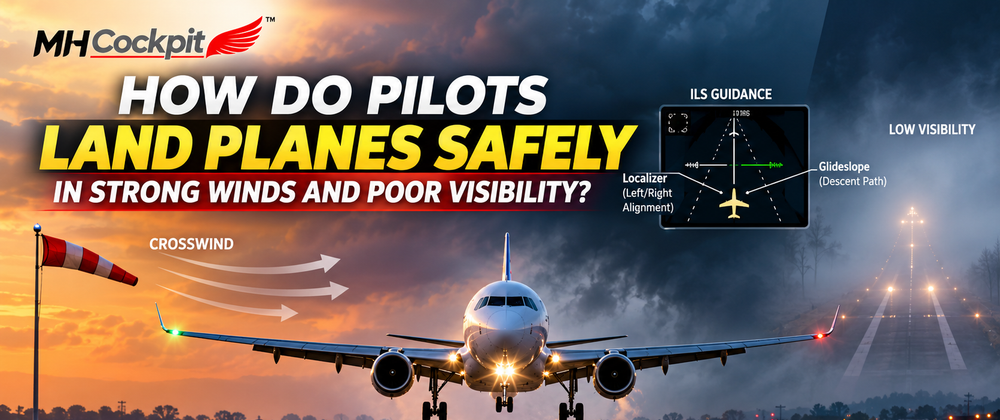

Landing an aircraft is one of the most demanding stages of a flight. Pilots must manage speed, altitude, direction, and descent while accounting for changing weather conditions. Strong crosswinds, fog, rain, and sudden wind changes can make the task more challenging. Yet, pilots are trained to handle these situations using flight instruments, navigation systems, and established procedures.
Understanding how aircraft approach and align with a runway also offers a useful introduction to aviation for students considering a career in flying.
- How Pilots Align an Aircraft With a Runway
Pilots begin preparing for landing well before reaching the airport. Air traffic control provides instructions, while the crew reviews the approach procedure, weather reports, runway conditions, and aircraft performance.
During the approach, pilots use navigation instruments to maintain the correct flight path. One widely used system is the Instrument Landing System (ILS), which provides lateral guidance towards the runway centreline and vertical guidance along the descent path.
Pilots also monitor their altitude, airspeed, descent rate, and position. These checks help them identify deviations early and make controlled corrections.
When the runway becomes visible, they use visual references such as the centreline markings, runway edges, and approach lights to confirm alignment. The objective is to reach the runway at a safe speed, height, and direction.
- How Crosswinds Affect Aircraft Landings
A crosswind blows across the runway rather than directly along it. This can push an aircraft sideways during its approach, making runway alignment more difficult.
Pilots commonly use two techniques to manage crosswinds.
The crab technique: The pilot points the aircraft's nose slightly into the wind. Although the nose is angled relative to the runway, the aircraft's overall flight path remains aligned with the centreline.
The wing-low technique: The pilot lowers the upwind wing slightly and applies opposite rudder to keep the aircraft's nose aligned with the runway. This helps counter sideways drift during the final stage of landing.
Depending on the aircraft and operating procedures, pilots may transition from a crab approach to a wing-low position near touchdown. The correct technique depends on wind conditions, aircraft characteristics, and the manufacturer's procedures.
- How Pilots Land in Poor Visibility
Fog, heavy rain, and low cloud can prevent pilots from seeing the runway until late in the approach. In these situations, approved instrument approaches provide guidance even when visual references are limited.
An ILS approach can help suitably equipped aircraft maintain the required lateral and vertical path. Some airports and aircraft also support automatic landing systems under approved conditions.
However, an instrument approach does not mean that every aircraft can land in any visibility. The permitted limits depend on the aircraft's equipment, airport facilities, crew qualifications, operator approvals, and applicable regulations.
If the required conditions are not met, pilots must discontinue the approach or divert to another airport when necessary.
- What Happens When the Wind Changes Suddenly?
Wind conditions can change during the final approach. A sudden change in wind speed or direction may affect an aircraft's airspeed, lift, and flight path.
One particularly challenging condition is wind shear, which involves a rapid change in wind speed or direction over a relatively short distance. It can affect an aircraft during take-off or landing.
Pilots receive weather information, monitor aircraft indications, and follow specific wind-shear procedures. If the approach becomes unstable or cannot be continued safely, they may perform a go-around.
A go-around involves discontinuing the landing approach and climbing away from the runway before attempting another approach or proceeding elsewhere. It is a normal safety procedure, not necessarily a sign that something has gone wrong.
- Why Pilot Training Matters
Accurate landings require a combination of theoretical knowledge, practical flying skills, decision-making, and repeated training. Pilots must understand aerodynamics, navigation, meteorology, aircraft systems, and the procedures relevant to the aircraft they operate.
Simulator training allows pilots to practise challenging scenarios, including crosswinds, poor visibility, instrument failures, and unstable approaches, in a controlled environment.
For students interested in aviation, ground training provides the theoretical foundation needed to understand these procedures. Subjects such as navigation, meteorology, and flight instruments help explain how pilots make decisions during different stages of flight.
Students in India who want to learn more about pilot training can refer to MH Cockpit Aviation Academy, which provides information about becoming a commercial pilot in India and the training pathway involved.
Conclusion
Landing an aircraft safely is not simply about aiming for the runway. It involves continuous monitoring, accurate navigation, wind correction, and sound decision-making. Instrument guidance helps pilots maintain the correct approach path, while crosswind techniques allow them to manage sideways drift.
Just as importantly, pilots must know when to stop an approach and try again. A safe landing depends not only on technical ability but also on following procedures and recognising the limits imposed by weather, aircraft performance, and operating conditions.







Top comments (0)