
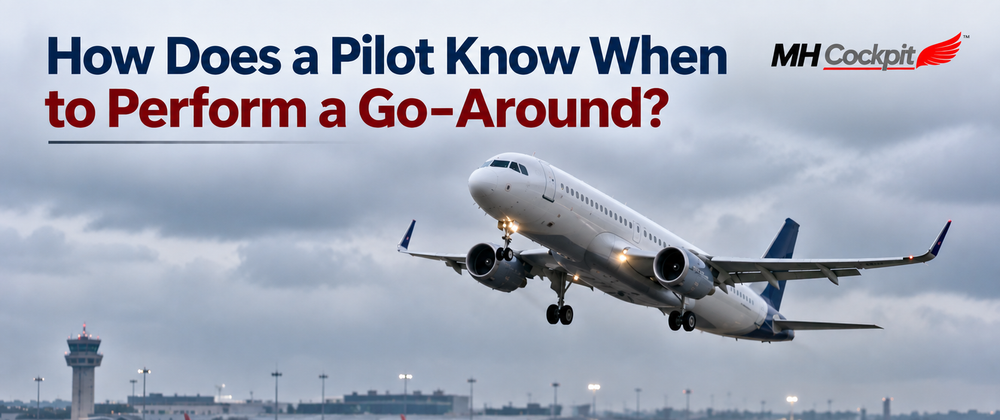

For most passengers, landing is expected to be the final stage of a flight. The aircraft descends, the runway gets closer, and everyone prepares for touchdown. Occasionally, however, an aircraft may suddenly increase power and begin climbing again instead of landing.
This is called a go-around.
Although it can surprise passengers, a go-around is a normal aviation procedure. It does not automatically mean that the aircraft has experienced an emergency or that something has gone seriously wrong. In many cases, it simply means the pilots have decided that continuing the landing is not the safest option at that particular moment.
So, how does a pilot know when it is time to perform a go-around?
The Importance of a Stabilised Approach
One of the main factors pilots consider is whether the aircraft is established on a stable approach.
Before landing, the aircraft needs to meet specific conditions. Depending on the aircraft, airline procedures, and type of approach, this generally includes being at an appropriate speed, altitude, descent rate, and configuration while remaining correctly aligned with the runway.
If an aircraft is too high, too fast, descending too quickly, or not properly aligned with the runway, the pilots may have limited time and distance to correct the situation safely.
Rather than trying to force the aircraft onto the runway, pilots can perform a go-around and set up for another approach.
This is an important part of pilot decision-making. A landing does not have to be completed simply because the aircraft is already close to the runway.
When Weather Conditions Affect the Landing
Weather is another reason a go-around may be required.
An aircraft can begin an approach under acceptable conditions, but weather can change quickly. Heavy rain, low visibility, strong winds, crosswinds, or wind shear may affect the approach and make it unsuitable to continue.
During certain types of instrument approaches, pilots are required to have the necessary visual references by a specified point in the approach. If they do not meet those requirements, they must follow the missed approach procedure.
In simple terms, pilots cannot continue descending indefinitely while hoping that the runway will eventually become visible. There are established procedures that determine when an approach must be discontinued.
What If the Runway Is Not Clear?
A runway must be clear before an aircraft lands.
There are situations where another aircraft may still be on the runway, a vehicle may be crossing, or another unexpected situation may occur. In such cases, Air Traffic Control may instruct the approaching aircraft to go around.
Pilots may also initiate a go-around themselves if they identify that the runway is not safe for landing.
This is why communication between pilots and Air Traffic Control remains important throughout the approach and landing.
Go-Arounds Are Briefed Before the Approach
A go-around is not usually something the pilots suddenly have to figure out when a problem develops.
Before beginning the approach, pilots typically review and brief the relevant procedures. This includes discussing what they will do if the landing cannot be continued.
The crew will know the expected climb procedure, the initial flight path, and other actions required after initiating a go-around.
This preparation is one reason why a go-around can be carried out in an organised and controlled manner. The possibility has already been considered before the aircraft begins its final approach.
Pilots Do Not Wait for an Emergency
One of the most important things to understand about go-arounds is that pilots do not have to wait for a serious emergency before performing one.
Sometimes the approach simply does not meet the required criteria.
The aircraft may be slightly unstable, the weather may not provide the required visibility, or the runway situation may change. In these circumstances, continuing with the landing may not be the best option.
A go-around gives the crew another opportunity to assess the situation and prepare for a safer approach.
What Happens During a Go-Around?
When a go-around is initiated, the pilots increase thrust and begin climbing away from the runway. They follow the required go-around or missed approach procedure and coordinate with Air Traffic Control.
The aircraft may then be given instructions for another approach.
In some situations, the aircraft may enter a holding pattern while waiting for better conditions. If weather or other operational factors make another landing attempt unsuitable, the crew may decide to divert to another airport.
For passengers, the experience may involve a sudden increase in engine power followed by a climb. While this can feel unexpected, it is a procedure that pilots regularly train for.
Why Go-Around Training Matters
Pilots practise go-arounds repeatedly during their training because the decision needs to be understood and the procedure needs to become familiar.
A friend of mine who trained at a flight school in Chennai once mentioned that go-around procedures were practised so frequently during training that responding to one eventually became almost instinctive.
That is really the purpose of training.
A go-around is not something a pilot has to invent when a landing becomes difficult. It is a procedure that has been practised and prepared for repeatedly so that, when the situation requires it, the crew can make the decision and carry out the required actions without hesitation.
For students interested in understanding pilot training, flight operations, and the decision-making involved in commercial aviation, learning about procedures such as go-arounds provides a useful picture of how pilots are trained to prioritise safety throughout a flight.
Resources and discussions from aviation education platforms such as MH Cockpit can also help students understand how pilot training goes beyond simply learning how to control an aircraft. Decision-making, procedures, communication, and preparation are equally important parts of becoming a professional pilot.
Final Thoughts
A pilot performs a go-around when continuing the approach or landing no longer meets the conditions required for a safe landing.
The reason could be an unstable approach, poor weather, limited visibility, strong winds, an occupied runway, or instructions from Air Traffic Control.
For passengers, a go-around may feel unexpected. For pilots, however, it is a planned procedure that is considered before the approach and practised throughout training.
In aviation, choosing not to land can sometimes be the best decision. A go-around gives the crew another opportunity to approach the runway under better and safer conditions.







Top comments (0)