
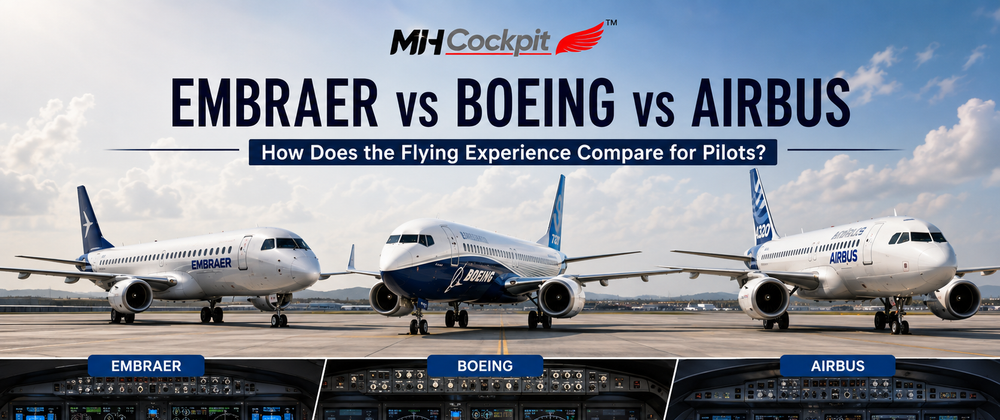

For someone outside aviation, an Embraer, Boeing, and Airbus may seem like different versions of the same thing: commercial aircraft designed to carry passengers safely from one airport to another. From a pilot's point of view, however, every aircraft type has its own handling characteristics, cockpit layout, automation logic, and operating procedures.
The basic principles of flying do not change. Pilots still use the same fundamental knowledge of aerodynamics, navigation, weather, aircraft performance, and aviation regulations. What changes is the way a particular aircraft is designed to be operated. This is one of the main reasons why commercial pilots require aircraft-specific training and type ratings.
Different Manufacturers, Different Cockpit Philosophies
One of the most noticeable differences between aircraft manufacturers is their approach to cockpit design and flight controls.
Modern Airbus aircraft are widely associated with fly-by-wire technology and side-stick controllers. Instead of a traditional mechanical connection between the pilot's controls and the aircraft's control surfaces, pilot inputs are processed through flight-control computers. Depending on the aircraft and flight-control mode, these systems provide various protections and functions designed to keep the aircraft operating within defined limits.
Boeing aircraft also use advanced electronic systems and automation, but their cockpit and control philosophy can feel different. Many Boeing aircraft retain conventional control columns, and their systems are designed around a different approach to pilot interaction and aircraft control. Pilots transitioning between manufacturers need to understand these differences rather than assuming that similar-sized aircraft will operate in the same way.
Embraer's modern commercial aircraft, including the E-Jet family, also use advanced technology and electronic flight-control systems. However, their cockpit design, system logic, and procedures are specific to Embraer aircraft. A pilot trained on one aircraft manufacturer does not automatically know how to operate another simply because both aircraft are modern jets.
Does the Aircraft Feel Different to Fly?
Yes, although the difference is not always as simple as saying one aircraft is easier or harder to fly.
Aircraft size, weight, wing design, engine placement, and flight-control systems all influence how an aircraft responds during different phases of flight. A regional jet such as an Embraer E-Jet may feel different from a larger narrow-body aircraft during takeoff, landing, or turbulence. Performance calculations and operating limitations will also vary from one aircraft to another.
However, airline pilots are trained to fly according to standard procedures rather than personal preference. Modern commercial aviation relies heavily on standardisation. Pilots learn exactly how a particular aircraft is expected to be operated, including normal procedures, abnormal situations, automation management, and emergency responses.
This means that while pilots may notice differences in handling and cockpit design, proper training ensures they understand how to operate the aircraft safely and consistently.
Where Does Type Rating Come Into the Picture?
This is where type rating becomes directly relevant.
A type rating is additional qualification required for pilots to operate certain aircraft types. The training focuses on the specific aircraft's systems, limitations, procedures, and performance. It also prepares pilots to handle normal and abnormal situations using the manufacturer's procedures and airline operating standards.
For example, a pilot qualified on an Embraer aircraft cannot simply move into a Boeing or Airbus cockpit and begin flying passengers. Even if the pilot has thousands of hours of commercial flying experience, they need appropriate training and qualification for the new aircraft type.
Type rating training typically includes extensive ground school and simulator training. Pilots learn the aircraft's electrical, hydraulic, pneumatic, fuel, flight-control, and other major systems. They also practise normal operations and various abnormal or emergency scenarios in a simulator before operating the actual aircraft in airline service.
The purpose is not just to teach a pilot where every switch is located. It is to help the pilot understand how the entire aircraft works and how its systems interact during real operations.
Transitioning Between Aircraft Types
Pilots may fly different aircraft throughout their careers. An airline could operate multiple aircraft types, or a pilot may change employers and move to a different fleet. Each transition requires structured training based on the aircraft and the pilot's previous experience.
Experience on one modern jet can help a pilot understand the general demands of airline operations, such as working with automation, following checklists, and operating within a multi-crew environment. However, previous experience does not replace type-specific knowledge.
For this reason, pilots are trained to avoid making assumptions based on another aircraft they have flown. A procedure that is correct on one aircraft may not apply to another. Standard operating procedures and manufacturer documentation are always specific to the aircraft being operated.
What Should Aspiring Pilots Understand?
Students planning a career as a commercial pilot do not need to decide at the beginning whether they want to fly an Embraer, Boeing, or Airbus. The first stage is building the required aviation knowledge and flight experience. The aircraft type a pilot eventually operates often depends on the airline they join and the fleet they are assigned to.
Understanding the role of type rating can still help students see how a pilot's career develops. Becoming a pilot involves more than obtaining a basic licence. As a pilot moves into commercial airline operations, additional qualifications and aircraft-specific training become part of the professional journey.
Those researching pilot education, commercial aviation, and the different stages of pilot training can refer to platforms such as MH Cockpit for general information about aviation education and career options. It is helpful to understand the training path early, while remembering that type rating and aircraft assignment usually depend on the stage of a pilot's career and the requirements of an employer.
Final Thoughts
Flying an Embraer, Boeing, or Airbus is built on the same foundation of aviation knowledge, but the experience inside the cockpit can be quite different. Each manufacturer has its own approach to aircraft systems, flight controls, automation, and procedures.
For pilots, adapting to those differences is a normal part of professional aviation. That is exactly why type rating and aircraft-specific training are so important. They ensure that a pilot does not just know how to fly, but knows how to operate a particular aircraft safely, correctly, and according to established procedures.







Top comments (0)