
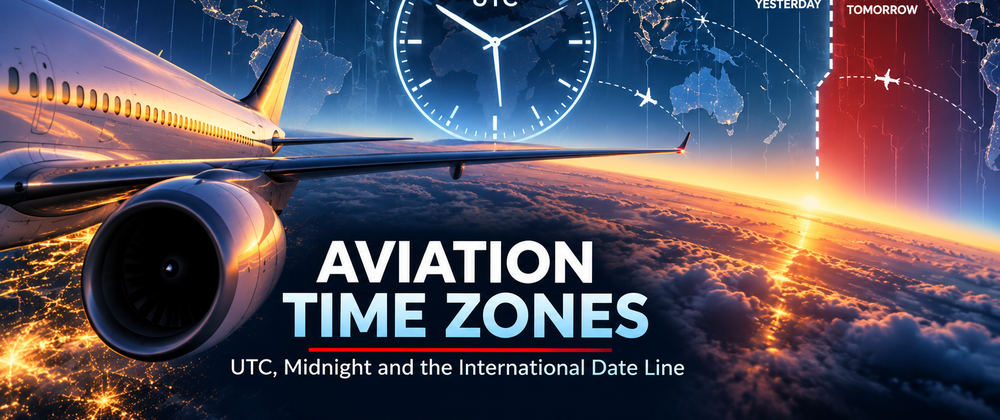

International aviation operates across different time zones, where the same moment can have different local times and calendar dates. A flight may depart late at night, cross midnight during its journey, and arrive at a destination where the local date is earlier or later than expected. Pilots and air traffic controllers manage these differences using standardised timekeeping procedures.
One of the most important tools in this process is Coordinated Universal Time (UTC), commonly referred to as Zulu time in aviation. It provides a common time reference for flight operations, regardless of the aircraft's location.
- Why Is UTC Important in Aviation?
Every country follows its own local time zone, and some countries also observe seasonal clock changes. Using local time alone would make international flight coordination more difficult.
UTC helps pilots, air traffic controllers, airline operations teams, and meteorological services work from a shared reference. Flight plans, aviation weather reports, and many operational messages use UTC to reduce confusion.
For example, when a pilot receives weather information from another country, the reported observation time can be compared against the flight plan without first converting between local time zones.
This common reference is especially useful for long-distance flights, international connections, and coordination between different air traffic control centres.
- What Happens When a Flight Crosses Midnight?
Crossing midnight does not create a special operational problem for an aircraft. The date simply changes in the relevant timekeeping system.
Consider a hypothetical flight departing at 11:30 PM UTC on Monday. If it is still flying at 12:30 AM UTC, the recorded date has changed to Tuesday.
The aircraft continues its journey according to its flight plan, air traffic clearances, and operational procedures. Aviation records reflect the appropriate date and time.
The distinction matters because departure and arrival records must use the correct timestamps. An incorrect date can cause confusion when reviewing flight schedules, coordinating connections, or examining operational records.
- How Do Pilots and Air Traffic Controllers Coordinate Flights?
Pilots prepare for flights using information such as planned departure times, estimated arrival times, weather conditions, fuel requirements, and route information. UTC provides a consistent reference for operational coordination.
Air traffic controllers use flight-plan data, surveillance systems, and clearances to manage aircraft movements within their areas of responsibility.
When an aircraft moves from one control centre's airspace into another, the controllers coordinate the handover. This process relies on accurate flight information and communication, rather than on the local calendar date alone.
Airlines also consider crew duty limits and rest requirements when planning international operations. These requirements are separate from simply converting a departure time into the destination's local time.
- What Is the Role of the International Date Line?
The International Date Line runs roughly through the Pacific Ocean and separates two calendar dates. Crossing it can cause the local date to move forward or backward by one day.
For example, an aircraft travelling from Asia towards the United States across the Pacific may depart on Tuesday and arrive on Tuesday local time, even after spending many hours in the air.
The apparent date difference occurs because the departure and destination use different local time zones. The actual elapsed flight time remains measurable using consistent timestamps.
This is why travellers should not calculate flight duration simply by subtracting the departure clock time from the arrival clock time. The dates and time-zone offsets at both airports must also be considered.
- How Do Airlines Calculate Flight Duration?
Airlines use departure and arrival timestamps alongside the applicable time-zone information to calculate elapsed flight time.
Imagine a flight departing at 11:50 PM on Monday and arriving at 6:00 AM on Tuesday. These times may represent the local times at the two airports, rather than UTC.
To determine the actual duration, the airline must account for the time-zone difference and the calendar dates. Depending on the route, the flight may cross one or more time zones or the International Date Line.
Scheduling systems use these details when planning aircraft rotations, crew assignments, connecting flights, and airport operations.
- Why Should Aviation Students Understand UTC?
Understanding aviation timekeeping is useful for students preparing for pilot training and other aviation careers. UTC appears in operational contexts such as flight planning, meteorological information, navigation, and communication procedures.
Students should understand the difference between UTC, local time, and elapsed time. They should also practise converting times between time zones and identifying when a date change occurs.
For those interested in becoming pilots, structured ground training can help build the theoretical foundation needed to understand these operational concepts. You can learn more about pilot ground training at MH Cockpit.
Conclusion
Time-zone differences and date changes are a normal part of international aviation. Pilots and air traffic controllers use UTC as a common operational reference, while airlines account for local time zones and calendar dates when preparing schedules and calculating flight durations.
The International Date Line can make a flight appear to arrive on the same local date on which it departed, but this does not change the actual time spent travelling.
By understanding UTC and local time conversion, aviation students can develop a clearer picture of how international flight operations are coordinated.
About MH Cockpit: If you want to learn more about aviation or pursue pilot training, visit MH Cockpit to learn about its pilot ground training programmes.





Top comments (0)