
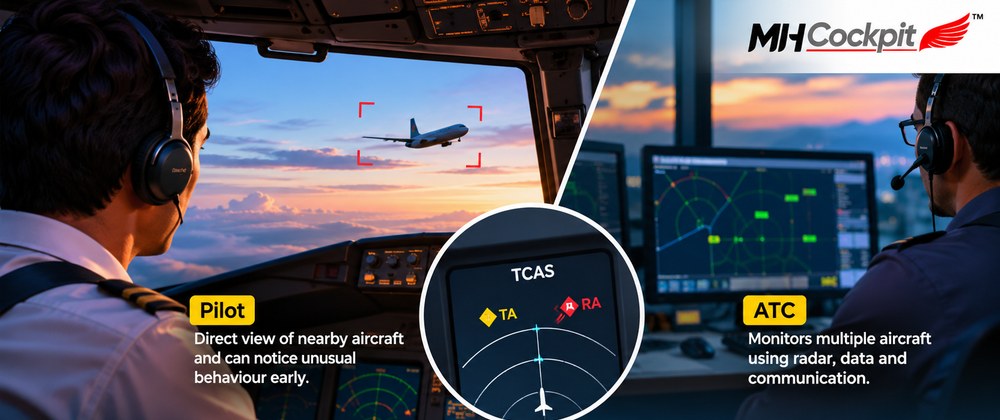

Aviation safety depends on constant monitoring, communication and coordination between flight crews and air traffic controllers. While air traffic control (ATC) plays an important role in maintaining safe distances between aircraft, pilots also have the responsibility of monitoring their surroundings during flight.
In certain situations, pilots may visually identify unusual aircraft movements or potential traffic conflicts before these are recognised by air traffic control. This raises an interesting aspect of aviation safety: how do pilots identify potential threats, and what systems help prevent mid-air collisions?
How Pilots Monitor Other Aircraft During Flight
Pilots do not concentrate exclusively on their aircraft's instruments and flight path. Maintaining awareness of surrounding air traffic is also part of their responsibilities.
When visibility permits, pilots use visual scanning techniques to identify nearby aircraft. They observe aircraft positions, movement, relative altitude and direction of travel.
For instance, an aircraft approaching from an unexpected direction, descending towards another aircraft's flight level or closing distance rapidly may attract a pilot's attention.
This does not automatically indicate dangerous behaviour. Aircraft may change altitude or direction for operational reasons, weather avoidance or instructions from air traffic control. However, recognising unusual movement allows pilots to remain alert and report potential concerns when necessary.
The principle of See and Avoid is an important part of visual traffic awareness, although it does not replace other collision avoidance systems.
Why Air Traffic Control May Not Detect Every Situation Immediately
Air traffic controllers monitor aircraft movements across designated areas of airspace. They use radar, surveillance data, flight information and radio communication to maintain separation between aircraft.
However, ATC surveillance and cockpit observation work differently.
Controllers generally have a wider picture of aircraft operating within their assigned airspace. They can monitor multiple aircraft and identify developing traffic conflicts based on available surveillance information.
Pilots, meanwhile, have a direct visual perspective of nearby traffic. Under suitable visibility conditions, they may notice an aircraft's unusual movement before a potential conflict becomes apparent to a controller.
The effectiveness of ATC surveillance depends on factors such as radar coverage, available aircraft information, communication and controller workload.
Therefore, neither pilots nor controllers have a complete picture in every situation. Aviation safety relies on their responsibilities working together.
What Is TCAS and How Does It Prevent Mid-Air Collisions?
One of the most important onboard safety systems is the Traffic Collision Avoidance System (TCAS).
TCAS monitors nearby aircraft equipped with compatible transponders and assesses potential collision threats independently of ground-based air traffic control instructions.
Depending on the system, it can provide two types of alerts.
- Traffic Advisory (TA)
A Traffic Advisory alerts pilots when another aircraft is approaching and may present a potential collision risk. It helps the flight crew identify nearby traffic and prepare to respond if the situation develops.
- Resolution Advisory (RA)
A Resolution Advisory provides a recommended vertical manoeuvre to help prevent a collision. Depending on the situation, this may involve climbing or descending.
When a TCAS Resolution Advisory is issued, pilots are expected to follow the applicable RA procedures. Air traffic controllers are also expected to avoid issuing instructions that conflict with the resolution advisory.
This independent onboard protection adds another layer of safety, particularly when aircraft are operating close to one another.
Pilot Awareness vs ATC Surveillance
Pilots and air traffic controllers have different responsibilities, but their roles are closely connected.
Pilots can visually identify nearby aircraft when visibility allows. They can observe unexpected movements and respond to onboard alerts.
Air traffic controllers have a broader view of traffic within their assigned airspace. They coordinate aircraft movements, provide traffic information and issue instructions to maintain separation.
Neither system is a substitute for the other.
A pilot may see an aircraft that has not yet attracted attention on the controller's display. Similarly, ATC may identify a developing conflict involving aircraft that are outside the pilot's visual range.
This is why communication between the flight crew and ATC remains an important part of flight safety.
Multiple Layers of Protection in Modern Aviation
Preventing mid-air collisions requires more than one safety measure. Modern aviation uses several layers of protection that work together.
These include:
- Pilot awareness: Visual scanning and monitoring of surrounding aircraft.
- ATC surveillance: Monitoring aircraft positions and coordinating separation.
- TCAS: Providing onboard traffic and collision avoidance alerts.
- Radio communication: Allowing pilots and controllers to exchange information and coordinate responses.
- Standard operating procedures: Providing established actions for handling traffic conflicts and other abnormal situations.
Each layer has limitations, but together they reduce the likelihood of an incident developing into a collision.
Why Aviation Students Should Understand These Safety Systems
Understanding how pilots, air traffic controllers and onboard safety systems work together is an important part of aviation education.
Students interested in commercial aviation should become familiar with aircraft operations, airspace management, communication procedures and collision avoidance technology.
Institutions and aviation training academies such as MH Cockpit Aviation Academy provide aviation education and training pathways for students interested in different areas of the aviation industry.
Learning about flight safety systems also helps students understand that aviation is not dependent on a single person or technology. It is built around coordinated responsibilities, technical systems and established operating procedures.
Conclusion
Pilots can sometimes recognise potentially unsafe aircraft behaviour before air traffic control does, particularly when they have a clear visual view of nearby traffic. However, visual observation has limitations, just as ground-based surveillance systems do.
TCAS, ATC surveillance, pilot awareness and effective communication work together to maintain safe aircraft separation.
Ultimately, aviation safety is not about whether pilots or controllers detect a threat first. It is about ensuring that multiple layers of protection work together to prevent a developing traffic conflict from becoming an accident.





Top comments (0)