

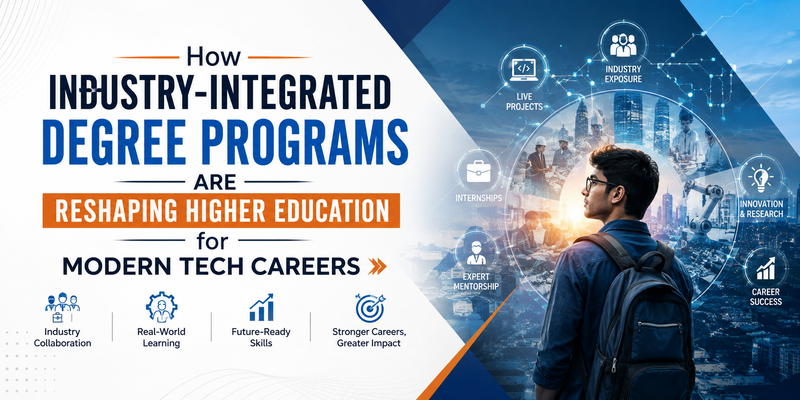
In today's fast-moving digital economy, traditional higher education models face a significant challenge. The speed at which technology evolves leaves standard academic curricula struggling to keep pace with enterprise hiring requirements. Emerging fields like Artificial Intelligence, Machine Learning, Data Analytics, Cloud Infrastructure, and Physical Robotics require practical, hands-on skills right from the first year of college. To bridge this gap, universities and industry partners are introducing specialized undergraduate programs designed directly around modern technology stacks.
The Power of Specialized Undergraduate Degrees
A traditional software or general computing degree provides a broad theoretical foundation. However, enterprise hiring teams seek graduates who can build data pipelines, train predictive algorithms, manage cloud infrastructure, or program embedded controllers immediately upon entering the workforce. By enrolling in an applied BCA in AI and Data Science track, students focus directly on real-world tools such as Python, SQL, Docker, and AWS without spending years on outdated legacy systems.
Inclusivity Across Academic Streams
One of the most encouraging developments in modern higher education is academic stream inclusivity. Degree programs like a dedicated BSc Computer Science in AI and Data Science welcome students from Science, Commerce, and Arts backgrounds. Because foundational modules start with introductory coding logic, statistical reasoning, and data structures, non-science graduates excel by pairing business domain knowledge with practical analytics.
Before enrolling, verifying standard entry criteria through a comprehensive guide on BCA AI and Data Science eligibility requirements ensures students meet standard 10+2 marks thresholds. Furthermore, checking if commerce students can do BCA AI and Data Science gives non-science applicants the confidence to pursue high-growth software roles.
The Role of Physical AI and Autonomous Systems
While digital software development continues to expand, physical hardware automation is experiencing rapid growth across industrial manufacturing, healthcare, and logistics. Pursuing an advanced B.Tech in Robotics and AI provides engineering aspirants with cross-functional training across ROS2 frameworks, spatial computer vision, and embedded microcontrollers.
Students looking to understand how intelligent algorithms control physical machines can explore an introductory breakdown explaining what is AI and robotics. For applicants evaluating top universities in Tamil Nadu, researching industry-aligned B.Tech in Robotics and AI in Chennai highlights how academic alliances with industry partners equip campuses with state-of-the-art automation labs.
Navigating Degree Pathways and Career Outcomes
Selecting the right academic track requires evaluating long-term market demand and university infrastructure. Students exploring three-year software programs can evaluate a structured BSc Computer Science in AI and ML degree to master statistical modeling, neural network architectures, and deep learning libraries.
To understand semester course structures, inspecting a complete overview of what is BSc CS AI and ML and reviewing the detailed list of core AI and ML subjects in BSc CS provides complete clarity on academic progression. Finally, checking market demand reports on BCA in AI and Data Science career scope in India ensures graduates enter the hiring landscape with competitive portfolio preparation.






Top comments (0)