

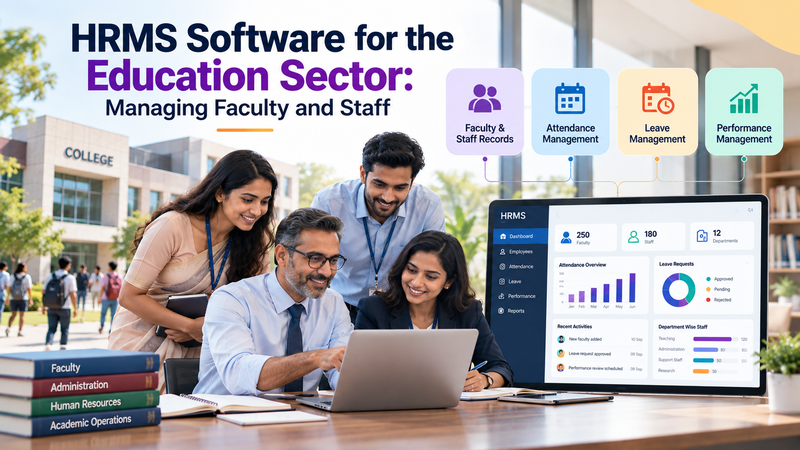
Educational institutions manage a large workforce that can include teaching faculty, administrative staff, department heads, support teams and other employees. Managing employee records, attendance, leave, performance and HR processes across different departments can become challenging as an institution grows.
A Human Resource Management System (HRMS) can help educational institutions organise workforce-related processes through a centralised digital platform.
Instead of managing employee information across spreadsheets, physical records and separate systems, institutions can use HR technology to create more structured HR workflows.
What Is HRMS Software for the Education Sector?
HRMS software for the education sector is a digital HR management solution that can support workforce-related activities within schools, colleges, universities and other educational organisations.
Depending on the platform, an HRMS can support areas such as:
- Employee management
- Faculty records
- Staff attendance
- Leave management
- Performance management
- Payroll-related processes
- Employee self-service
- HR reporting
The exact features available can vary between HRMS platforms.
Why Educational Institutions Need Structured HR Management
Educational institutions may have multiple departments, campuses and employee categories.
Faculty members may have different schedules and responsibilities, while administrative and support teams may follow different working arrangements.
Managing all these workforce processes manually can make it difficult for HR teams to maintain consistent records.
A centralised HRMS can help institutions organise employee information and standardise selected HR workflows.
1. Centralised Employee Records
Educational institutions maintain a significant amount of employee information.
This can include:
- Employee details
- Contact information
- Department
- Job role
- Joining information
- Employment status
- Reporting structure
- Documents
An HRMS can provide a centralised location for managing employee information.
This can make it easier for authorised HR personnel to access and update employee records when required.
Learn more about employee management in HRMS:
https://mhcognition.com/blogs/employee-management-system-in-hrms
2. Faculty and Staff Attendance
Attendance management can be an important requirement for educational institutions.
Faculty members, administrative employees and support staff may have different working schedules and attendance requirements.
An HRMS attendance module can help institutions manage information such as:
- Attendance records
- Working hours
- Absences
- Late arrivals
- Attendance reports
Digital attendance management can help HR teams maintain more organised workforce records.
Read more about employee attendance management:
https://mhcognition.com/blogs/employee-attendance-management-system
3. Leave Management
Faculty and staff may need to request different types of leave during the academic year.
An HRMS can provide a structured process for submitting, reviewing and approving leave requests.
A digital leave workflow may include:
- Leave requests
- Leave balances
- Approval processes
- Leave history
- Notifications
- HR records
This can reduce reliance on manual forms and email-based processes for routine leave requests.
4. Performance Management
Performance management can help institutions structure employee development and review processes.
For teaching faculty, performance discussions may involve academic responsibilities, institutional activities and professional development.
For administrative staff, performance processes may focus on role-specific responsibilities and organisational goals.
An HRMS can help HR teams maintain performance-related records and organise review workflows.
More information about HR performance management software:
https://mhcognition.com/blogs/hr-performance-management-software
5. Employee Self-Service
Educational institutions can have many employees who need access to routine HR services.
An employee self-service feature can allow employees to handle selected HR activities directly.
Depending on the platform, employees may be able to:
- View personal information
- Submit leave requests
- Check attendance
- Access HR documents
- Update selected information
- Track requests
This can reduce the need for HR teams to handle every routine employee request manually.
6. Supporting Multiple Departments
A university or college may have multiple departments and administrative teams.
An HRMS can help organise employee information according to departments, roles and reporting structures.
For example, an institution may have:
- Computer Science department
- Management department
- Engineering department
- Administration
- Finance
- Student services
- Technical support
- Facilities
A structured HR platform can make it easier to manage workforce information across these different groups.
7. HR Reporting
HR teams need accurate information to understand their workforce.
An HRMS can provide reports related to areas such as:
- Employee records
- Attendance
- Leave
- Department information
- Performance
- Workforce activity
The reporting capabilities depend on the platform and its configuration.
Digital reporting can help HR teams access organised information instead of manually combining data from multiple spreadsheets.
8. Improving HR Workflows
Educational institutions often have recurring HR processes.
For example, a leave request may move from an employee to a department manager and then to HR.
An HRMS can help structure these workflows according to institutional policies.
Possible workflows can include:
- Leave approvals
- Attendance corrections
- Employee requests
- Performance reviews
- HR documentation
- Administrative approvals
A clearly defined workflow can help employees and HR teams understand how requests move through the organisation.
What Should Educational Institutions Consider Before Choosing an HRMS?
Institutions should evaluate their specific requirements before selecting HR software.
Important considerations include:
Employee Management
Check how the platform handles faculty and staff records.
Attendance
Review whether the system supports the institution's attendance requirements and working schedules.
Leave Management
Evaluate leave policies, approval workflows and employee access.
Performance Management
Consider how faculty and staff performance processes can be managed.
Reporting
Check whether the HRMS provides the workforce reports required by HR teams and administrators.
User Permissions
Review how access can be configured for employees, managers, HR teams and administrators.
Scalability
Consider whether the system can support future growth in employees, departments and locations.
MH Cognition and HR Management Solutions
MH Cognition provides technology solutions for organisations and educational environments.
Its MH Connekt HR management solution can help organisations explore digital approaches to employee and HR management.
Educational institutions evaluating HR technology can learn more about the solution here:
https://mhcognition.com/connekt
HRMS Checklist for Educational Institutions
Before implementing an HRMS, institutions can review the following:
- [ ] Employee records
- [ ] Faculty management
- [ ] Staff management
- [ ] Attendance
- [ ] Leave management
- [ ] Performance management
- [ ] Employee self-service
- [ ] HR reporting
- [ ] User permissions
- [ ] Workflow management
- [ ] Data management
- [ ] Scalability
Conclusion
Managing faculty and staff requires educational institutions to maintain organised employee records and HR workflows.
An HRMS can provide a centralised digital environment for employee management, attendance, leave, performance, reporting and other workforce processes.
Institutions should identify their HR requirements and compare available functionality before selecting a platform.
For organisations exploring digital HR management, MH Cognition's MH Connekt provides an HR technology solution worth evaluating:






Top comments (0)