

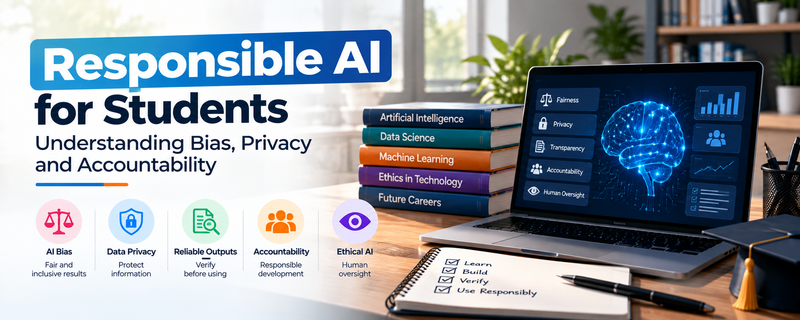
Primary Keyword: Responsible AI for students
Secondary Keywords: AI ethics for students, responsible artificial intelligence, AI bias, AI privacy, ethical AI development
Meta Title: Responsible AI for Students: Ethics, Privacy and Bias
Meta Description: Learn how students can understand responsible AI, identify bias, protect privacy, and build artificial intelligence projects ethically.
Introduction
Artificial intelligence is becoming part of education, software development, healthcare, business, and everyday digital tools. Students can use AI to explore ideas, analyse information, write code, and solve problems. However, understanding how AI works is only one part of becoming a responsible technology professional.
Students should also understand how AI systems use data, why biased results occur, how personal information can be exposed, and why human oversight matters. These considerations are important whether someone plans to study artificial intelligence, data science, software development, or another technology field.
Responsible AI helps students think beyond whether a system works. It encourages them to consider whether it is fair, reliable, transparent, and appropriate for its intended purpose.
1. Understand What Responsible AI Means
Responsible AI refers to designing, developing, and using artificial intelligence with attention to its potential effects on people and society.
Important principles include:
- Fairness: Avoiding unjustified differences in how people are treated.
- Privacy: Protecting personal and confidential information.
- Transparency: Explaining a system's purpose, limitations, and relevant decisions.
- Accountability: Identifying who is responsible for developing, deploying, and monitoring a system.
- Reliability: Testing whether a system performs consistently and safely in its intended environment.
- Human oversight: Ensuring people can review important decisions when necessary.
These principles help students understand that successful AI development requires more than producing accurate outputs.
2. Learn How Bias Can Affect AI Results
AI systems learn patterns from data. If the training data is incomplete, unbalanced, outdated, or reflects existing discrimination, a model may produce unfair results.
For example, a recruitment system trained on historical hiring data could reproduce patterns that disadvantage certain groups. An image recognition system may also perform differently across demographic groups if its training data lacks sufficient representation.
Students can explore this issue by asking:
- Who is represented in the dataset?
- Which groups or situations are missing?
- Does the model perform differently across relevant groups?
- Could the results unfairly affect a person or community?
Testing data quality and model performance across relevant groups can help identify problems before a system is used in real situations.
3. Protect Privacy When Working With AI
AI projects often involve collecting, processing, or sharing data. Students should understand what information is appropriate to use and how it should be protected.
Good practices include:
- Never upload passwords, authentication codes, or confidential documents to public AI tools.
- Avoid sharing identifiable personal information without a legitimate reason and appropriate permission.
- Use public, synthetic, or properly anonymised datasets for practice where suitable.
- Review the privacy policies and data-handling settings of AI tools.
- Store project data securely and restrict unnecessary access.
These precautions matter even when working on college assignments or personal experiments. A project should not expose someone's information simply because the data is convenient to access.
4. Verify AI Outputs Before Using Them
AI tools can generate incorrect facts, unreliable explanations, outdated information, and code containing errors. A confident answer is not necessarily a correct answer.
Students should verify important claims using reliable sources, test generated code, and check calculations against expected results. For research assignments, they should consult original sources rather than relying only on AI-generated summaries.
They should also follow their institution's rules for AI-assisted work and clearly disclose AI use when required.
5. Build Responsible AI Projects
Students can apply responsible AI principles to practical projects without needing advanced equipment or large datasets.
Possible project ideas include:
- A dataset audit that identifies missing values and representation gaps.
- A simple model evaluation report comparing performance across relevant data groups.
- A privacy awareness tool that identifies sensitive information in sample text.
- A fact-checking workflow that compares AI-generated claims with trusted sources.
- A project documentation template covering limitations, intended users, and potential risks.
Each project should explain its purpose, data sources, testing approach, limitations, and potential risks. Students should avoid presenting experimental models as reliable decision-making systems without adequate evaluation.
6. Connect Responsible AI With Technology Education
Responsible AI connects technical subjects such as programming, statistics, machine learning, and data management with questions about real-world impact.
Students exploring artificial intelligence and machine learning can review the B.Sc. Computer Science with AI and Machine Learning programme:
https://mhcognition.com/learning/bsc-cs-ai-and-ml
Students interested in data-driven systems can also explore the B.Sc. Computer Science with AI and Data Science programme:
https://mhcognition.com/learning/bsc-cs-ai-and-ds
The MH Cognition learning hub provides an additional starting point for exploring technology programmes and related learning paths:
https://mhcognition.com/learning
Regardless of their chosen degree, students should combine technical knowledge with careful testing, privacy awareness, and critical thinking.
Conclusion
Responsible AI is an important consideration for anyone learning to develop or use artificial intelligence. Understanding bias, protecting data, verifying outputs, documenting limitations, and maintaining suitable human oversight can help students approach AI projects more carefully.
The aim is not simply to build systems that work. It is to understand how they work, where they may fail, and how their use can affect others.
By practising these habits during college, students can build a stronger foundation for future work in AI, data science, software development, and other technology fields.
Explore technology learning paths:
https://mhcognition.com/learning







Top comments (0)